

Cargo theft losses stay high, even as incidents fluctuate
Recent supply‑chain risk reports show that across the United States and Canada, hundreds of cargo theft and fraud events are reported each quarter, with estimated losses exceeding 100 million dollars in just three months. Even when total incidents dip slightly, average losses per event remain stubbornly high, especially for food, consumer goods, and high‑value freight. Canadian sources estimate that cargo theft costs reach into the billions annually when you include unrecovered loads, disruption, and downstream impacts.canadacartage+2
For large Ontario truck yards and distribution hubs along the 401 and QEW corridors, this is more than a news headline. Sites in Brampton, Mississauga, Milton, and Pickering sit directly on some of the busiest freight routes in the country, with constant churn of tractors, trailers, and containers. Every poorly lit corner, blind spot, and unmonitored dock door is an opening for organized theft crews who know exactly what they are looking for.cargonet+1
Why Ontario truck yards are a prime target
Cargo theft groups adapt quickly, and Ontario yards present a tempting mix of density and complexity.piotrservice+1
Key risk factors include:
-
High trailer density with tight parking and frequent re‑spotting, which makes it easier for thieves to blend in and move units unnoticed.
-
Mix of carrier‑owned, customer‑owned, and leased trailers, meaning not every unfamiliar unit raises suspicion.
-
Limited after‑hours staffing, especially on weekends and shoulder shifts, when thieves prefer to operate.cargonet+1
-
Third‑party contractors handling yard moves, maintenance, and security, creating more “edges” in your processes.
Canadian logistics operators and associations continue to warn that stolen freight recovery rates are low, often in the single‑digit percentages, meaning most loads are never seen again. That reality puts more pressure on Ontario yards to prevent theft at the gate and fence line – not rely on recovery efforts later.piotrservice+1
How CCTV for Ontario truck yards shifts the advantage
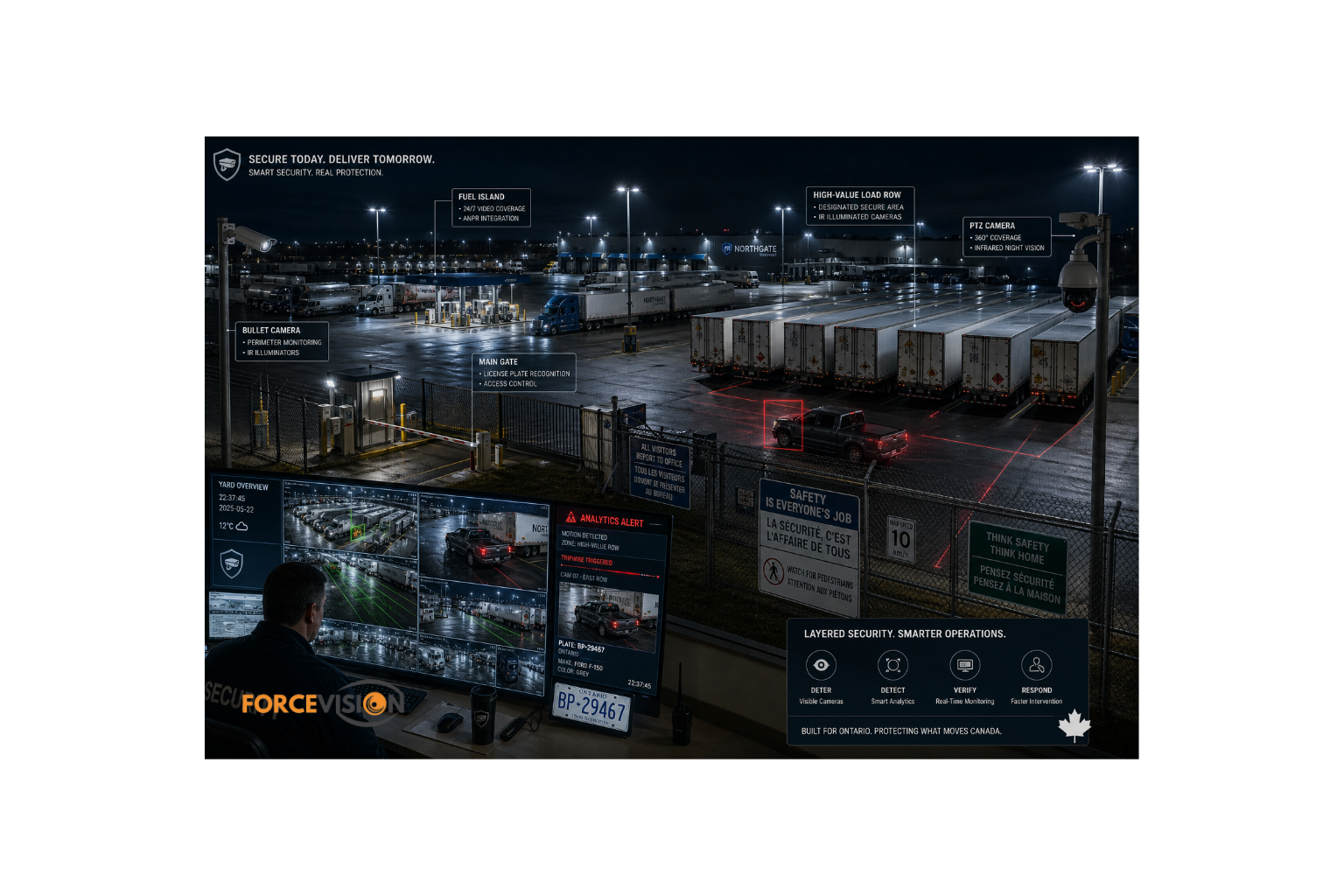
A modern CCTV design for Ontario truck yards can do far more than capture grainy images of a missing trailer spot.
With a 64‑camera‑plus layout, you can:
-
Monitor every gate and access road with high‑resolution views and licence plate recognition (LPR) where appropriate.
-
Cover all yard lanes, parking rows, and staging areas with overlapping fixed cameras, so a trailer move is visible from multiple angles.
-
Use PTZ cameras from elevated poles or rooftops to follow suspicious activity across a wide area.
-
Tie camera views to yard‑management and gate‑control logs, so investigators can quickly match footage to entry and exit records.
Companies such as Canada Cartage publicly note that they use camera systems to cover truck yards, docks, and warehouse areas, with signage clearly indicating CCTV in use. That combination of visible deterrence, comprehensive coverage, and documentation greatly increases the chance that a suspicious move will be noticed – or at least well‑documented for police and insurers.canadacartage
Designing a 64‑camera truck yard system that actually works
For a mid‑to‑large Ontario yard with 200–400 parking spots, your CCTV for Ontario truck yards should be treated like a core operational utility.
Key design considerations:
-
Elevated pole‑mounted cameras around the yard perimeter, with wide‑angle lenses to see entire rows and zoom capabilities for plate and unit numbers.
-
High‑dynamic‑range cameras at gates to handle headlights at night while still capturing driver faces and plates.
-
Coverage inside and outside guard shacks, weigh scales, and fuel islands to track who interacts with which assets.
-
Redundant views for high‑value and “hot” lanes where premium or at‑risk cargo is parked.
On the backend, an industrial NVR platform should support:
-
24/7 recording of all critical views.
-
At least 30 days of retention at full quality for yard cameras, and longer retention for gate and dock doors tied to claims.
-
Quick search by time, camera, or even analytic event (for example, virtual line crossing after hours).
Adding analytics: from video to actionable alerts
Analytics can turn raw footage into something your dispatch and security teams can act on in real time.mdpi+1
Useful analytics for CCTV for Ontario truck yards include:
-
Virtual fence and line‑crossing detection along perimeter fences, triggering alerts when people or vehicles cross where they should not.mdpi
-
Dwell‑time alerts for vehicles in unauthorized areas, like a tractor lingering near a high‑value row after hours.mdpi+1
-
People detection in the yard outside defined safe zones, which can also help spot trespassers and unsafe pedestrian movement.mdpi+1
-
Licence plate capture integrated with gate logs to identify unknown units or patterns involving certain plates.
These tools help bridge the gap between a single guard watching a wall of monitors and an intelligent system that points them to the 1% of activity that actually needs human judgment.
CCTV’s value in claims, contracts, and customer trust
Beyond stopping theft in the moment, CCTV for Ontario truck yards plays a critical role in the aftermath of a loss.
Video evidence can:
-
Support your insurer’s investigation, leading to faster claims resolution and potentially better terms over time.ontruck+1
-
Help you demonstrate due diligence to key customers, especially in sectors like pharmaceuticals, electronics, or food where chain‑of‑custody is scrutinized.citt+1
-
Provide clarity when disputes arise over when and where a trailer was last seen intact.
Cargo‑security guides and industry programs increasingly emphasize detailed reporting and collaboration with insurers and law enforcement. High‑quality CCTV, linked with accurate yard records, makes your reports more credible and your relationships more resilient after an incident.ontruck+1
ForceVision works with truck yards and logistics hubs across Southern Ontario to design CCTV systems that integrate with real‑world yard operations, not just IT diagrams. If you are revisiting your yard security in light of rising cargo‑theft losses, ForceVision can help map a 64‑camera design that fits your lanes, traffic patterns, and risk profile.
FAQs
Q1. How many cameras do most Ontario truck yards need?
For a busy yard with several hundred spots, 64 cameras is often the starting point for comprehensive coverage, especially when you include gates, docks, lanes, and office areas.
Q2. Can CCTV really deter organized theft crews?
Yes. While it will not stop every attempt, visible cameras, signage, and analytics‑backed monitoring significantly raise the risk of identification and arrest, which many professional crews actively try to avoid.canadacartage+2
Q3. What retention period should truck yards aim for?
Thirty days is a practical baseline, but yards with complex flows, long‑haul dwell times, or demanding customers may benefit from 60–90 days of retention for key cameras.
Q4. How does CCTV integrate with yard‑management software?
Modern systems allow event‑linked recording and bookmarking, so you can jump directly to video around a gate event, trailer move, or exception flagged in your yard‑management or TMS platform.


