

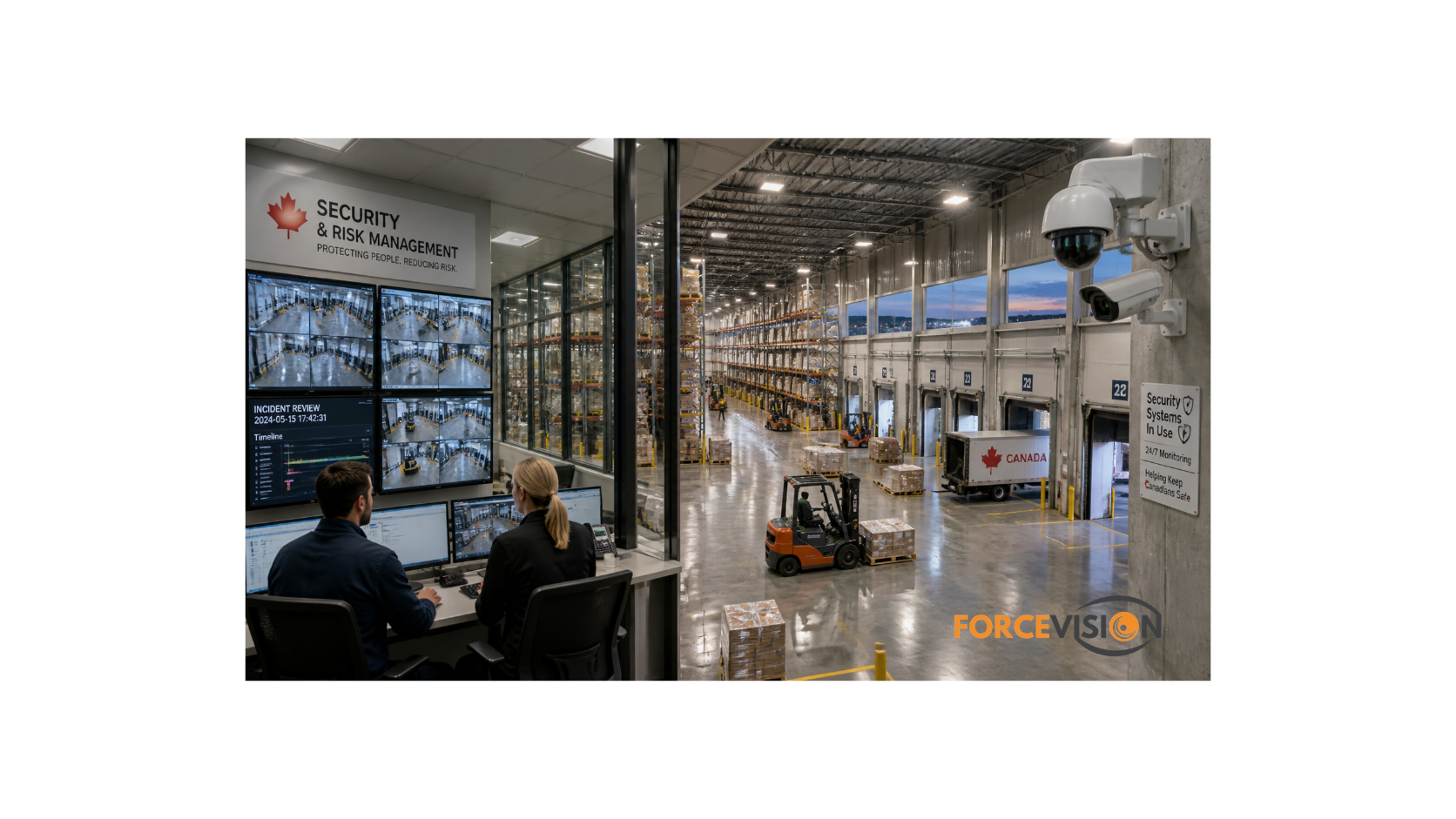
Insurance markets are paying closer attention to how well industrial sites manage physical security and safety. While CCTV once seemed like a generic requirement, underwriters now ask more pointed questions: how extensive is coverage, how long is footage kept, and how quickly can it be retrieved after an incident. For rail yards, warehouses, logistics hubs, and manufacturing plants across Canada, this shift turns camera systems into a direct lever for risk and cost.
Security and risk reports have noted significant increases in cargo and facility theft in recent years, especially across freight hubs and major cities in the U.S. and Canada. Against that backdrop, insurers look for tangible controls—like robust CCTV—when pricing policies and evaluating claims. A well‑designed industrial CCTV to reduce insurance risk in Canada can demonstrate that a site takes loss prevention seriously.
Why insurers care about industrial CCTV
From an insurer’s perspective, video surveillance influences both the likelihood of a loss and the ability to validate claims afterwards. When theft, fire, or injury occurs, high‑quality footage can:
-
Clarify timelines and root causes.
-
Confirm that required procedures and controls were followed.
-
Help distinguish genuine claims from suspicious or fraudulent ones.
The rise in cargo theft across freight hubs underscores why underwriters are focusing on sites near major highways and urban centres. If an Ontario operator can show that their yard or plant is covered by a modern CCTV system with appropriate retention and quick retrieval, they present as a more controlled risk.
Key CCTV elements that matter to insurers
Not all camera setups are viewed equally. When discussing industrial CCTV to reduce insurance risk in Canada with brokers or underwriters, operators should be prepared to describe:
-
Coverage scope. Which areas are monitored—perimeters, gates, parking, docks, production lines, warehouses, fuel or chemical storage, etc.
-
Camera quality. Resolution and low‑light performance, particularly for high‑risk zones.
-
Retention period. How many days or weeks of footage are retained at full resolution and how incidents are archived.
-
Access and integrity. Who can access footage, how it is protected from tampering, and how access is logged.
Insurers appreciate systems that make it easy to retrieve specific segments, such as the 30 minutes before and after a loss, without delay. Delays or missing footage can complicate claims and prolong settlements.
Examples of how CCTV supports claims
Consider a warehouse cargo theft where a trailer goes missing from a yard. With comprehensive CCTV, the operator can provide:
-
Entry and exit footage showing the truck and trailer, including plates and unit numbers.
-
Timeline clips showing when the trailer was parked, who accessed it, and how it left.
-
Any suspicious activity or vehicles observed near the scene beforehand.
Similarly, in a workplace injury case, cameras may capture whether guards were in place, PPE was worn, and procedures followed in the moments leading up to the incident. This visual evidence helps both insurers and insureds understand what happened and respond fairly.
Cyber‑enabled cargo theft schemes—where criminals impersonate brokers or carriers to redirect freight—are also on the rise. When documentation is muddied, video of who actually picked up the load, using which equipment and at what time, becomes critical to untangling the event.
Structuring CCTV to align with risk and insurance goals
For large industrial operators, it helps to view camera investments through a risk lens:
-
Identify your top insured risks. Common examples include theft (internal and external), fire, product damage, business interruption, and liability from injuries.
-
Map those risks to specific site locations. For example, theft at gates and yards, fire in storage areas, injuries in loading zones.
-
Align CCTV coverage and analytics accordingly. Ensure each major insured risk has corresponding visual coverage and, where appropriate, event‑driven alerts.
This approach ensures that industrial CCTV to reduce insurance risk in Canada is not generic; it is tuned to the claims that would be hardest to resolve without strong evidence.
Working with insurers and brokers
Proactive communication can turn CCTV into a negotiating asset. Risk managers and plant managers can:
-
Provide summaries of camera coverage, retention, and incident response procedures during renewals.
-
Share examples (anonymized where appropriate) of how video helped resolve incidents.
-
Invite brokers or insurer risk engineers for site tours that showcase improvements.
In some cases, insurers may offer guidance on additional controls that could positively influence terms over time, such as extended retention in specific zones or integration with access control.
ForceVision’s role in insurance‑aligned CCTV design
ForceVision regularly designs camera systems for rail yards, warehouses, and plants where insurance and claims support are explicit goals. We work with clients to understand not only their security concerns but also their insurer’s expectations around documentation and response.
By designing industrial CCTV to reduce insurance risk in Canada—with solid coverage, retention, and audit trails—ForceVision helps operators build systems that support incident prevention and demonstrate to insurers that they are serious about managing risk. If you are unsure how your current CCTV posture looks from an underwriter’s viewpoint, ForceVision can help benchmark and propose targeted upgrades.
Turning video into an asset, not overhead
When treated as a compliance checkbox, CCTV feels like a cost. When aligned with risk and operations, it becomes a multi‑use asset that supports security, safety, quality, and insurance. For large industrial operators across Canada, the goal is not simply to have cameras, but to have systems that:
-
Deter and detect incidents.
-
Make investigations faster and more accurate.
-
Strengthen the organization’s position in claims and negotiations.
The next time your policy renews, being able to speak confidently about your CCTV system’s capabilities may make a real difference.
FAQ
Q1: Can CCTV directly lower our insurance premiums?
While there is no universal formula, strong surveillance and loss prevention measures can improve how insurers view your risk profile, which can support better terms over time.
Q2: How much retention do insurers typically expect?
Expect questions about at least 30 days of storage for key areas, with the ability to retain specific incidents longer for investigations and legal needs.
Q3: Does audio recording matter for insurance?
Video is usually the primary focus. Audio may be restricted by privacy laws and is not always necessary for insurance purposes.
Q4: How can we prove our footage has not been tampered with?
Using secure NVR or enterprise platforms with access logs, user permissions, and export hashes helps demonstrate footage integrity to insurers and legal teams.


