

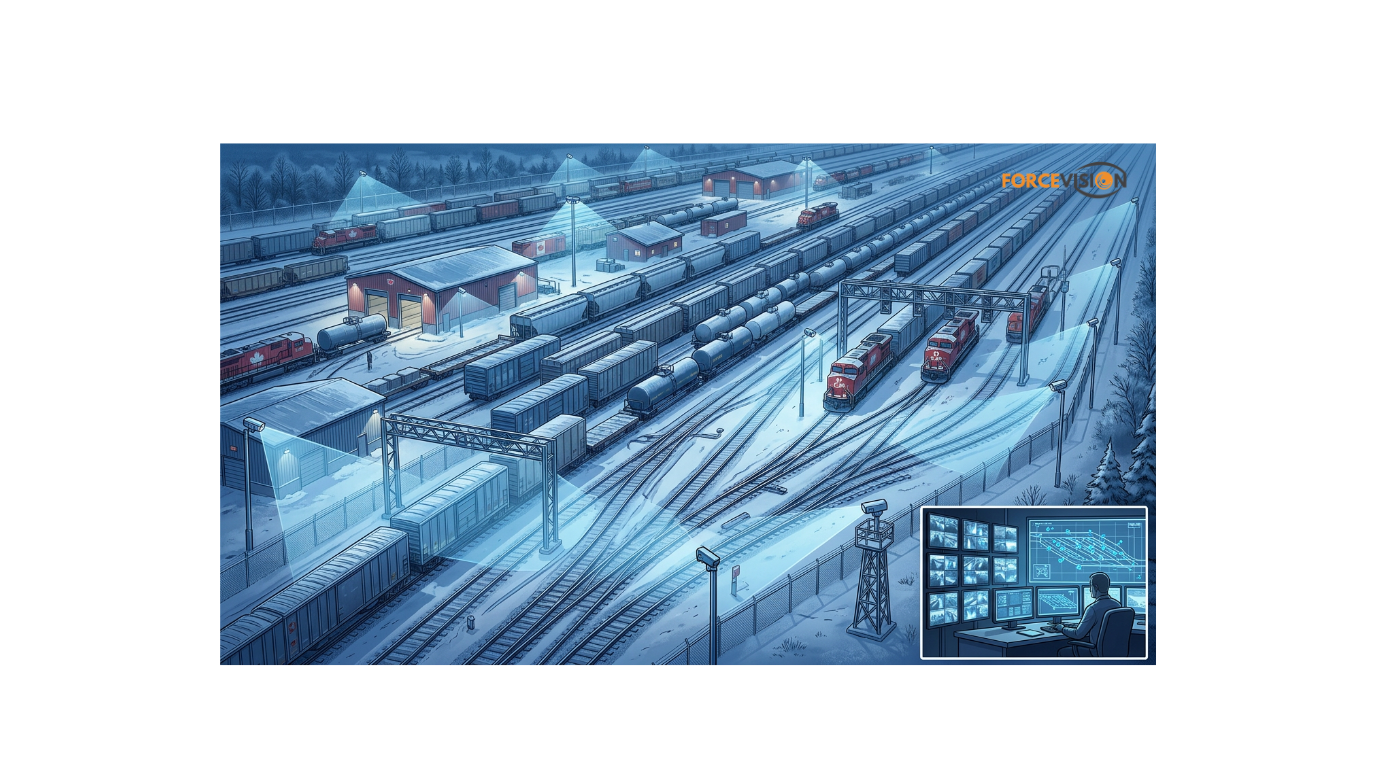
Rail yards have always been complex environments—long sight lines, moving equipment, shifting cargo, and a mix of employees, contractors, and visitors. As rail networks modernise, the challenge has become managing security, safety, and efficiency across vast outdoor spaces with limited staff. For Canadian rail operators, especially those managing yards around Hamilton, Toronto, and the Golden Horseshoe, the question is not whether to use CCTV, but how to design 64‑camera systems that actually improve outcomes.
Recent research into video analytics for rail networks emphasises the need to detect trespass, vandalism, and other critical events across large infrastructure while reducing false alarms. That balance only comes with thoughtful design.
Why 64‑camera systems are a realistic baseline
On paper, 64 cameras sounds like a lot. On a real rail yard map, it is barely enough. Consider what needs coverage:
-
Perimeter fencing and access gates
-
Main tracks and switching zones
-
Locomotive and rolling stock storage tracks
-
Maintenance shops and fuelling stations
-
Control buildings and crew access points
-
Public interface zones like road crossings and pedestrian pathways
When each of these areas is broken into specific views, a 64‑camera CCTV for Canadian rail yards deployment quickly fills up. Some operators ultimately expand into 96 or 128 camera environments, but 64 is a realistic, scalable starting point.
How should rail yards prioritise coverage?
Rail yards should begin with a risk map. The highest‑risk zones usually fall into three categories:
-
Trespass and public interface areas – Places where the public can access or approach tracks. Research highlights these as critical zones for incident prevention, including trespass and self‑harm.
-
Asset concentration points – Locomotive staging tracks, high‑value cargo sidings, and areas with expensive equipment or materials.
-
Operational choke points – Switches, hump yards, and busy ladder tracks where incidents can cause major delays.
64‑camera CCTV for Canadian rail yards should ensure each risk category has overlapping coverage. For example, a level crossing might be covered by one camera focused on vehicle approaches, another on the crossing itself, and a third giving a wide view of adjacent track and pedestrian movement.
What mix of cameras works best?
A rail yard is not a uniform space. Camera types should reflect that:
-
Fixed bullet/dome cameras for gatehouses, building perimeters, and specific equipment pads
-
High‑zoom PTZ cameras for long tracks, hump yards, and remote corners
-
Thermal cameras in low‑light locations and areas prone to fog, snow, or heavy rain
-
Rugged, vandal‑resistant housings for cameras near public access points
Video analytics research in rail settings notes that combining multiple sensor types—including thermal and visible light—can improve detection accuracy for trespass and suspicious behaviour. For Canadian climates, thermal imaging also helps maintain situational awareness through snow, darkness, and industrial lighting glare.
How do analytics improve safety and operations?
The latest studies on rail surveillance show analytics can do far more than record incidents. For example:
-
Trespass detection: Automatically flagging when people enter track zones from non‑designated access points.
-
Object on track alerts: Identifying static hazards such as tools, debris, or vehicles encroaching on the running line.
-
Behaviour recognition: Detecting unusual movement patterns, such as loitering near critical infrastructure or at end‑of‑line buffers.
-
Near‑miss analysis: Using archived footage to review close calls between rolling stock and personnel.
For Canadian rail yards, 64‑camera CCTV for Canadian rail yards systems with analytics can support both safety and productivity. Operators can, for example, identify recurring congestion at specific switch points, then adjust procedures or staffing to improve flow.
How does surveillance interact with worker culture?
One concern rail operators often raise is how extensive CCTV will affect worker morale. The key is positioning cameras and messaging around safety and operational clarity, not micromanagement.
When cameras are used to highlight near‑miss trends, improve lighting, validate PPE compliance at dangerous points, and support fair incident investigations, they can build trust. Workers see that footage helps exonerate them from blame when equipment or process design is at fault.
ForceVision’s approach with yard and plant environments across Southern Ontario is to pair camera design with clear policies: who can access footage, how long it is retained, and how it will be used in safety and HR contexts. That transparency goes a long way.
How should rail operators phase implementation?
Moving straight to 64‑camera CCTV for Canadian rail yards might feel daunting, particularly for mid‑sized yards. A phased approach can help:
-
Phase 1 – Critical risk zones: Public crossings, main gates, and ladder tracks with a history of incidents.
-
Phase 2 – Asset protection: Locomotive and rolling stock staging, fuel points, and expensive equipment pads.
-
Phase 3 – Operational optimisation: Analytics‑enabled views that support efficiency, such as hump operations and bottleneck analysis.
Along the way, NVR and storage capacity should be sized for future expansion, with at least 30–60 days of retention across all cameras and longer retention for flagged events.
How can ForceVision support Canadian rail yards?
ForceVision helps design and implement 64‑camera CCTV for Canadian rail yards across Ontario, leveraging experience in other large industrial environments like ports, logistics hubs, and manufacturing plants. Engagements often include:
-
Reviewing historical incidents and near‑misses
-
Walking yards with safety, operations, and security leaders
-
Designing camera layouts aligned to both rail‑specific risks and broader industrial standards
-
Integrating CCTV with existing rail control, access control, and yard management systems
If you are evaluating upgrades, ForceVision can provide a no‑pressure assessment that differentiates between “must have” and “nice to have” coverage, ensuring budgets are focused where they deliver the greatest risk reduction and operational insight.
FAQ
Q1: Is 64 cameras enough for a major rail yard?
For many Canadian yards, 64 cameras is a strong starting point, but larger or more complex sites may ultimately expand beyond 100 cameras for full coverage.
Q2: Can analytics really detect trespass reliably?
Recent research shows that advanced analytics and multi‑sensor fusion can significantly improve detection of trespass and critical events, though careful tuning and testing are essential.
Q3: How long should rail yard footage be stored?
At least 30 days of retention is recommended, with longer storage for key cameras covering incident‑prone areas or where regulatory or investigative requirements apply.
Q4: Do cameras replace physical patrols?
No. CCTV complements patrols by extending visibility, helping target patrols to high‑risk events, and providing evidence to review when something is missed in real time.


