

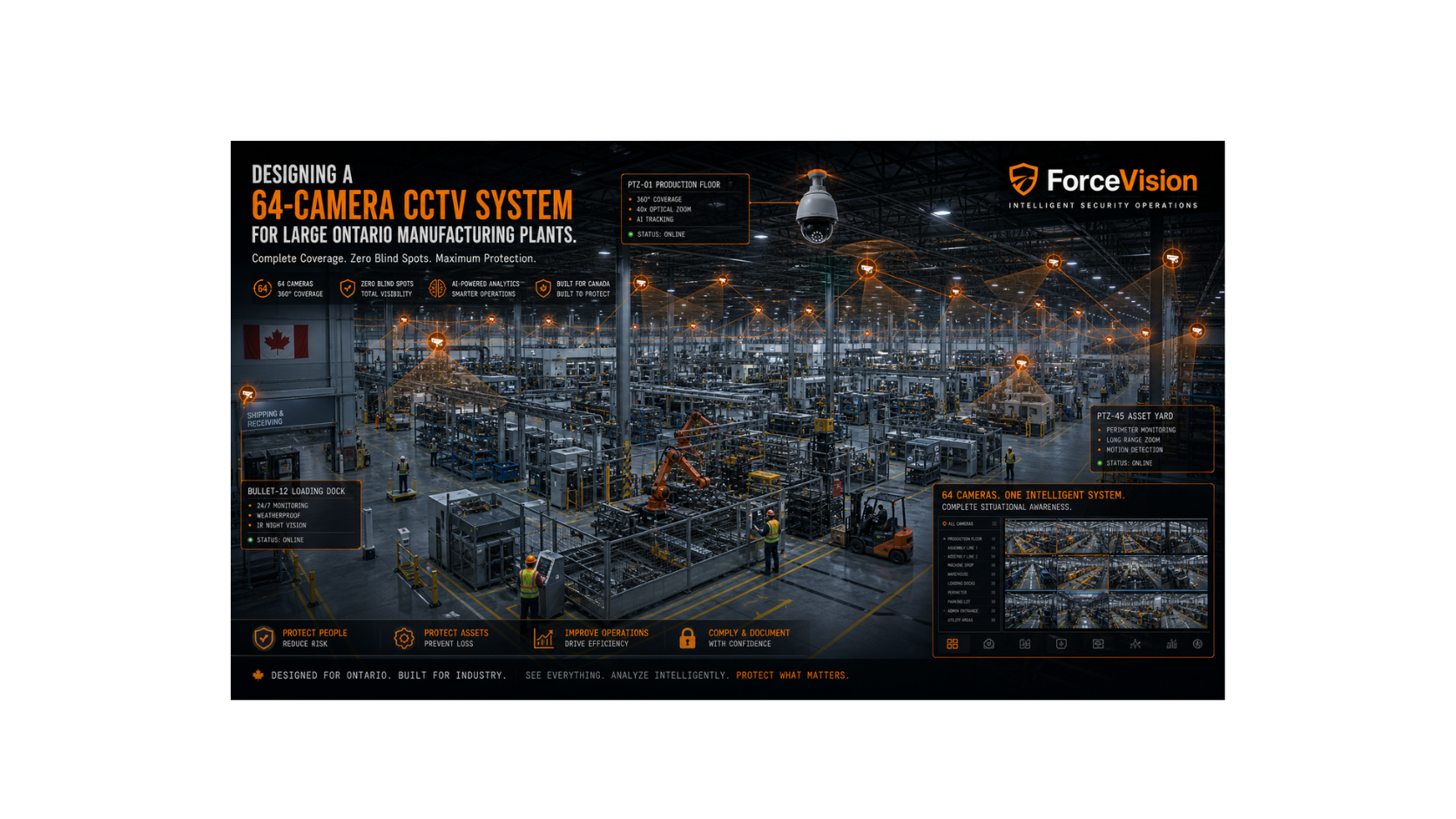
Large manufacturers in Ontario—auto OEMs, tier‑one suppliers, heavy equipment makers—operate sprawling plants with production lines, storage yards, and high‑value warehouses. Every day, millions of dollars in materials, finished goods, and tooling move through these facilities. When something goes wrong, from internal theft to a safety incident on the loading dock, the cost is measured not just in dollars but in lost production hours and strained customer commitments.
A 64‑camera CCTV system for large Ontario manufacturing plants is no longer a “nice to have.” It is the baseline for understanding how assets, people, and processes move across your site—and for giving security, operations, and HR teams the evidence they need to act quickly and fairly.
What risks should a manufacturing CCTV design address?
Before deciding where cameras go, plant leaders should map the risks that matter most to them. Common concerns at industrial‑scale manufacturers include:
-
Theft of high‑value components or finished goods from warehouses and shipping bays
-
Unauthorised access to restricted zones such as tool cribs, test labs, or high‑hazard production areas
-
Safety incidents involving forklifts, pedestrians, and contractors in mixed‑use aisles
-
Downtime caused by bottlenecks at loading docks, staging areas, or internal logistics routes
These are not small‑business problems. For a manufacturer supplying global automotive or industrial clients, a single mis‑shipped load or extended downtime event can jeopardise service‑level agreements and long‑term contracts.
How should 64 cameras be allocated across a plant?
Designing 64‑camera CCTV for large Ontario manufacturing plants starts with dividing the site into functional zones.
-
Perimeter and yards: cameras along fence lines, gates, parking areas, and trailer storage to monitor vehicle and pedestrian movements.
-
Loading docks and shipping: cameras covering every dock door, staging area, and high‑value storage zone.
-
Production floors: targeted coverage of key lines, changeover areas, and zones with higher safety risk.
-
Internal corridors and access points: cameras at doors leading to restricted areas and between major plant sections.
-
Offices and control rooms: limited, policy‑driven coverage of entry points to sensitive information and control systems.
PTZ cameras can be used outdoors and in large indoor halls to provide flexible, zoomable coverage, while fixed dome or bullet cameras handle specific chokepoints and asset locations. The aim is not to watch every square metre but to ensure that critical movements of people and assets are visible and traceable.
Integrating CCTV with operations and safety workflows
A common mistake is to treat CCTV as a standalone security project. In high‑value plants, the video system is most powerful when it feeds multiple departments:
-
Security uses it to investigate theft, trespassing, and vandalism.
-
Operations uses it to understand flow on docks, aisles, and internal logistics routes.
-
Safety teams use footage of near‑misses and incidents to refine training and procedures.
-
HR uses video carefully, within clear policies, to address repeated procedural violations while supporting fair investigations.
This integrated approach turns your 64‑camera system into a continuous improvement tool. For example, a pattern of near‑misses between forklifts and pedestrians at a particular corner might prompt signage changes, new barriers, or rerouting of traffic.
What role do analytics play in manufacturing plants?
With dozens of cameras running 24/7, no team can watch every feed. Video analytics help focus attention:
-
Line‑crossing alerts in restricted zones such as machine guarding perimeters or chemical storage rooms
-
People counting or zone occupancy monitoring in high‑risk areas, especially during shutdowns or maintenance
-
Vehicle movement tracking in yards and docks to study flow and detect unusual patterns at night
-
Tampering detection if cameras are covered, redirected, or disabled
For large Ontario manufacturers, analytics also support workplace safety by flagging certain types of unsafe behaviour, such as frequent pedestrian traffic through areas designated for powered vehicles only. Any such use needs clear policies and communication with employees to maintain trust and ensure the focus remains on prevention and coaching.
Planning for scalability, retention, and integration
Industrial manufacturing sites rarely stay static; lines are reconfigured, warehouses expand, and new processes are added. A good CCTV design anticipates this.
Key considerations:
-
NVR platform capacity to add more cameras over time without major rework
-
Sufficient storage for 30–90 days of footage at appropriate resolution and frame rates
-
Network infrastructure that can carry video traffic without affecting production systems
-
Integration options with access control, alarms, and manufacturing execution systems (MES) where appropriate
ForceVision regularly helps large manufacturers in Southern Ontario assess whether their existing infrastructure can support a move from small, fragmented camera setups to unified 64‑camera (and larger) platforms. The focus is always on building a system that can grow with the plant—not painting you into a corner.
A practical path forward for Ontario plants
If you are responsible for physical security or operations at a major manufacturing facility in Burlington, Oakville, Hamilton, Kitchener‑Waterloo, or the broader GTA, start with a straightforward exercise:
-
List your top five loss and safety risks across plant, yard, and warehouse.
-
Map those risks on a site plan and note where you have cameras today.
-
Mark obvious blind spots, especially where high‑value goods or complex interactions occur.
-
Involve safety and HR early to understand how footage will be used to support people, not just catch problems.
From there, you can build a phased roadmap—starting with the most critical areas, then expanding towards full 64‑camera coverage.
ForceVision helps Ontario manufacturers design CCTV systems that align with their operational reality and labour environment. If you are exploring how a 64‑camera CCTV system for large Ontario manufacturing plants could work at your site, ForceVision can walk you through options with a practical, no‑pressure design session.
The goal is simple: protect your assets and people while giving your teams the visibility they need to keep complex operations running smoothly.
FAQ
Q1: Do cameras on the production floor raise privacy concerns?
A1: Transparent policies, clear signage, and involvement of joint health and safety committees help ensure cameras are used to improve safety and operations, not to micro‑monitor individual workers.
Q2: How long does it take to deploy a 64‑camera system in an existing plant?
A2: Timelines depend on plant size and infrastructure, but many projects are completed in phases over several weeks to minimise disruption, starting with highest‑risk zones.
Q3: Can CCTV help reduce internal theft in warehouses?
A3: Yes; well‑placed cameras at dock doors, pick faces, and high‑value cages both deter theft and provide evidence for targeted interventions when shrink patterns appear.
Q4: Will adding cameras overload our network?
A4: Proper network design, including VLANs and bandwidth planning, keeps video traffic from interfering with production systems; this is a key part of any industrial CCTV design.


