

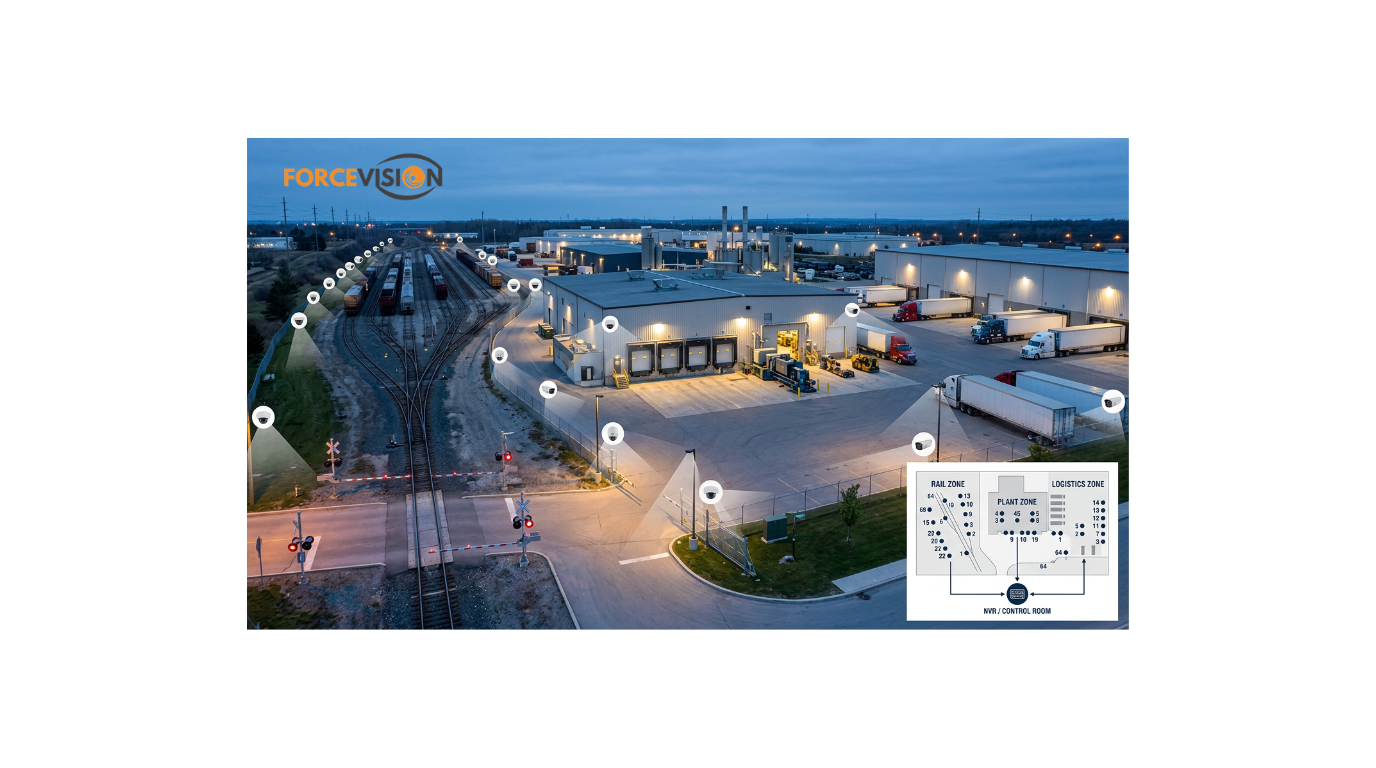
For many large industrial sites, the decision to move from a handful of legacy cameras to a 64‑camera platform is both exciting and daunting. You know you need better coverage—but where should all those cameras actually go to protect assets, support safety, and deliver operational value?
Across Southern Ontario, rail yards, manufacturing plants, warehouses, and logistics hubs are asking the same question. Planning a 64‑camera industrial CCTV system in Ontario is not about filling ports on an NVR; it is about designing coverage that maps directly to your risk and your workflows.
What makes 64 cameras a practical baseline for large sites?
In dense urban environments and industrial corridors, crime and operational risks have been trending upward, with freight fraud and cargo theft losses surging in recent years. At the same time, regulators, insurers, and customers are expecting clearer evidence when something goes wrong. For many large sites, a 16‑ or 32‑camera system simply cannot keep up with:
-
Multiple perimeter lines and access points
-
Large yards or laydown areas
-
Complex internal workflows and high‑value zones
-
The need to support safety, HR, and operations—not just security
A 64‑camera design provides enough capacity to cover perimeters, critical assets, and key internal processes while keeping room for growth. For multi‑building campuses or rail yards, it is often the minimum viable size that allows a truly strategic layout.
How should Ontario operators plan coverage by zone?
When planning a 64‑camera industrial CCTV system in Ontario, it helps to think in zones rather than individual cameras:
-
Perimeter zone: Fences, gates, and external roads. Use high‑resolution bullets aimed at entrances, licence plates, and potential breach points.
-
Yard and outdoor operations: Rail ladders, trailer yards, laydown areas, fuel and chemical storage. PTZs paired with fixed cameras provide both overview and detail.
-
Building envelope: Dock doors, loading bays, and external doors. Overhead cameras capture truck positions, seal integrity, and people movement.
-
Interior high‑value zones: Tool cribs, parts cages, IT and server rooms, high‑value racks. Domes focused on access points and key aisles.
-
Safety‑critical areas: Forklift intersections, machine infeed and outfeed areas, rail crossings, and marshaling zones. Cameras provide incident reconstruction and support analytics.
By mapping each zone and assigning approximate camera counts, you can quickly see how 64 channels will be consumed—and where trade‑offs or future expansion may be needed.
How do recent incidents inform camera placement?
Real‑world incidents offer practical lessons. Copper theft from rail signal cabinets in Guelph highlighted the vulnerability of remote, unmonitored infrastructure. Major cargo theft operations using warehouses and truck yards as staging points show how blind spots at gates, docks, and high‑value aisles can be exploited. Forklift fatalities and serious pinning incidents underline the need for coverage at intersections and dock edges.
When planning your 64‑camera layout, ask:
-
If a similar incident happened here, what angles would we need to fully understand it?
-
Would we be able to see the approach, the action, and the aftermath—or just a single, partial view?
-
Which external investigations (police, regulators, insurers) might rely on our footage?
Designing with these questions in mind ensures that the system is not just “watching” but actively supporting post‑incident learning and accountability.
Where do NVR capacity, analytics, and retention fit into the plan?
Camera placement is only part of the design. To make a 64‑camera system truly industrial‑grade, Ontario operators need to consider:
-
NVR/server capacity: Ensure enough processing for all channels at the desired resolution and frame rate, plus headroom for analytics.
-
Analytics strategy: Prioritize rules where they add the most value—perimeter intrusion, trespassing near rail lines, loitering in high‑value aisles, unsafe behaviour near docks.
-
Retention policies: Align storage capacity with risk and regulatory expectations. Many sites aim for 60–90 days, with longer retention for flagged incidents.
-
Network resilience: Use VLANs, QoS, and redundant links where necessary to keep video flowing during partial outages.
Planning a 64‑camera industrial CCTV system in Ontario is partly an IT project. Early collaboration between security, operations, safety, and IT avoids bottlenecks later.
How can phased deployment help large Ontario sites?
Not every site can overhaul its surveillance overnight. A phased approach allows you to move toward a 64‑camera standard over time:
-
Phase 1: Critical gaps. Address obvious blind spots: main gates, dock doors, high‑value cages, remote infrastructure.
-
Phase 2: Safety and operations. Add cameras at forklift intersections, rail crossings, and congested process areas to support EHS and process improvement.
-
Phase 3: Intelligence and analytics. Layer in advanced analytics, integrations with access control and yard management, and specialized cameras (e.g., thermal for perimeter).
ForceVision regularly helps Ontario operators prioritize these phases based on incident history, insurer feedback, and strategic initiatives. If you have already outgrown your current system, a no‑pressure assessment can help you build a roadmap to a 64‑camera platform without disrupting day‑to‑day operations.
What is the practical checklist before you buy?
Before issuing an RFP or calling vendors, site leaders in rail, manufacturing, logistics, and energy should align on a few key points:
-
The primary objectives: theft reduction, safety support, operational visibility, or all three
-
Critical zones that must be covered from Day 1
-
Target retention duration and any regulatory considerations
-
Integration priorities: access control, HR systems, yard or terminal management
Clarity upfront makes it much easier to compare proposals and avoids ending up with a system that looks impressive on paper but misses your real‑world risks.
Whether you operate a rail yard in Hamilton, a plant in Burlington, or a distribution centre in Brampton, planning a 64‑camera industrial CCTV system in Ontario is an opportunity to rethink how you see your site. Thoughtful design ensures those 64 cameras become an everyday tool for asset protection, safety, and operational excellence—not just a rack of blinking lights in the server room.
FAQ
Q1: Is 64 cameras always enough for large industrial sites?
A1: For many single‑site operations, 64 cameras is a strong starting point, but some multi‑building campuses may need 96 or 128 channels as their risk profile and operations grow.
Q2: Should we start with fewer cameras and expand later?
A2: You can, but it is wise to select an NVR or platform that can scale to 64 or more channels, so you do not have to replace core infrastructure in a year or two.
Q3: How do we avoid over‑monitoring low‑risk areas?
A3: Use a risk‑based approach: focus cameras on high‑value assets, safety‑critical zones, and access points, while giving only minimal coverage to low‑risk storage or office areas.
Q4: Can we reuse existing analog cameras in a 64‑camera design?
A4: Yes. Many systems support encoders and hybrid NVRs, letting you mix analog and IP while phasing upgrades over time.


