

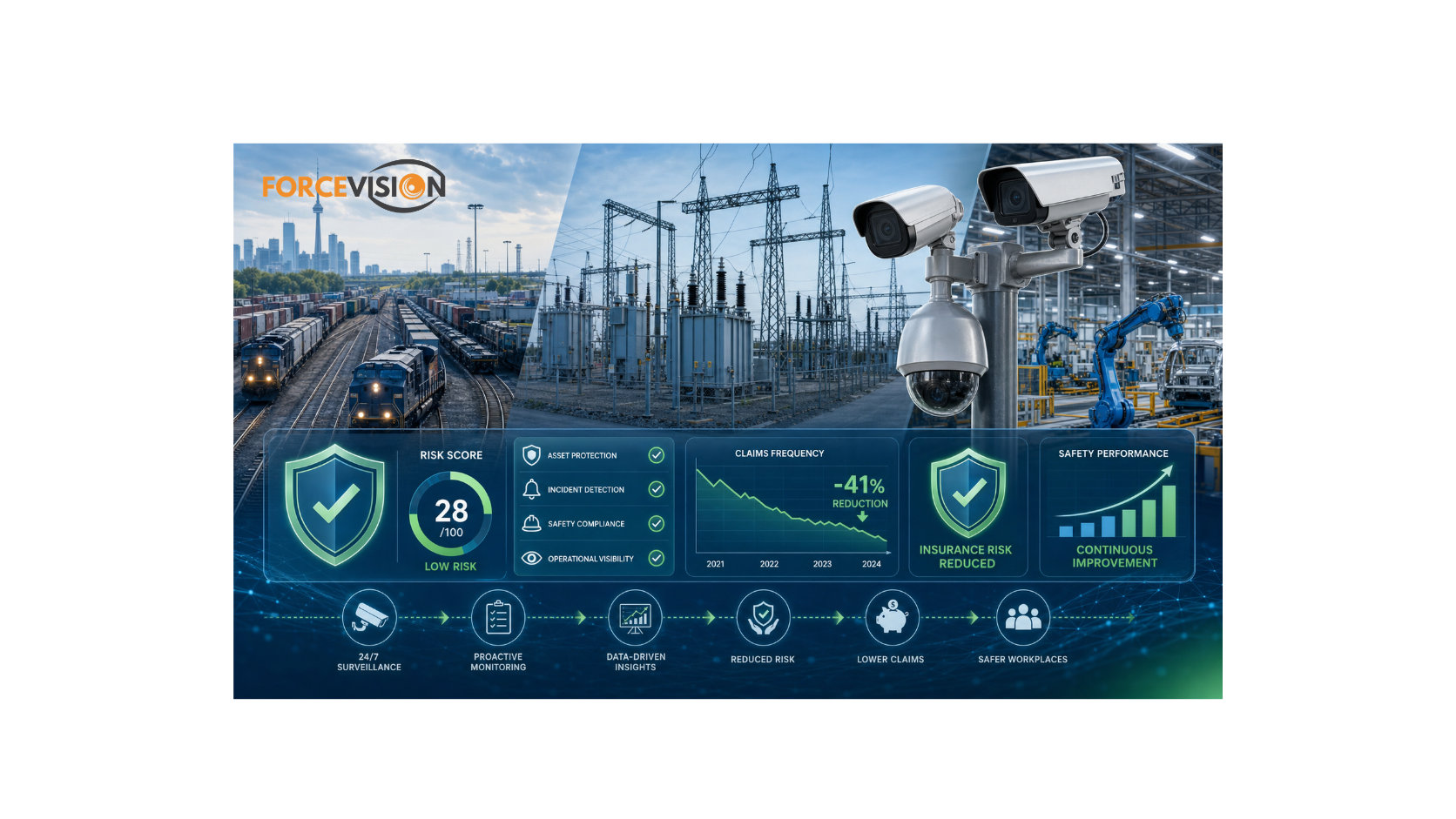
Insurers increasingly expect large industrial operators in Ontario to demonstrate robust controls around theft, safety, and business interruption. For rail yards, energy facilities, and major manufacturing plants, a single incident can result in multi‑million‑dollar claims—from stolen assets and damaged equipment to extended downtime after a safety event. Industrial CCTV is no longer just a “nice‑to‑have” security measure; it is a core part of how risk is quantified and priced.
The ForceVision Industrial Asset Protection guide emphasizes that 64‑camera and larger systems give operators site‑wide visibility and actionable intelligence for operations, safety, and HR. This same visibility is what risk engineers and underwriters look for when they assess whether a site is managing risk proactively or simply reacting. When cameras are strategically deployed, integrated with procedures, and used consistently, they can help lower both the frequency and severity of insured losses.
How do insurers view industrial CCTV today?
For major Canadian insurers and global carriers, industrial CCTV is part of the broader loss‑control picture. Site surveys and engineering reports often ask:
-
Are there cameras covering high‑value asset areas and critical processes?
-
Is footage recorded, retained, and easily retrievable?
-
Are cameras used for safety and operations, not just burglary deterrence?
When the answer to these questions is “yes,” and when operators can provide examples of incidents avoided or resolved thanks to video, insurers may view the risk profile more favourably. While CCTV alone does not guarantee lower premiums, it often supports broader improvements that do—fewer thefts, fewer injuries, and faster recovery from disruptions.
Where does CCTV make the biggest difference to risk?
Industrial CCTV insurance risk reduction Ontario is especially impactful in three domains:
-
Asset protection
Large rail, logistics, and manufacturing sites store locomotives, rolling stock, heavy equipment, and high‑value inventory. Well‑designed camera systems reduce opportunities for theft, vandalism, and sabotage by increasing perceived and actual detection rates. -
Worker safety
Video helps identify recurring unsafe behaviours, congested work areas, and process deviations that could lead to injury. By addressing these proactively, operators reduce the likelihood of large injury claims and associated legal costs. -
Business interruption
When incidents do occur, clear footage supports faster root‑cause analysis and more targeted repairs, shortening downtime. In complex facilities, that can be the difference between a minor interruption and an extended shutdown.
How should a system be configured to satisfy insurers?
From an insurance lens, coverage matters as much as camera count. A 64‑camera system should:
-
Provide continuous coverage of perimeters, entrances, and high‑value storage areas
-
Monitor critical production lines, loading racks, or pump stations where failures would be costly
-
Capture clear identification at access points (faces, plates, credentials)
Retention policies also matter. Many industrial sites aim for at least 30–90 days of footage retention to support delayed discovery of thefts, safety issues, or process failures. NVR and VMS platforms should allow quick retrieval of relevant footage, with the ability to export clips and logs that support claim files and investigations.
How does CCTV support claims handling?
When a claim is filed—whether for stolen inventory, equipment damage, or a worker injury—insurers seek clarity on what happened and whether policy terms were met. Industrial CCTV insurance risk reduction Ontario becomes very tangible at that point:
-
Video can confirm or refute timelines, alleged causes, and reported behaviours.
-
Footage may reveal contributing factors, such as third‑party contractors or external intruders.
-
Clear evidence can accelerate claim settlement and reduce disputes.
In some cases, video may even prevent claims by demonstrating that alleged incidents did not occur as described, or by revealing that damage pre‑dated a reported event.
What is the insurer’s perspective on analytics and AI?
While formal frameworks are still evolving, many risk engineers are increasingly interested in how analytics and AI are used to detect and respond to emerging hazards. Systems that provide configurable alerts—such as unauthorized access, after‑hours movement in high‑value zones, or people in exclusion areas—allow operators to respond before a loss occurs.
By documenting these alerts and responses, industrial operators can show insurers that their CCTV is not just recording, but actively supporting risk management. Over time, that may feed into more favourable loss histories and, potentially, improved terms.
How can ForceVision help link CCTV to your risk strategy?
ForceVision designs industrial CCTV not just as a security layer, but as part of a broader asset protection and risk‑management strategy for rail, energy, manufacturing, and logistics operators across Southern Ontario. When planning 64‑camera and larger deployments, the team considers where insurance‑critical exposures live—tank farms, yard access, control rooms, high‑value warehouses—and how footage will be used to support both operations and claims.
If your risk manager or broker has raised questions about visibility, incident reconstruction, or loss history, ForceVision can help translate those concerns into a camera and analytics design tailored to your site and your insurer’s expectations. The conversation starts with your risks, not with hardware.
FAQ
Q1: Can CCTV alone lower my insurance premium?
A1: CCTV is one piece of the puzzle. It supports better controls and fewer losses, which can contribute to more favourable terms over time when combined with other improvements.
Q2: Should brokers or insurers be involved in CCTV planning?
A2: Yes. Involving your broker or insurer’s risk engineer early can ensure that camera coverage aligns with key exposures and audit expectations.
Q3: Does adding analytics change the insurance equation?
A3: Analytics can strengthen your risk story by showing that you are proactively detecting and responding to hazards, not just documenting them.
Q4: How important is documentation?
A4: Very important. Clear policies, retention schedules, and incident logs show insurers that your system is managed, not just installed.


