

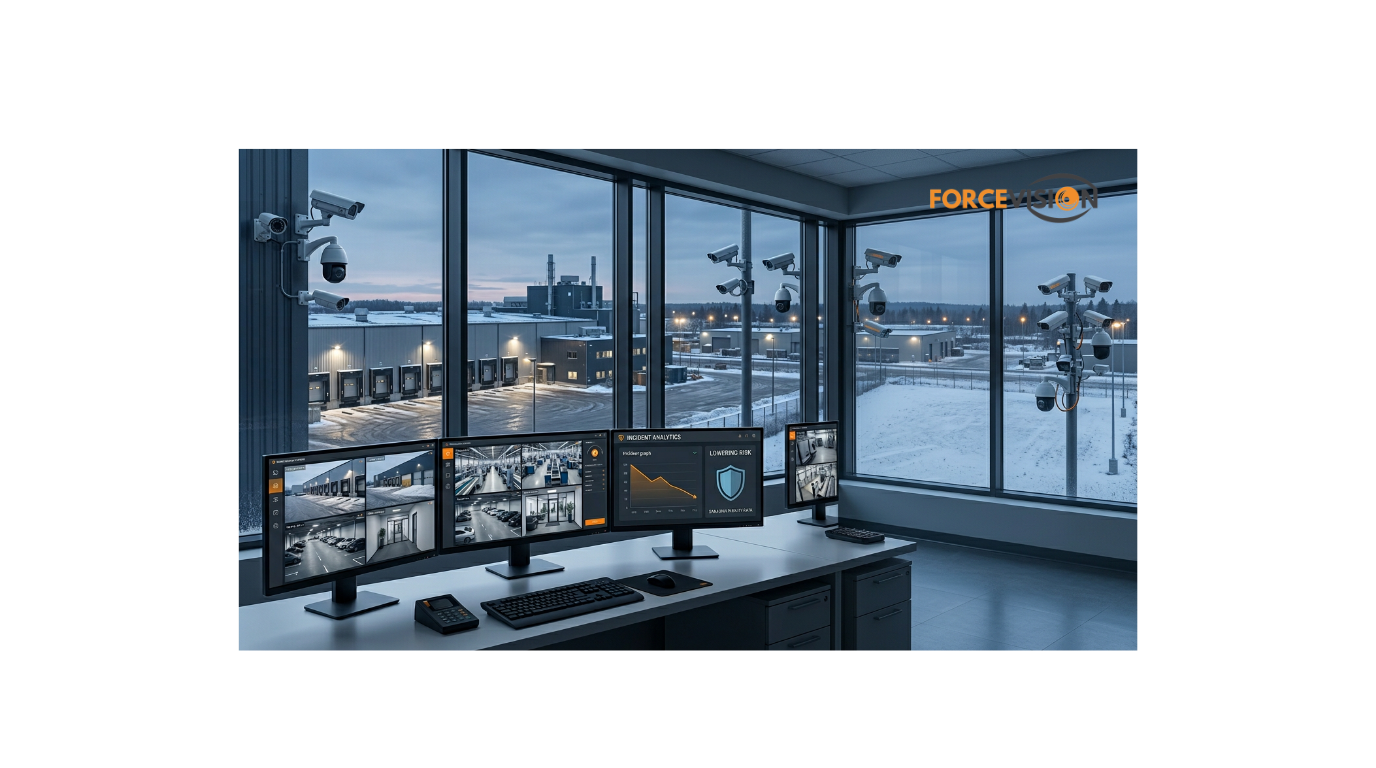
Insurance renewals have become a strategic moment for large industrial operators across Canada. Whether you run a rail yard, a distribution hub, or a major manufacturing plant, underwriters now dig deeper into how you manage physical risk and document incidents. At the same time, industrial theft and equipment losses continue to impose multi‑million‑dollar costs. Ontario construction statistics alone point to annual equipment theft in the tens of millions, with poor recovery rates when tracking and surveillance are weak. Against this backdrop, industrial CCTV to lower insurance risk in Canada has become more than a checkbox — it is a key part of the story you tell your insurer.
CCTV has long been associated with catching thieves after the fact, but that view is incomplete. In the industrial context, well‑designed 64‑camera systems create a continuous, time‑stamped record of how you operate, how you control access, and how you respond to issues. This is exactly the type of evidence insurers and adjusters rely on when assessing risk and adjudicating claims.
How do insurers look at industrial CCTV today?
Underwriters effectively ask two questions when they look at your security posture: how likely is a loss to occur, and how hard will it be to verify what happened if it does. In sectors like rail, energy, and manufacturing, the potential severity of an incident is high, so robust controls and documentation matter.
Industry commentary emphasises that modern security systems — including cameras, alarms, and tracking — are increasingly tied to reduced risk profiles and better claim outcomes. When you can show perimeter coverage, monitored access points, and well‑documented safety practices, you are demonstrating that you take loss prevention seriously. In contrast, a patchy set of cameras with inconsistent retention sends the opposite signal.
What makes CCTV “industrial‑grade” from an insurance perspective?
Not all camera systems are equal in the eyes of insurers. Industrial CCTV to lower insurance risk in Canada must show that it is designed for the scale and complexity of the operation. Key attributes include:
-
Coverage: Site‑wide visibility, including perimeters, key process areas, high‑value storage, and transfer points, not just front doors.
-
Retention: Sufficient storage (often 30–90 days) to support delayed discovery of theft, safety incidents, or cargo discrepancies.
-
Reliability: Redundant recording, secure storage, and documented maintenance.
-
Usability: The ability to quickly retrieve and export relevant footage with accurate timestamps.
For a 10‑billion‑dollar‑scale industrial client, this typically implies 64‑camera‑plus deployments, robust NVR platforms, and a clear governance framework for how video is used.
How does video evidence change claim outcomes?
Consider two versions of the same event: a major equipment theft from a construction yard or a high‑value cargo loss at a distribution hub. In the first version, the site has a pair of outdated cameras that were not recording properly that night, leaving only rough estimates of timing and no visuals of vehicles or people. In the second, the site runs industrial CCTV to lower insurance risk in Canada and can provide:
-
Entry and exit views from the perimeter showing vehicles, license plates, and timelines.
-
Footage of how intruders moved through the site and which assets were touched.
-
Evidence that fences, gates, and lighting were in place and used appropriately.
Evidence‑rich cases are faster to adjust and harder to dispute. They may also allow subrogation or recovery if third parties or carriers are involved. Over time, insurers may reflect this in more favourable terms for clients who consistently demonstrate such capabilities.
How does CCTV help reduce loss frequency, not just support claims?
Insurers care about frequency as much as severity. Industrial CCTV to lower insurance risk in Canada becomes more valuable when it is used proactively to address patterns before they produce large claims. Examples include:
-
Identifying recurring after‑hours trespass or suspicious vehicles around yards and adjusting patrols or lighting accordingly.
-
Using video to investigate near‑miss incidents and then updating procedures or training, reducing the likelihood of serious injuries.
-
Spotting careless handling of high‑value equipment or loads, then coaching teams to prevent damage.
Research into construction and industrial security notes that integrating surveillance with asset tracking and alarms can significantly improve recovery rates and deter theft. From an underwriter’s perspective, sites that continually learn from their own footage and implement improvements present a lower long‑term risk.
What documentation should you prepare for insurers?
If you want to use industrial CCTV to lower insurance risk in Canada, you need to present it clearly during underwriting and renewal discussions. Helpful documentation includes:
-
A site plan highlighting camera coverage, especially around high‑value areas.
-
A summary of your retention policy and storage configuration (e.g., 64‑camera NVR, 60 days retention on critical streams).
-
Examples of how video has supported recent incident resolutions or process improvements.
-
Governance policies detailing who can access footage and how privacy is maintained.
This material shows that CCTV is a structured part of your risk management program, not an afterthought. It also reassures insurers that footage will be available and usable when needed.
Where does ForceVision fit into this picture?
Designing industrial CCTV to lower insurance risk in Canada is not just about installing more cameras; it is about aligning technology with your risk profile and insurer expectations. ForceVision works with large industrial operations across Southern Ontario — rail yards, manufacturing plants, logistics hubs, and energy facilities — to design systems that cover the right areas, retain the right data, and support the right stakeholders.
If you are preparing for an insurance renewal or facing pressure after a large loss, ForceVision can help you map your current coverage, identify gaps, and propose a 64‑camera‑scale architecture that supports both security and insurance objectives. This can be done as a collaborative, no‑pressure assessment focused on risk and operational realities, not just hardware.
The key lesson is that industrial CCTV to lower insurance risk in Canada is most powerful when it is treated as shared infrastructure: it helps security prevent theft, safety reduce injuries, operations improve flow, and insurers understand your risk profile. If your cameras are not yet part of that story, now is the time to change it.
FAQ
Q1: Will adding more cameras automatically reduce my insurance premiums?
A: Not automatically. Insurers look at how your system is designed, how footage is retained and used, and whether it meaningfully reduces loss potential. Industrial CCTV to lower insurance risk in Canada works best as part of a broader risk program.
Q2: How long should we retain footage for insurance purposes?
A: Many industrial sites aim for 30–90 days retention on key cameras, aligning with how quickly losses are discovered and reported. Some high‑risk areas may justify longer retention depending on claim patterns and regulatory requirements.
Q3: Do insurers require 64 cameras specifically?
A: No, they do not specify camera counts, but large industrial sites often need 64+ cameras to achieve coverage that underwriters view as robust. The goal is risk‑based coverage, not hitting a number.
Q4: Can CCTV help with liability claims, not just theft?
A: Yes, industrial CCTV to lower insurance risk in Canada is valuable for slip‑and‑fall incidents, vehicle collisions, worker injuries, and other liability claims where clear, objective evidence can clarify what happened.


