

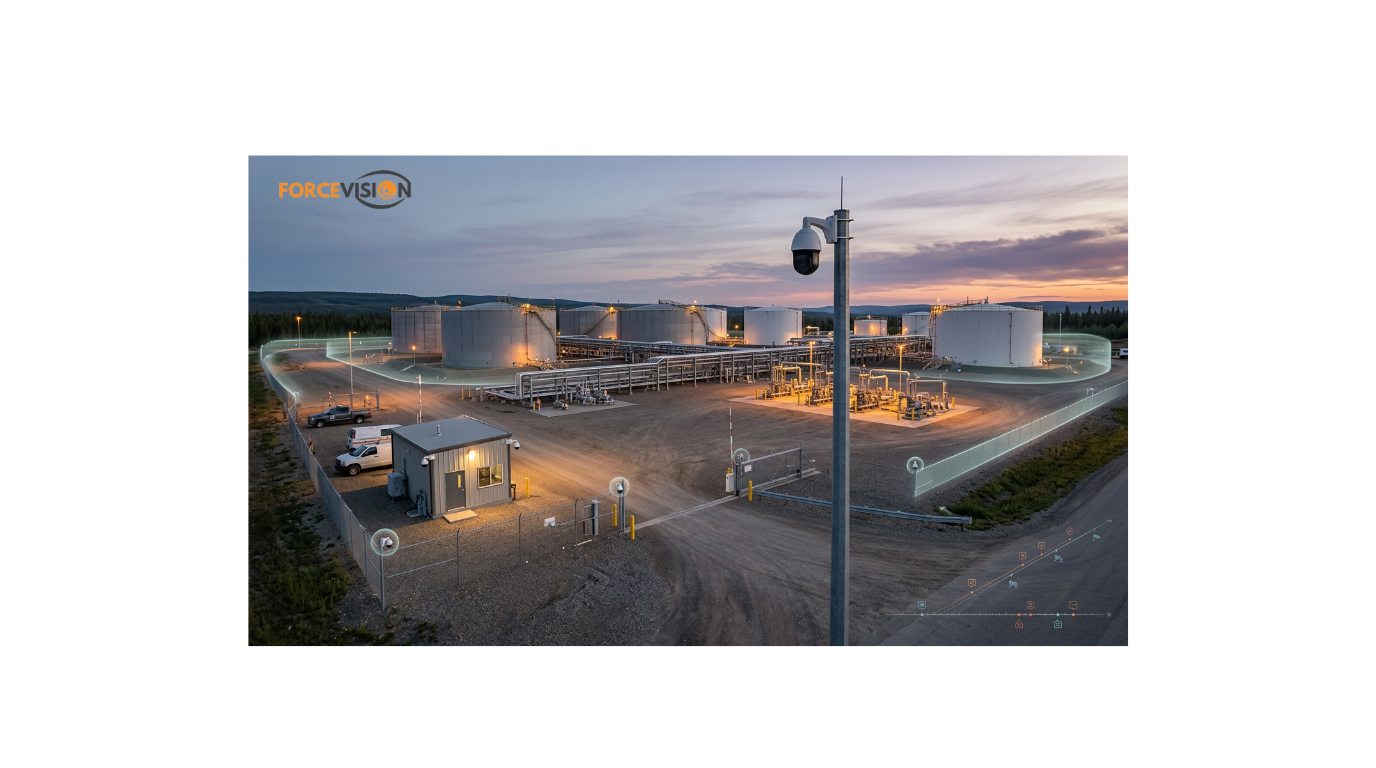
Energy companies like Enbridge, Suncor, and Imperial Oil operate terminals, tank farms, and pipeline facilities where a single incident can have far‑reaching safety, environmental, and financial consequences. These sites bring together high‑value assets, hazardous materials, and strict regulatory obligations. In that context, the question is no longer whether to deploy cameras, but whether the existing CCTV architecture is truly designed for the scale and risk profile of the operation.
Recent incident reports and safety bulletins in the energy sector have highlighted concerns ranging from unauthorized access and vandalism to equipment failure and leaks at storage and transfer facilities. In many cases, CCTV footage has been used after the fact to reconstruct events leading up to an incident—yet operators often discover gaps in coverage, lighting, or retention just when they need video most.
Why energy terminals and tank farms need industrial‑grade CCTV
Energy terminals and tank farms differ from most industrial sites in three key ways:
-
They store and handle hazardous products under pressure or at volume.
-
They are subject to intense regulatory scrutiny and audit requirements.
-
They often occupy large footprints with a mix of public‑facing and restricted areas.
A handful of cameras on gates and control rooms is not enough. Operators need to monitor:
-
Perimeter fences and access roads for intrusions or suspicious activity.
-
Tank tops, manifolds, and valve corridors for unauthorized presence or unsafe behaviours.
-
Truck and rail loading racks where personnel, vehicles, and hazardous product intersect.
-
Pump houses, compressor stations, and control buildings.
A 64‑camera CCTV design for Canadian energy terminals and tank farms can provide continuous visibility over these zones, giving operations, safety, and security teams a shared picture of what is happening on site.
Designing coverage for both security and process safety
Industrial‑grade CCTV at energy facilities must serve dual purposes: asset protection and process safety. That means:
-
High‑resolution bullet cameras along perimeters and access roads to detect vehicles and people approaching restricted areas.
-
Explosion‑proof or appropriately rated cameras installed near classified process areas where flammable vapours may be present.
-
PTZ cameras positioned for wide‑area oversight of tank farms, loading racks, and shared yards, allowing operators to zoom in on alarms or unusual activity.
-
Fixed cameras in control‑room corridors and muster points to verify personnel movements during drills or actual emergencies.
By mapping cameras to safety‑instrumented systems, alarms, and control logic, operators can quickly pull up relevant views when an alarm goes off—a possible leak, an overfill, or an unauthorized access event. Instead of relying solely on instrumentation and radio calls, control room staff can see what’s happening in seconds.
Supporting emergency response and post‑incident investigations
When something does go wrong—whether a small spill, a fire, or an unplanned shutdown—time‑synchronized CCTV footage becomes a critical part of the response and investigation. It can show:
-
How quickly personnel responded to alarms and muster instructions.
-
Whether emergency equipment such as fire monitors or deluge systems activated as designed.
-
The sequence of vehicle and contractor movements in the affected area.
-
Any unauthorized access or procedural deviations prior to the event.
Regulators and insurers often request video evidence as part of incident reviews. When footage is clear, comprehensive, and retained for an adequate period, operators can demonstrate due diligence, clarify timelines, and identify specific opportunities for improvement. When coverage is patchy or retention is too short, critical pieces of the puzzle may be lost.
Integrating CCTV into energy‑sector risk management
For energy companies, CCTV should not sit in a silo. A modern design for terminals and tank farms can tie into:
-
Access‑control and badge systems, linking card events to visual verification.
-
Process control and alarm systems, so operators can pull up relevant cameras with a single click.
-
Physical security information management (PSIM) platforms for unified situational awareness.
-
Incident‑management tools, ensuring footage is tagged and preserved when events are logged.
This integrated approach aligns with broader risk‑management and ESG commitments, helping companies show stakeholders that they are proactively managing safety, environmental, and security risks at critical infrastructure sites.
How ForceVision works with energy operators
ForceVision’s industrial focus makes it well‑suited to terminals, tank farms, and pipeline facilities that need robust, compliant CCTV designs. Instead of simply adding cameras, ForceVision helps energy operators:
-
Map cameras to risk zones, process units, and regulatory obligations.
-
Select appropriate camera types and enclosures for hazardous areas.
-
Design NVR and storage architectures that support long retention periods and secure evidence handling.
-
Integrate video with existing access, control, and incident‑management systems.
If you are responsible for security or operations at a Canadian energy facility and are unsure whether your current CCTV would truly support you in a major event, a structured assessment is a logical next step. ForceVision can provide that assessment and propose phased upgrades that respect budget cycles while closing the most critical gaps first.
A practical takeaway for energy leaders
Pick one recent drill, alarm, or minor incident at your facility. Consider how effectively your current cameras captured what happened. Could you clearly see who responded, how quickly, and what conditions looked like at the time?
If the answer is “not really” or “only from one angle,” your CCTV system is likely under‑engineered for the risk you carry. A 64‑camera, industrial‑grade design can transform video from a compliance checkbox into a central tool for security, safety, and environmental stewardship.
FAQ
Q1: Are there special cameras for hazardous areas in energy facilities?
Yes. Classified areas often require explosion‑proof housings or intrinsically safe camera designs that meet relevant standards for flammable atmospheres.
Q2: How long should energy terminals retain CCTV footage?
Many operators target 30–90 days of retention, with the ability to lock clips for much longer when they relate to incidents, audits, or regulatory investigations.
Q3: Can CCTV help with regulatory compliance and audits?
Absolutely. Video evidence can demonstrate that access controls, procedures, and emergency responses are functioning as intended, supporting internal and external audits.
Q4: What is the first step to upgrading CCTV at a tank farm?
Start with a risk‑based coverage assessment, mapping cameras to high‑risk process units, access points, and emergency routes, then design a 64‑camera baseline that can scale.


