

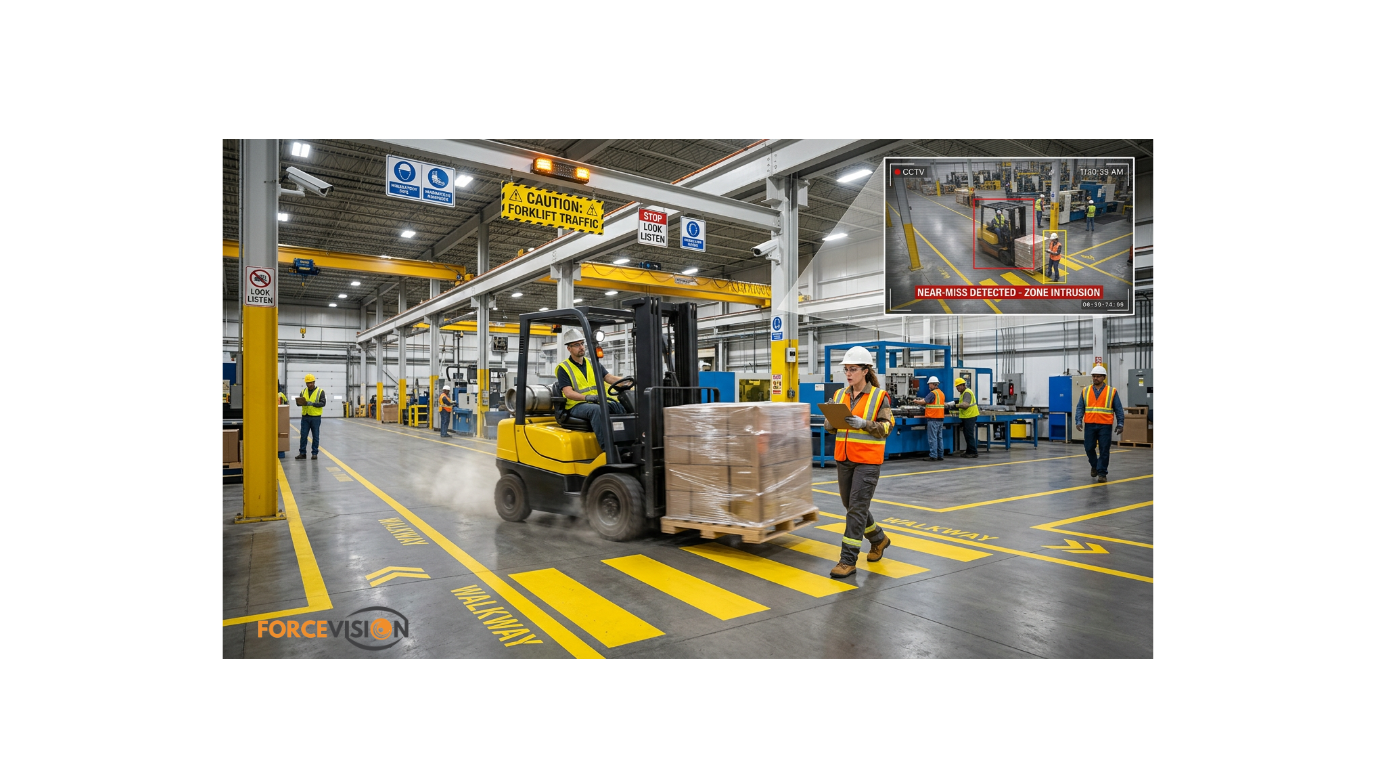
In January, a man in his 40s died after being trapped under a forklift at a Vaughan worksite, prompting a police and safety investigation. The incident was one of several serious forklift‑related events reported across North America this year, each reminding manufacturers that material‑handling risks can turn deadly in seconds.
For large plants and warehouses across Southern Ontario, forklifts are as common as conveyor belts. They are essential to production and shipping—but they also introduce a concentrated set of hazards that traditional supervision and paper procedures struggle to control.
Why are forklift incidents still happening in modern plants?
Despite mandatory training and strict rules, investigations into serious incidents often reveal familiar patterns:
-
Poor visibility at intersections, racking ends, and dock edges
-
Pedestrians and forklifts sharing the same aisles under time pressure
-
Shortcuts: riding on forks, speeding, or carrying unstable loads
-
Inconsistent enforcement of PPE and traffic‑flow rules
In Vaughan, reports indicated the worker was trapped under the forklift, leading to fatal injuries. In another recent case at a major warehouse, a worker was pinned between a semi‑trailer and a loading dock for roughly 20 minutes before rescue. These are the kinds of scenarios where seconds matter and where after‑the‑fact reconstruction is critical to preventing repeat events.
How does industrial CCTV change forklift safety discussions?
When plant leaders rely solely on witness statements and partial memories, it is difficult to move safety conversations beyond blame or speculation. Industrial CCTV for forklift safety in Ontario factories allows EHS teams to:
-
See the full sequence: speed, traffic conditions, and line of sight leading up to an incident
-
Identify systemic issues: blind corners, congested aisles, or chronic rule‑breaking
-
Differentiate between training gaps and environmental design problems
Instead of asking, “What went wrong?” in abstract terms, supervisors can review time‑stamped footage from overhead dome cameras or corner‑mounted bullets that show exactly how the forklift, pedestrians, and other equipment interacted in the seconds before impact.
This not only improves incident investigation but also makes toolbox talks and safety training more concrete. Showing anonymized clips of near‑misses from your own plant can be far more powerful than generic stock videos.
What does an effective forklift‑focused CCTV layout look like?
In a large Ontario factory or warehouse, a forklift‑safety‑centred design typically includes:
-
Intersection coverage: Dome cameras mounted at major cross‑aisles, capturing both forklift and pedestrian traffic.
-
Dock and staging areas: Cameras overlooking truck bays, staging lanes, and trailer interfaces where pinning and fall risks are high.
-
Production lines: Targeted coverage of areas where forklifts approach workstations or machine infeed zones.
-
Battery and charging rooms: Cameras monitoring battery changes and refuelling for unsafe practices.
These feeds connect back to an NVR or video platform capable of handling 64+ cameras, so forklift‑related angles do not compete with traditional security views. Industrial CCTV for forklift safety in Ontario factories becomes one layer in a broader safety and operations design.
Can video analytics actually prevent forklift incidents?
While cameras do not replace good engineering controls, modern analytics can support safer behaviours in several ways:
-
Zone‑based alerts: Virtual zones in front of dock edges or high‑risk intersections can trigger alerts when forklifts enter at excessive speed or during restricted times.
-
Pedestrian detection: Some analytics engines can flag people entering forklift‑only aisles or areas marked as exclusion zones.
-
Behavioural patterns: Over time, video data can highlight recurring patterns of congestion or risky manoeuvres around specific machines.
In serious incidents like the Vaughan fatality, regulators and employers are keen to understand whether the environment contributed to the outcome. Analytics‑driven insights help teams redesign layouts, add mirrors and guardrails, or separate flows entirely, guided by actual data, not gut feeling.
How does CCTV support regulatory and insurance expectations?
After a workplace fatality or serious injury, multiple stakeholders become involved: internal EHS, labour ministries, insurers, sometimes even law enforcement. Industrial CCTV provides:
-
Objective evidence of training, signage, and traffic control measures in place at the time
-
Precise timelines for event sequences and response efforts
-
Documentation of corrective actions (e.g., new barriers, changed routes) over time
Insurers increasingly ask about industrial CCTV when underwriting large manufacturing and warehousing risks, especially where heavy material handling is central to operations. A robust system aligned with forklift safety can strengthen your risk profile and support claims when disputes arise around cause and liability.
For Ontario plants and DCs, this is not about surveillance of workers for its own sake; it is about building a shared, factual understanding of what actually happens on the floor, so improvements are grounded in reality.
How can Ontario factories start integrating CCTV into forklift safety programs?
If your site already has cameras, the first step is to overlay forklift traffic maps onto your current coverage:
-
Identify intersections, docks, and pinch points without clear visual coverage
-
Review past near‑miss reports and match them to what your cameras actually see
-
Evaluate whether your NVR and network can support additional forklift‑focused cameras
From there, you can prioritize upgrades: intersection domes, dock‑overhead cameras, better lighting in critical zones, and analytics licences where they will add the most value.
ForceVision helps large industrial sites across Southern Ontario—factories, warehouses, and logistics hubs—design CCTV layouts that explicitly account for forklift routes and pedestrian interactions. If you are not sure whether your cameras would truly help after a serious incident, ForceVision can provide a no‑pressure assessment focused on forklift‑related risk and regulatory expectations.
What is the key takeaway for plant leaders?
Events like the Vaughan forklift fatality are tragic reminders that even well‑run operations can have serious blind spots. Cameras cannot prevent all incidents, but they can:
-
Reveal where your controls are not working as intended
-
Provide evidence that supports fair investigations and corrective action
-
Anchor forklift safety discussions in real, site‑specific examples
For Ontario plants and warehouses, industrial CCTV for forklift safety in Ontario factories is a practical, scalable tool in the broader safety toolkit—one that connects safety, operations, HR, and risk management around a common set of facts.
FAQ
Q1: Do we need separate cameras just for forklift safety?
A1: Not always. Many existing cameras can be repositioned or supplemented to capture high‑risk intersections and docks. The key is designing coverage with forklift routes explicitly in mind.
Q2: Will workers feel “spied on” by more cameras?
A2: Transparent communication that focuses on safety, near‑miss learning, and fair investigations—rather than discipline—goes a long way to building trust and acceptance.
Q3: How long should plants keep footage related to safety incidents?
A3: Many sites keep at least 60–90 days of footage, with longer retention for flagged incidents and formal investigations, depending on internal policy and legal guidance.
Q4: Can CCTV replace physical controls like guardrails and barriers?
A4: No. Cameras complement engineering controls and training, but they cannot substitute for proper traffic separation, signage, and safe‑system design.


