

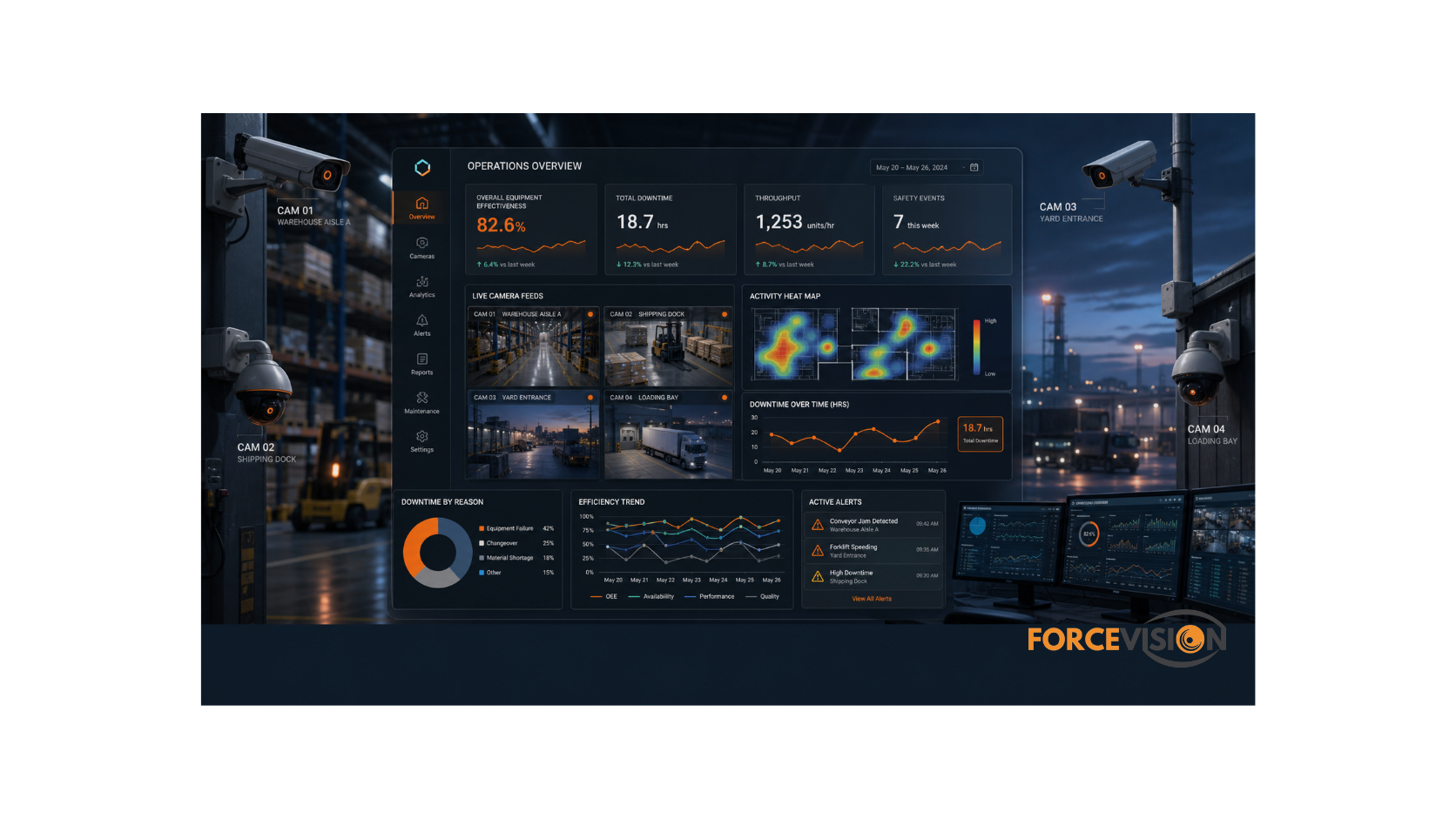
Many large industrial sites invested in CCTV years ago to deter theft and document incidents. But a growing number of rail yards, manufacturers, and logistics hubs are discovering a bigger opportunity: turning industrial CCTV into operational intelligence for Canadian yards and plants. Used well, video becomes a data source that helps reduce bottlenecks, improve safety, and support a healthier workplace culture.
This shift is especially relevant for operators handling high‑value assets and complex flows, from CN‑scale yards to major auto plants and large distribution centres. They already have dozens of cameras in place; the question is how to extract more value from that infrastructure without necessarily adding more hardware.
What is “operational intelligence” in a video context?
Operational intelligence means using data to understand how work actually happens so you can improve it. In the context of turning industrial CCTV into operational intelligence for Canadian yards and plants, it involves analysing patterns in camera footage to answer questions like:
-
Where do trucks or railcars consistently queue or idle?
-
Which tasks regularly involve unsafe shortcuts?
-
When and where do near‑misses cluster during a shift?
Instead of relying solely on anecdote, supervisors and engineers can review clips and quantify what they see. Over time, this evidence‑based view supports better decisions on staffing levels, layout changes, training priorities, and capital investments.
Key use cases across rail, manufacturing, and logistics
Industrial operators are already finding practical ways to use CCTV beyond security:
-
Rail yards: Analysing hump and flat‑switch operations to spot congested ladder tracks, unsafe walking routes, or repeated close calls at crossings.
-
Manufacturing plants: Reviewing changeovers and maintenance tasks to identify steps that cause delays or deviations from standard work.
-
Distribution centres: Studying dock operations to see how long trailers sit at doors, where forklifts and pedestrians conflict, and when mis‑loads occur.
These use cases all depend on a foundational 64‑camera‑class deployment, but the incremental value comes from how teams interact with footage—regular review sessions, structured investigations, and collaboration between security, operations, safety, and HR.
The role of video analytics and AI
Modern video analytics and AI tools can help scale this approach by automating pattern recognition. Instead of manually scanning hours of footage, operators can:
-
Use people and vehicle counting to quantify flows through key chokepoints.
-
Set virtual zones to track how long assets dwell in specific areas.
-
Configure alerts when forklifts exceed speed thresholds or enter pedestrian‑only zones.
As research in rail network surveillance and multi‑sensor analytics has shown, automated detection can significantly improve the ability to monitor large, complex infrastructures without overwhelming human operators. The same principles apply to factories and logistics hubs: AI filters the noise so teams can focus on actionable insights.
Cultural and privacy considerations
Turning industrial CCTV into operational intelligence for Canadian yards and plants requires thoughtful communication with the workforce. Employees need to understand that the goal is to improve safety, reduce frustration, and support fair investigations—not to micromanage every move. Clear policies, consistent use of footage, and a focus on coaching rather than punishment go a long way toward building trust.
Some organisations involve joint health and safety committees in defining how analytics will be used and what metrics will be tracked. This collaborative approach helps align video use with existing safety programs, and it reassures employees that data will be used responsibly.
How ForceVision helps unlock more value from video
ForceVision works with industrial clients who already have substantial CCTV infrastructure and want to get more out of it. For rail yards, manufacturing plants, and logistics hubs, we help:
-
Assess current camera layouts for analytics readiness.
-
Identify priority operational questions that video can help answer.
-
Recommend analytics modules and NVR upgrades suited to industrial environments.
If your site already has dozens of cameras but you suspect they are underused, a short operational review can uncover quick wins—simple changes in how footage is tagged, shared, or reviewed that deliver outsized benefits.
A simple way to start using CCTV as data
You do not need a full AI platform to begin turning industrial CCTV into operational intelligence for Canadian yards and plants. A straightforward starting point is to:
-
Choose one operational pain point—like shift‑change congestion or near‑misses at a particular intersection.
-
Pull a week’s worth of relevant footage.
-
Have a small cross‑functional group review and document patterns.
In many cases, the first review will immediately suggest low‑cost changes—additional signage, adjusted traffic flows, or targeted training—that can yield rapid improvements. From there, you can build toward more systematic analytics and automation.
FAQ
Q1: Do we need new cameras to use analytics?
A: Not always. Many existing IP cameras can support basic analytics if resolution, frame rate, and positioning are sufficient. However, some critical zones may benefit from targeted camera upgrades.
Q2: Who should “own” operational intelligence from video?
A: The most effective models involve shared ownership, with security providing infrastructure and operations, safety, and HR using footage to support their respective programs.
Q3: Are there risks of relying too much on analytics?
A: Analytics should augment human judgment, not replace it. Teams still need to validate findings, consider context, and involve people in designing solutions.
Q4: How do we protect privacy while using video for analysis?
A: Clear policies, limited access, defined retention, and, where appropriate, anonymised or aggregated analytics outputs help balance privacy with safety and efficiency goals.


