

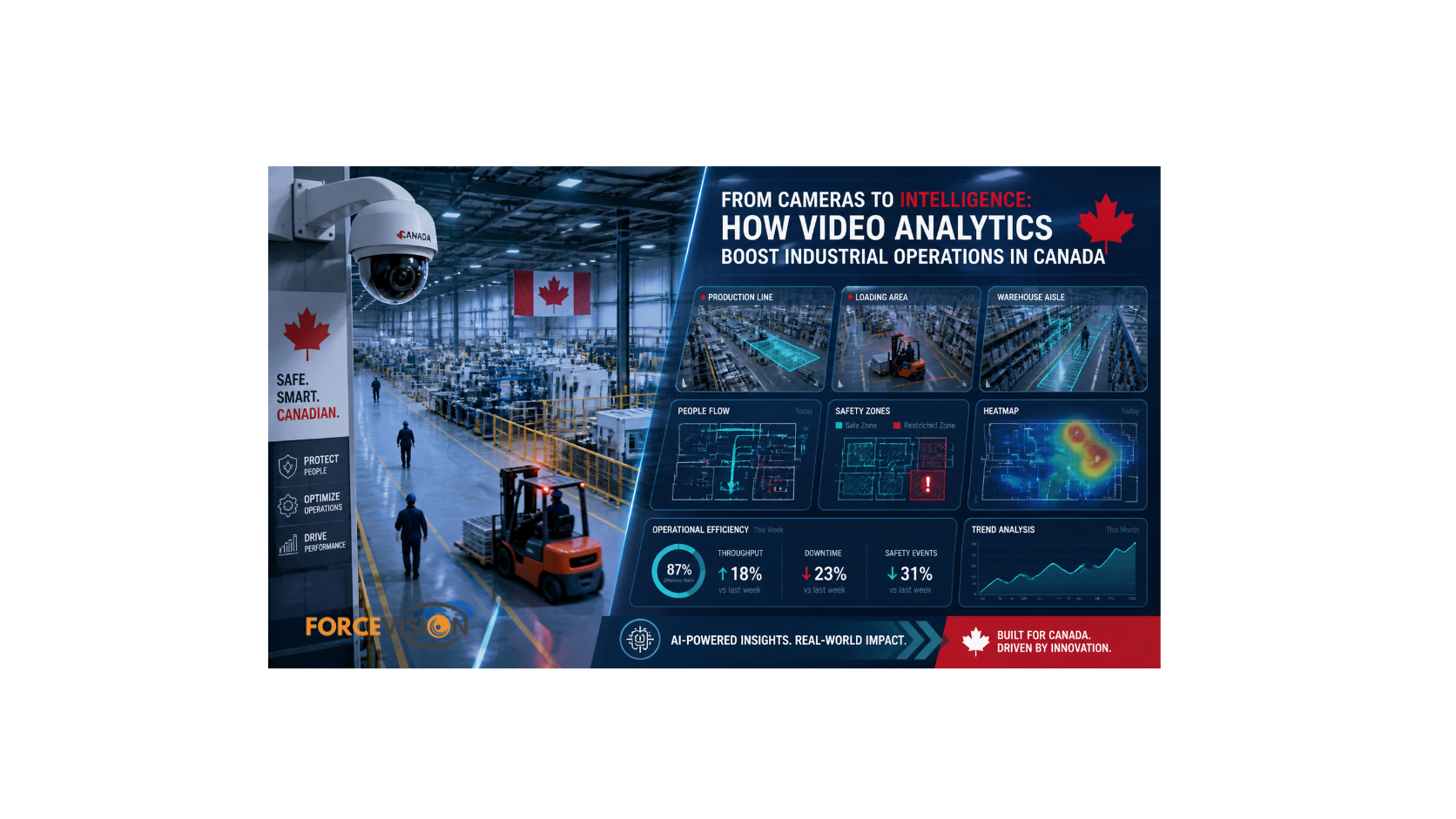
Across rail yards, logistics hubs, manufacturing plants and large construction sites, cameras are everywhere — but intelligence is not. Too often, industrial video systems act as silent witnesses, recording terabytes of footage that no one reviews unless something goes badly wrong. Yet recent advances in surveillance analytics, especially in rail and transportation, show how video can actively monitor people, detect unexpected events and support safer, more efficient operations.
Industrial video analytics for Canadian yards and plants is about bridging that gap: turning raw footage into a real‑time signal that helps security, safety and operations teams see problems sooner and respond more effectively.
What can modern industrial video analytics actually do?
Research into rail network surveillance highlights several capabilities that are now moving from pilot projects into mainstream deployments: automatic detection of static objects, trespassing, abnormal behaviour and critical events across complex environments. In logistics, practitioners emphasise the importance of situational awareness, using cameras and analytics to monitor parking lots, detect suspicious vehicles and support safer driver behaviour.
For Canadian industrial operators, this translates into practical functions such as:
-
Intrusion detection along fences, restricted process areas or laydown yards, distinguishing people and vehicles from wildlife or wind‑blown debris.
-
Line‑crossing and zone alerts at rail crossings, loading zones and equipment danger areas to warn when people or forklifts enter hazardous spaces.
-
Object‑left‑behind or removed detection near critical infrastructure, tool cribs or high‑value materials, highlighting potential theft or safety hazards.
-
Traffic and congestion analysis in truck yards or internal logistics corridors, helping planners smooth flows and reduce bottlenecks.
The same 64‑camera CCTV systems installed for security can often support these analytics with software upgrades, turning an existing asset into a source of operational value.
Managing alert fatigue and false alarms
One of the most common worries about analytics is the risk of constant false alarms. Research on multimodal sensor fusion for railway security points out that integrating multiple sensors can actually create information overload if not managed carefully. The key is to design analytics rules and thresholds around real‑world patterns rather than theoretical risks.
Best practices include:
-
Starting with a small set of high‑value rules — for example, off‑hours intrusion into fuel storage or rail spurs — and tuning them before expanding.
-
Using object classification to distinguish between people, vehicles and animals, cutting down on nuisance alerts.
-
Combining video analytics with other signals (access control events, scheduled work orders) to validate whether an alert is likely legitimate.
When configured thoughtfully, analytics reduce rather than increase workload by filtering a 64‑camera wall down to a handful of actionable events per shift.
Safety and HR: using video intelligence beyond security
Video analytics are increasingly relevant to safety and HR teams. In rail and transit environments, CCTV with behaviour recognition is being explored for early detection of trespass and self‑harm risk, aiming to give responders more time to intervene. Similar logic applies to industrial yards and plants, where cameras can:
-
Detect people or vehicles entering exclusion zones around moving equipment or overhead crane paths.
-
Support investigations into near‑misses by providing precise timelines and trajectories of people and machinery.
-
Verify adherence to high‑risk procedures such as confined‑space entries or lockout/tagout processes when combined with checklists and permits.
From an HR perspective, consistent video records help resolve disputes, assess claims and support fair treatment across the workforce, provided policies and access controls are properly managed.
Operational efficiency: seeing the flow, not just the incident
In logistics, analysts have emphasised that good situational awareness — knowing where vehicles are, how they are moving, and whether patterns deviate from normal — is key to reducing theft and improving performance. Industrial video analytics for Canadian yards and plants extends this idea inside the fence:
-
In truck yards, analytics can track dwell times in different zones, helping planners adjust gate staffing or dock scheduling.
-
In manufacturing, cameras over key conveyors or buffer areas can highlight recurring backups that signal upstream or downstream issues.
-
On large construction sites, analytics tied to connected cameras have been used to monitor equipment utilisation and spot idle assets, feeding into rental and deployment decisions.
Instead of relying purely on anecdotes or periodic manual counts, operations teams gain a continuous, visual data stream that complements traditional KPIs.
Making analytics work on the ground
Technology is only part of the equation. To make analytics deliver consistent value, industrial operators need:
-
Clear roles and playbooks: who responds to which alert types, how events are documented, and when issues are escalated.
-
Training for control room and field staff so they understand what alerts mean and how to verify them safely.
-
Feedback loops to refine rules and camera views based on real incidents and lessons learned.
In the construction sector, practitioners stress that cameras only prevent theft and incidents when alerts lead to actual intervention — voice‑downs, on‑site checks, or calls to law enforcement. The same holds for plants and yards: analytics must be embedded into day‑to‑day routines, not left in “demo mode.”
How ForceVision helps industrial sites move from footage to insight
ForceVision’s work with industrial sites across Southern Ontario increasingly focuses on this shift from raw video to intelligence. Whether you run a rail yard in Hamilton, a distribution hub in Brampton, or a manufacturing campus in Kitchener, we start by asking what decisions you wish you could make faster or with more confidence.
From there, we look at how your existing 32‑ or 64‑camera system can support targeted analytics pilots — perhaps starting with perimeter intrusion alerts on one fence line, or congestion analysis at a busy truck gate. Our goal is to build trust in the tools through practical wins, then scale to a broader industrial video analytics strategy for Canadian yards and plants.
If you are curious about what your current cameras could be telling you that you are not yet hearing, ForceVision can offer a low‑pressure walkthrough of options tailored to your site and budget.
FAQs
Q1: Do we need to replace all cameras to use analytics?
Not necessarily. Many modern IP cameras already support basic analytics, and more advanced functions can often run on servers or NVRs. A site assessment will reveal which existing cameras are suitable and where upgrades would bring the most benefit.
Q2: How do analytics affect network and storage requirements?
Analytics can be processed at the edge (in the camera) or centrally. Both approaches have implications for bandwidth and storage, but careful configuration — such as event‑based clip retention — can keep resource use manageable while still delivering insight.
Q3: Are there privacy concerns with analytics?
Yes, and they must be addressed head‑on. Policies should explain what analytics are used for, how data is stored, and who can access it. Aggregated operational metrics can often be used without referencing individuals.
Q4: Where is the best place to start with analytics?
Start where the intersection of risk and potential payoff is highest — often a specific perimeter segment, a high‑risk process area, or a chronic operational bottleneck. Prove value there, then expand.


