

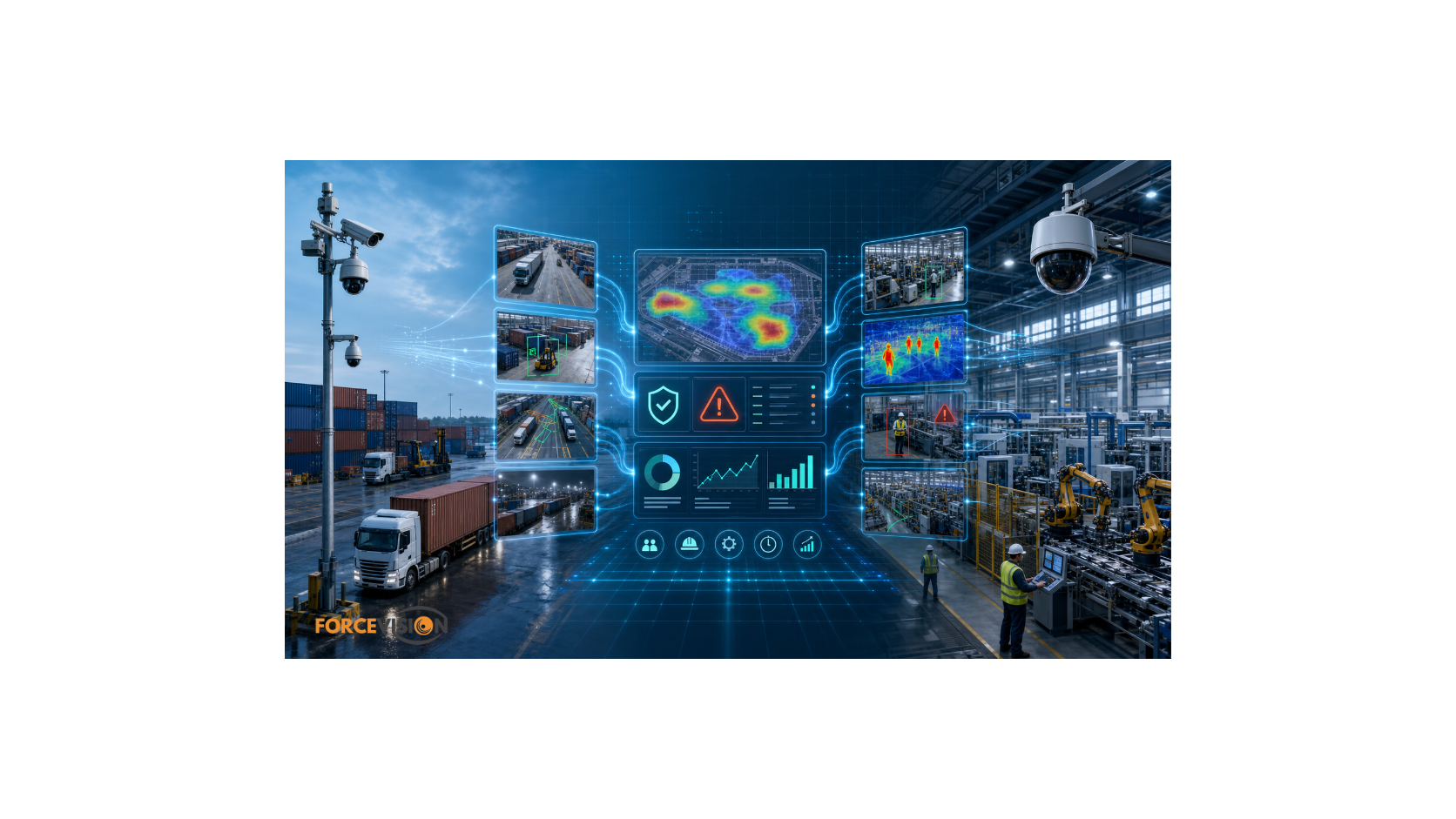
Large industrial operators across Southern Ontario—rail yards, manufacturing plants, energy facilities, and logistics hubs—have been investing in camera systems for years. Many already operate 32, 64, or even 128 cameras spread across yards, warehouses, and production lines. Yet for many operations teams, these systems still behave like silent recorders: footage is only reviewed when something goes wrong. The real opportunity lies in turning industrial CCTV into operational intelligence that delivers 10x value for asset protection, safety, HR, and continuous improvement.
The Industrial Asset Protection Blog Writing Guide used by ForceVision’s team emphasizes that large companies want more than “security.” They want visibility into who touches high‑value assets, where disruptions occur, and how teams actually interact with equipment and each other. That visibility, when structured properly, can reduce theft, cut downtime, support insurance claims, and even flag early signs of employee disengagement—such as recurring unsafe behaviours or process violations.
What does “operational intelligence” from CCTV really mean?
Operational intelligence means using video not just to see events, but to understand patterns. Instead of replaying footage after a forklift strikes a rack, you use data derived from that footage to identify that a particular aisle is consistently congested at certain times or that operators are repeatedly taking risky shortcuts.
In practical terms for Ontario industrial sites, industrial CCTV operational intelligence for Ontario looks like:
-
Heatmaps of people and vehicle flow, highlighting bottlenecks at doors, loading lanes, or track crossings
-
Trending analytics on near‑miss events, such as close passes between forklifts and pedestrians
-
Dashboards showing where and when unauthorized entries or dwell times spike in high‑value areas
These insights help plant managers and yard supervisors adjust layouts, staffing, and procedures to reduce risk and increase throughput.
How do 64‑camera systems enable this level of insight?
Scale matters. With 16 cameras, you can monitor a few entrances and a couple of critical zones. With 64 cameras and a properly designed NVR platform, you can see the entire site:
-
Rail operators can monitor ladder tracks, loading tracks, service roads, and crew walkways simultaneously.
-
Manufacturers can cover receiving, production lines, tool cribs, and finished goods warehouses with minimal blind spots.
-
Logistics hubs can oversee every dock door, yard lane, and trailer row across multiple acres.
The more comprehensive the coverage, the more complete your data set. Analytics engines can then correlate events across cameras, detecting trajectories, repeated behaviours, and cross‑zone patterns that would be invisible in isolated clips.
What role do AI and video analytics play in industrial environments?
Research into video analytics for rail and industrial networks has demonstrated how machine learning can detect unexpected events, trespassing, and unsafe behaviours in complex environments. For a factory, yard, or terminal, AI‑powered analytics can:
-
Detect people or vehicles entering restricted zones or crossing safety lines
-
Alert on loitering near high‑value assets, tank farms, or tool cribs
-
Count objects (pallets, vehicles) in defined zones to track congestion or staging issues
-
Recognize repeated instances of PPE non‑compliance in specific work areas
These capabilities turn industrial CCTV operational intelligence for Ontario into a continuous feedback loop. Operations, safety, and HR teams receive structured data alongside video clips, making it easier to prioritize corrective actions.
How does CCTV support employee retention and culture?
The ForceVision guide stresses that video should support workforce retention, not just discipline. In high‑risk environments, employees are more likely to stay when they feel the company takes their safety seriously and responds fairly when incidents occur. Camera systems contribute by:
-
Providing clear evidence when workers raise concerns about unsafe conditions or near‑misses
-
Helping supervisors coach individuals and teams using real examples rather than abstract rules
-
Reducing finger‑pointing after incidents by focusing on system issues (layout, workload, training) evident on video
When workers see camera‑derived insights leading to improved lighting, adjusted workflows, or better staffing, they understand that surveillance is being used to protect them and their livelihoods.
Where should Ontario operators start?
For large industrial operators considering the next step with their systems, a practical roadmap might include:
-
Audit existing coverage: Map current camera locations against high‑value assets, known bottlenecks, and safety hot spots.
-
Define operational questions: For example, “Where do we see the most near‑misses?” or “Why is this lane always congested at shift change?”
-
Upgrade platforms: Move to an NVR or video management system that supports analytics, tagging, and easy clip sharing across operations, safety, and HR.
-
Pilot analytics: Start in one or two zones (such as a busy yard entrance or high‑risk maintenance area), review results, and refine rules.
ForceVision works with industrial clients across the Golden Horseshoe to design and deploy 64‑camera and larger platforms with analytics tuned to their operations. If you’re unsure how to turn your existing camera network into an operational asset, ForceVision can provide a no‑pressure assessment focused on your business questions, not just hardware.
What outcomes should leaders expect over 12–24 months?
When industrial CCTV operational intelligence for Ontario is applied consistently, leaders typically see:
-
Reduced theft and shrinkage, as blind spots close and patterns of loss become visible
-
Fewer downtime incidents from collisions, blocked aisles, or mis‑staged materials
-
Stronger safety culture, with more proactive coaching and fewer repeat violations
-
Better insurance positioning, as operators can document improved controls and incident response
The technology is already here. The differentiator is whether you treat your cameras as passive witnesses or as active sensors feeding a continuous improvement engine.
FAQ
Q1: Do we need to replace all our cameras to get operational intelligence?
A1: Not necessarily. Many existing IP cameras can be integrated into modern analytics platforms, though some critical zones may benefit from higher resolution or better low‑light performance.
Q2: Which department should own operational video analytics?
A2: The most effective programs are cross‑functional, with security, operations, safety, and HR sharing ownership and reviewing insights together.
Q3: How much data storage is required for analytics?
A3: Storage needs vary, but most large sites target 30–90 days of retention, with the option to archive key clips long‑term for training or investigations.
Q4: Will staff need special training to use these systems?
A4: Yes, but modern platforms are increasingly user‑friendly. Short, focused training sessions can equip supervisors to search, tag, and interpret footage effectively.


