

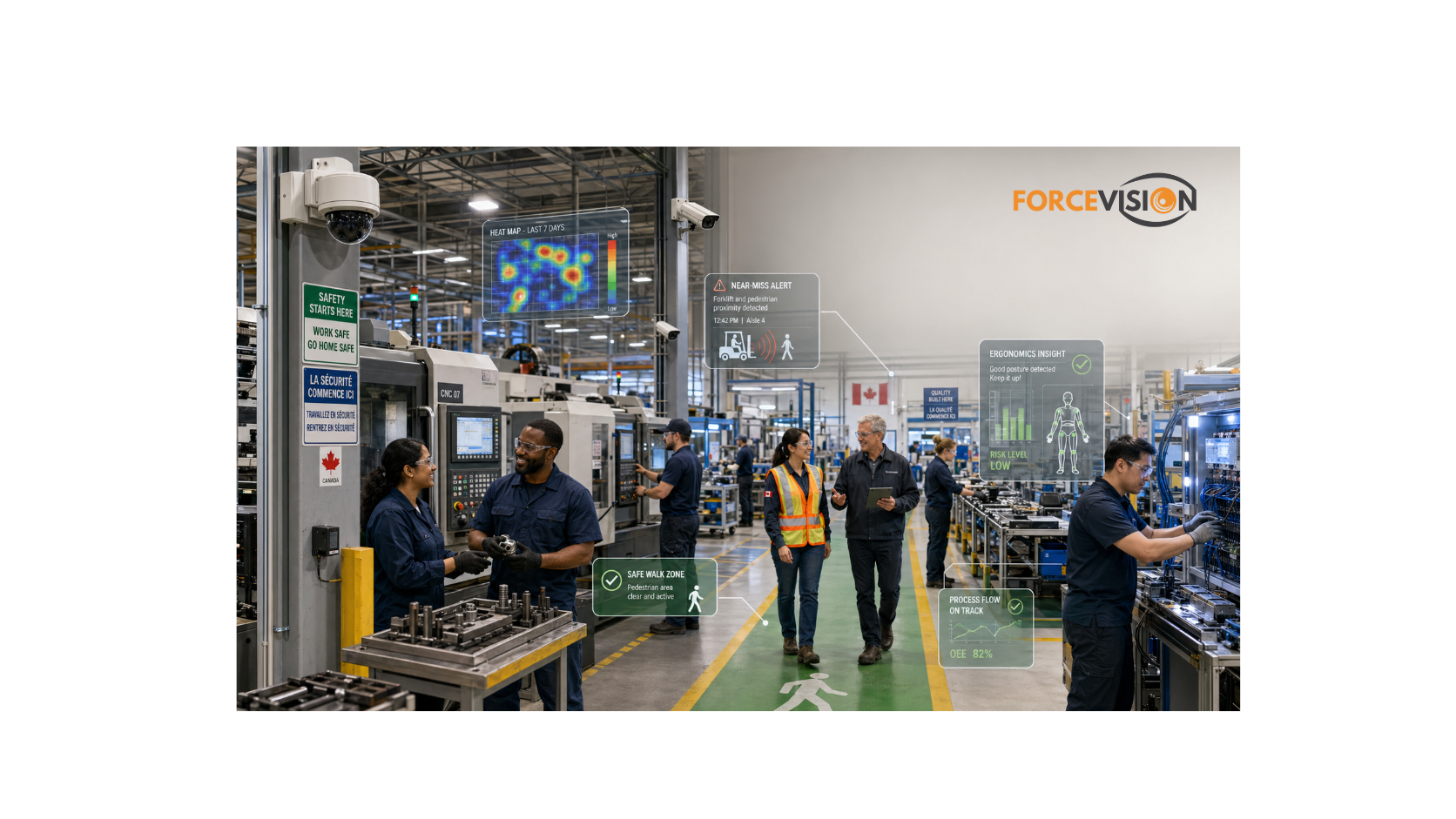
Across Ontario’s manufacturing belt—from Hamilton’s steel operations to automotive plants in Oshawa and engine facilities in the GTA—leaders are wrestling with a twin challenge: protecting high‑value assets while keeping skilled workers engaged and safe. While CCTV has traditionally been treated as a security expense, large industrial operators are starting to use 64‑camera and larger systems as a tool for workforce retention.
In an environment where one serious safety incident can derail careers, productivity, and morale, video isn’t just about catching wrongdoing. Properly designed, industrial CCTV helps supervisors spot unsafe behaviour patterns, coach teams, and demonstrate to employees that management is serious about sending people home safe at the end of every shift.
For plants with hundreds of workers spread across yards, loading areas, and production lines, that kind of visibility is increasingly essential for keeping experienced operators on the job.
Why link CCTV to retention in manufacturing?
Skilled trades and experienced machine operators are in short supply across Canada, and replacing them is expensive. Every time a veteran forklift driver or millwright leaves due to safety concerns or repeated conflicts, the plant pays twice: once in recruiting and training, and again in lost productivity and institutional knowledge.
Industrial CCTV can’t fix a broken culture on its own, but it gives supervisors and safety teams reliable, shared evidence of what’s happening in high‑risk zones. Instead of relying on conflicting accounts after a near‑miss or confrontation, teams can review footage, understand root causes, and agree on practical behaviour changes.
Crucially, this shifts video from being seen as a “gotcha” tool to a coaching instrument. When workers see that footage is used to improve processes, redesign traffic routes, and justify better guarding or lighting—not just to discipline—they are more likely to stay.
How should plants design 64‑camera systems for people as well as assets?
Most Ontario manufacturing facilities already cover obvious locations such as main gates and a few entrances. A 64‑camera industrial CCTV system goes further, mapping coverage to where people and assets interact most intensely.
Priority zones often include:
-
Loading docks and yard traffic lanes: Where forklifts, trailers, and pedestrians mix, and where many serious incidents occur.
-
Staging areas and material flow corridors: To see congestion, shortcuts, and unsafe workarounds that emerge over time.
-
High‑risk equipment cells: Presses, stamping lines, and robotic cells where lockout/tagout and guarding behaviour matters.
-
Contractor and visitor routes: Ensuring unfamiliar personnel are guided and monitored through the site safely.
By combining wide‑angle views with targeted PTZ cameras, plants can zoom into specific events when needed while still capturing overall context. That context is vital when assessing whether an incident was an isolated lapse or a systemic issue with layout, signage, or scheduling.
How can video analytics improve safety coaching?
Recent advances in video analytics make it possible to detect certain unsafe patterns automatically—without requiring someone to watch every camera feed in real time. For example, analytics can flag:
-
People entering restricted zones or crossing digital “trip lines” near mobile equipment.
-
Vehicles or pedestrians moving the wrong way through one‑way aisles.
-
Congestion in aisles that should remain clear for emergency egress.
In some cases, these alerts can be tied to audible warnings or messages at the point of risk, giving workers a real‑time nudge to correct behaviour. Over time, safety and HR teams can pull clips of recurring issues for toolbox talks and targeted training.
Used thoughtfully, this transforms CCTV into a continuous improvement engine. Instead of waiting for reportable injuries, plants act on early warning signs, which is exactly the type of proactive safety culture that keeps experienced workers on board.
How does video support fair investigations and conflict resolution?
Disputes over blame—after a collision, damage event, or interpersonal conflict—are a major source of frustration and turnover. Without clear evidence, decisions can feel arbitrary, and both supervisors and front‑line staff are left unsatisfied.
With a 64‑camera industrial CCTV system, Ontario manufacturers can anchor investigations in objective footage. This supports fairer outcomes when:
-
An equipment incident occurs and multiple operators were in the area.
-
A worker raises concerns about harassment or repeated unsafe behaviour by a colleague.
-
Disciplinary action is contemplated and must be backed by specific examples.
When employees see that management relies on video evidence—not hearsay—to make decisions, trust improves. For HR, this also provides defensible documentation in the event of grievances or legal disputes. The result is a more stable, predictable environment that skilled workers are less likely to leave.
How should plants communicate about CCTV to support retention?
How management talks about CCTV makes a huge difference. If cameras are presented purely as a way to “catch rule breakers,” workers will view them as surveillance, not support.
A more effective approach is to be transparent and explicit about objectives:
-
Emphasize that footage is used to improve layouts, procedures, and training.
-
Share examples where video led to safer forklift routes, better lighting, or adjustments to shift patterns.
-
Involve joint health and safety committees in setting policies for footage access and use.
This kind of communication signals respect. It reframes CCTV as part of the plant’s safety infrastructure—like guarding and PPE—rather than a one‑way watchtower. That framing matters when you’re asking people to build careers in high‑risk industrial environments.
Where does ForceVision fit for Ontario manufacturers?
Every plant’s risk profile is different. A large Hamilton steel operation doesn’t look like a precision parts manufacturer in Waterloo or a packaging plant in Brantford, even if all three need 64‑camera coverage.
If you’re considering how industrial CCTV could support both asset protection and skilled worker retention at your plant, ForceVision can walk you through options with a no‑pressure assessment. We help large manufacturing and warehousing sites across Southern Ontario design camera layouts, analytics rules, and retention policies tuned to their operations, safety goals, and workforce culture.
A useful starting point is to pick one recurring safety concern—near‑miss forklift collisions, for example—and ask: do we have the footage we would need to understand why this keeps happening? If not, that’s where a more deliberate, industrial‑grade CCTV design can start to pay off for both your balance sheet and your people.
FAQ
Q1: Won’t more cameras make workers feel like they’re constantly being watched?
It depends on how CCTV is introduced and used. When plants focus on coaching, layout improvements, and transparent policies, workers increasingly see video as a safety tool rather than a disciplinary weapon.
Q2: How can CCTV help reduce lost‑time injuries?
By giving safety teams clear evidence of near‑misses and unsafe patterns, CCTV helps target training and engineering controls before someone is seriously hurt, which reduces the odds of lost‑time incidents over the long term.
Q3: Who should have access to industrial CCTV footage?
Access should be governed by clear policies. Typically, security, safety, and HR leaders have defined roles, with strict controls and audit trails for how footage is requested, used, and stored.
Q4: Is 64 cameras always enough for a large plant?
For many plants, 64 cameras are a strong baseline, but very large, multi‑building sites may need more to cover yards, loading areas, and production lines adequately. A professional assessment helps right‑size the system.


