

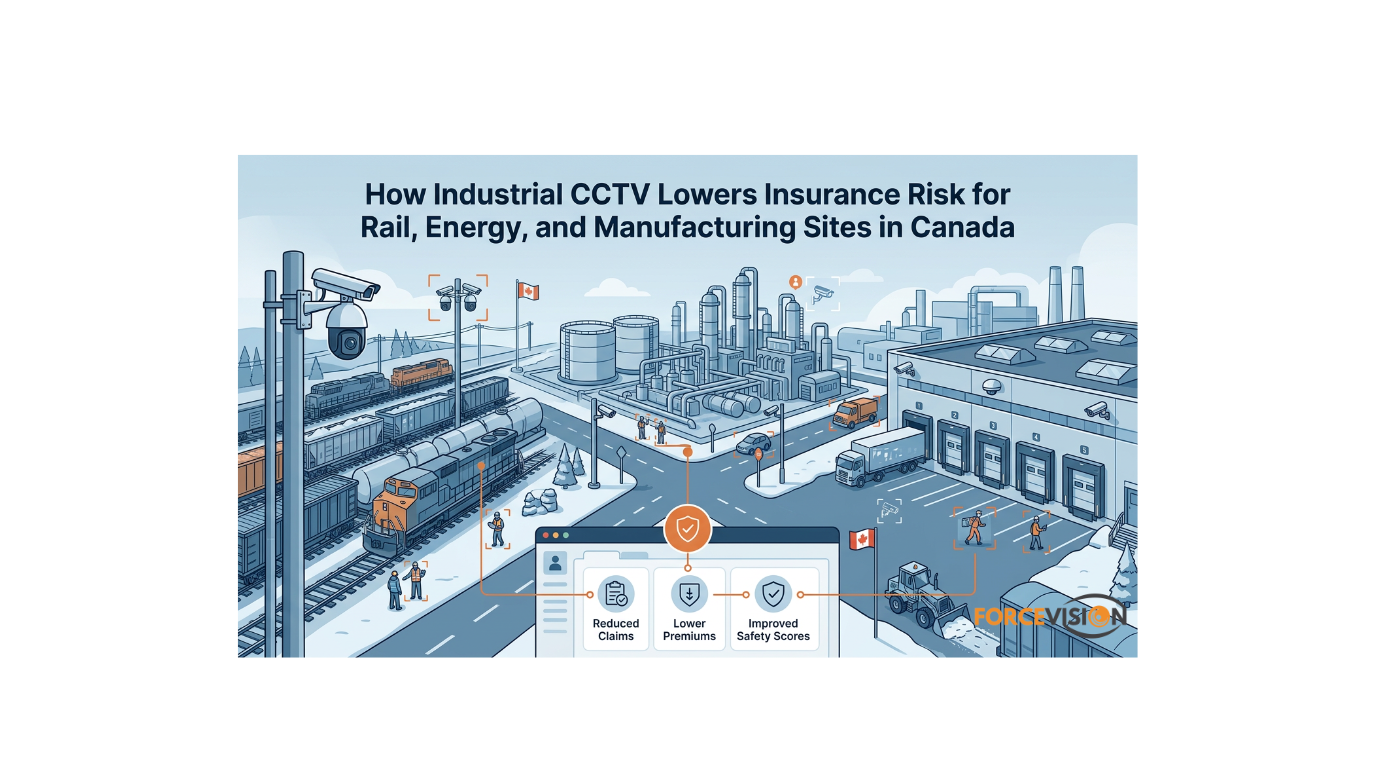
For large rail, energy, and manufacturing operators in Canada, insurance is not just a line item—it is a strategic relationship shaped by risk profile, loss history, and the strength of controls on the ground. As claims grow more complex and severe, insurers are scrutinising how companies protect high‑value assets, manage safety, and document incidents. One tool keeps rising to the top of their checklists: industrial‑grade CCTV.
Unlike small retail systems, industrial CCTV to lower insurance risk for Canadian rail and energy sites must provide yard‑wide, site‑wide visibility across tracks, plants, and terminals. Done right, these systems help prevent losses, accelerate claims, and demonstrate a culture of control that underwriters reward.
How does CCTV influence insurers’ view of industrial risk?
Insurers look at both frequency and severity of potential losses—fires, spills, collisions, theft, and injuries. Industrial CCTV affects this assessment in three ways:
-
Prevention: Cameras and related analytics discourage opportunistic theft, detect unsafe behaviours, and help identify hazards before they lead to claims.
-
Detection and response: Real‑time visibility helps operators respond faster to incidents such as intrusions, equipment failures, or developing fires.
-
Documentation: High‑quality footage provides objective evidence of what happened, supporting fair, efficient claims handling.
When underwriters see a modern, well‑managed CCTV platform, they see an organisation investing in control and transparency—two qualities that reduce uncertainty in their models.
What features matter most to insurers?
From an insurance perspective, certain CCTV characteristics stand out:
-
Coverage of high‑value assets (locomotives, transformers, tank farms, high‑value stock) and critical interfaces (gates, docks, transfer points).
-
Sufficient resolution and lighting to clearly identify events, people, and equipment.
-
Retention policies that ensure footage is available long enough for claims and investigations.
-
Evidence of regular testing, maintenance, and a clear process for retrieving and sharing footage.
In sectors like energy and rail, where incidents can involve regulators as well as insurers, the ability to provide detailed video timelines is increasingly seen as a sign of a mature risk‑management culture.
How can CCTV reduce the likelihood and severity of claims?
Beyond deterrence, industrial CCTV enables proactive risk control:
-
Yard supervisors can monitor for unsafe vehicle movements, blocked emergency routes, or unauthorised work in hazardous areas.
-
Maintenance teams can review footage to understand equipment failures and prevent recurrences.
-
Safety teams can analyse near‑misses, not just recorded injuries, and adjust procedures accordingly.
Each prevented collision, fire, or theft is a claim that never materialises—and over time, a cleaner loss record gives brokers more leverage in negotiations.
How does CCTV support contested liability and subrogation?
When something does go wrong—a collision in a yard, a contractor injury, or a major theft—industrial CCTV often becomes the deciding factor in who bears cost. Clear footage can:
-
Show compliance with lockout/tagout, confined space, or hot‑work procedures prior to an incident.
-
Confirm whether trespassers ignored signage and barriers, supporting defence against certain claims.
-
Document the precise sequence of a multi‑vehicle collision, supporting recovery from at‑fault parties.
In cargo and property cases, insurers increasingly expect their clients to provide this level of evidence, especially for high‑value claims. Operators that cannot do so may face slower settlements or higher deductibles as carriers account for added uncertainty.
How should industrial operators present CCTV capabilities to insurers?
Rather than waiting for the next renewal questionnaire, proactive operators prepare a concise CCTV and security overview for underwriters and brokers, highlighting:
-
System scope (camera counts, key coverage areas, retention).
-
Integration with access control, alarms, and operational systems.
-
Governance (policies, roles, regular audits, and training).
This framing positions CCTV as part of a broader risk‑management strategy that also includes safety programs, maintenance, and emergency response—exactly the narrative insurers want to see.
How can ForceVision align CCTV design with insurance goals?
ForceVision designs 64‑camera and larger CCTV systems with asset protection, safety, and insurance audiences in mind. For rail yards, energy plants, and manufacturing campuses, we prioritise coverage that matters most to loss‑prevention teams and underwriters: high‑value assets, hazardous operations, and critical access points.
If you are preparing for renewal discussions or responding to insurer recommendations, we can help you assess whether your current system meets expectations and where targeted upgrades would deliver the greatest risk‑reduction impact. Our assessments are collaborative and low‑pressure, focused on making sure your CCTV tells a strong risk story when it matters.
What can risk and safety leaders do before the next renewal?
In the months leading up to renewal, risk and safety leaders can:
-
Review recent claims and near‑misses and check whether video contributed to root‑cause analysis.
-
Identify incidents where footage would have helped but was missing or inadequate.
-
Prioritise one or two high‑impact CCTV improvements—such as adding coverage over a tank farm, busy yard crossing, or high‑value warehouse zone.
By showing carriers that you have a clear CCTV improvement plan tied to loss drivers, you strengthen your negotiating position and signal that industrial CCTV is an active part of your risk‑management strategy, not a static legacy system.
FAQ
Q1: Do insurers offer premium discounts for CCTV?
A: Discounts vary, but many carriers factor robust CCTV into their overall assessment, which can influence premiums, deductibles, and capacity over time.
Q2: How long should footage be kept for insurance purposes?
A: Retention depends on your loss experience and sector, but many large operators choose 45–90 days, with options for longer retention in high‑risk areas or after notifiable incidents.
Q3: Is basic retail‑grade CCTV enough for industrial insurers?
A: In most cases, no; insurers expect camera coverage, resolution, and retention that match the scale and complexity of rail, energy, and manufacturing operations.
Q4: Should brokers be involved in CCTV upgrade discussions?
A: Yes, involving brokers early helps ensure upgrades address the risk concerns and controls that matter most to your insurers.


