

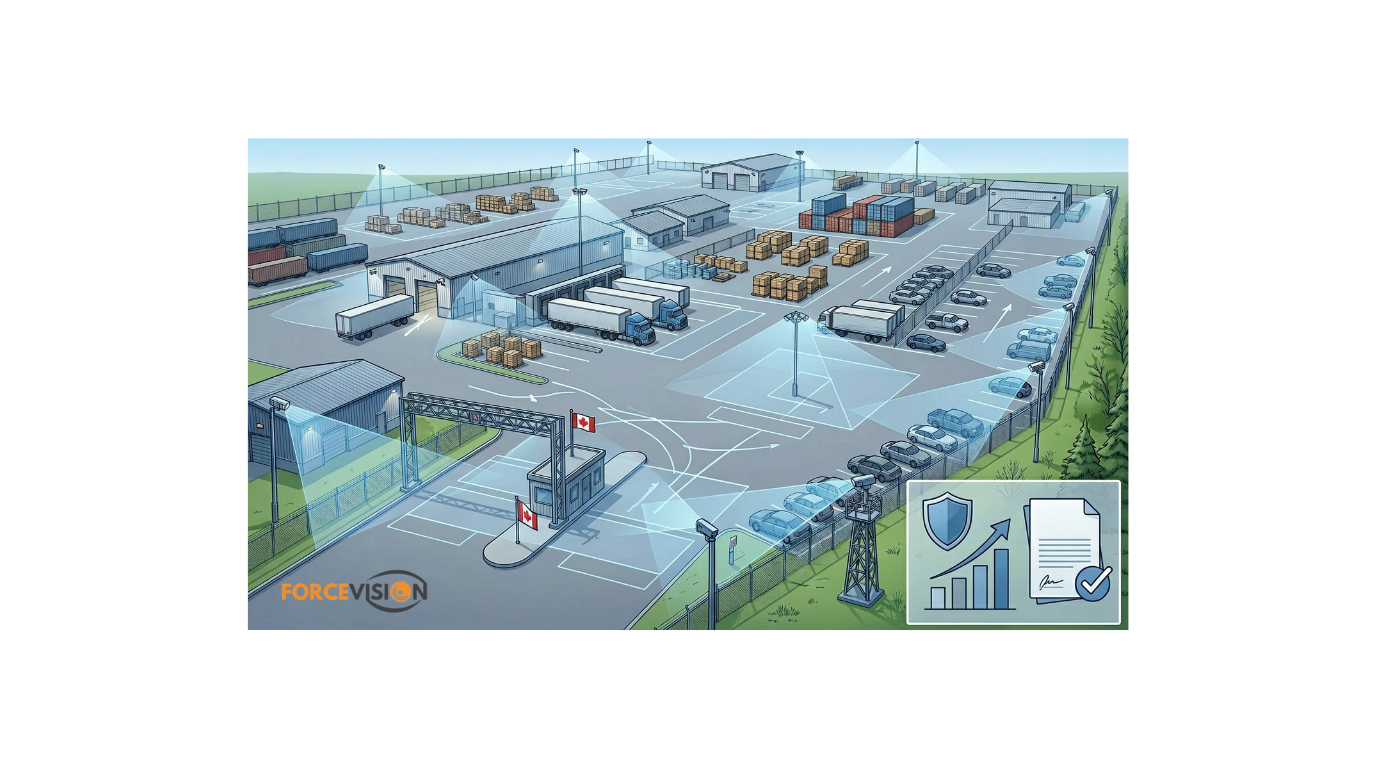
For large industrial operators in Ontario—rail yards, manufacturing plants, logistics hubs, and energy facilities—insurance is one of the biggest ongoing costs of doing business. Premiums reflect not just past claims but how insurers perceive your future risk. That is where industrial CCTV for insurance and risk management in Ontario has become a strategic tool, not merely a security accessory.
Insurers want visibility into how you manage people, property, and processes. Robust surveillance, paired with clear procedures and analytics, gives you that visibility—while simultaneously giving underwriters confidence that you are serious about risk.
How does CCTV change the claims conversation?
When a major incident occurs—fire, theft, injury, or equipment damage—insurers need to reconstruct what happened. Without quality footage, that reconstruction relies on statements, partial logs, and assumptions.
In contrast, industrial CCTV for insurance and risk management in Ontario sites can:
-
Provide time‑stamped visual evidence of the event sequence
-
Show whether safety procedures and PPE requirements were followed
-
Confirm whether access control policies were enforced
-
Document the extent of damage before remediation begins
This type of evidence can drastically reduce disputes over what occurred, speeding up claims settlement and reducing the risk of litigation. It also protects your organisation against unjust accusations of negligence when staff did the right thing in a difficult situation.
What do insurers look for in surveillance systems?
Not all CCTV systems are equal in the eyes of insurers. Underwriters and risk engineers increasingly ask about:
-
Coverage completeness: Are high‑value and high‑risk areas fully covered, or are there obvious blind spots?
-
Image quality: Is footage clear enough to identify people, actions, and key details like license plates or equipment IDs?
-
Retention periods: Can you go back far enough to review slow‑developing issues, repeated near‑misses, or disputed incidents?
-
Access controls: Who can view, export, or delete footage—and how is this logged?
-
Integration: Is CCTV linked to alarms, access control, or operational systems so that events are correlated?
Operators who can demonstrate strong answers often find they are better positioned in insurance discussions. While CCTV alone does not guarantee lower premiums, it is a powerful component of a broader risk‑management story.
How does CCTV help in cargo theft and property crime claims?
As cargo theft and organized property crime become more sophisticated, insurers are acutely aware of the rising loss trend. For logistics and warehousing sites, industrial CCTV for insurance and risk management in Ontario is essential to:
-
Prove that perimeter defences were intact prior to a theft
-
Show how thieves gained access—through force, deception, or insider involvement
-
Verify the timing of events relative to guard rounds or remote monitoring interventions
-
Cross‑check telematics and access logs with visual evidence
Recent cargo theft analysis emphasises the value of video telematics and smart sensors that trigger cameras when doors open or when motion is detected at unusual times. Such systems help produce a coherent narrative of events for insurers, strengthening your credibility and supporting subrogation efforts if third parties are involved.
What about worker injury and liability claims?
Injury claims can be complex, especially when contractors or visitors are involved. CCTV supports fair, fact‑based outcomes by showing:
-
Whether walkways and work areas were kept clear
-
If safety signage and barriers were in place and visible
-
How both the injured party and coworkers behaved before the incident
-
Whether the incident stemmed from individual behaviour, process design, or equipment failure
From a culture perspective, this is not about catching people out. It is about understanding true root causes so that corrective actions address the right factors and prevent repeats.
How can ForceVision support insurance‑aligned CCTV design?
ForceVision helps industrial operators across Southern Ontario design systems that deliver value at claim time as well as day‑to‑day. A typical insurance‑aligned design process includes:
-
Reviewing past incidents and claim types with your risk or HSE team
-
Mapping cameras to your highest‑severity and highest‑frequency risks
-
Ensuring key incidents would be clearly captured from at least two angles
-
Setting retention periods that align with regulatory, contractual, and insurance expectations
If you are preparing for renewal or a risk survey, ForceVision can support a no‑pressure review of your existing system and highlight practical upgrades that will resonate with insurers, such as improving coverage in areas with high claim frequency or extending retention for critical cameras.
What should Ontario operators do before their next renewal?
Ahead of your next insurance renewal, consider a short internal audit focused on industrial CCTV for insurance and risk management in Ontario:
-
Pull footage from your last three significant incidents—how clear is the story?
-
Confirm your actual retention period on all NVRs versus what is written in policies.
-
Identify any high‑value zones or injury‑prone areas without strong coverage.
-
Document your CCTV policies on access, privacy, and footage handling.
Having these answers ready turns an insurance questionnaire from a burden into an opportunity to showcase the maturity of your risk controls.
FAQ
Q1: Will better CCTV automatically lower our premiums?
Not automatically, but strong CCTV is a significant positive factor in the overall risk profile insurers consider, especially when combined with documented procedures and analytics.
Q2: How long should we retain footage for insurance purposes?
Many industrial operators aim for 30–90 days, with extended retention for cameras covering critical risks, subject to storage capacity and privacy laws.
Q3: Do insurers care if we use analytics?
Yes. Analytics that reduce false alarms, detect risks earlier, and improve incident response demonstrate a mature security posture, which can be persuasive in risk discussions.
Q4: How do we share footage securely with adjusters?
Best practice is to export only relevant clips, watermark them if possible, and share via secure channels with clear documentation of time‑stamps and camera views.


