

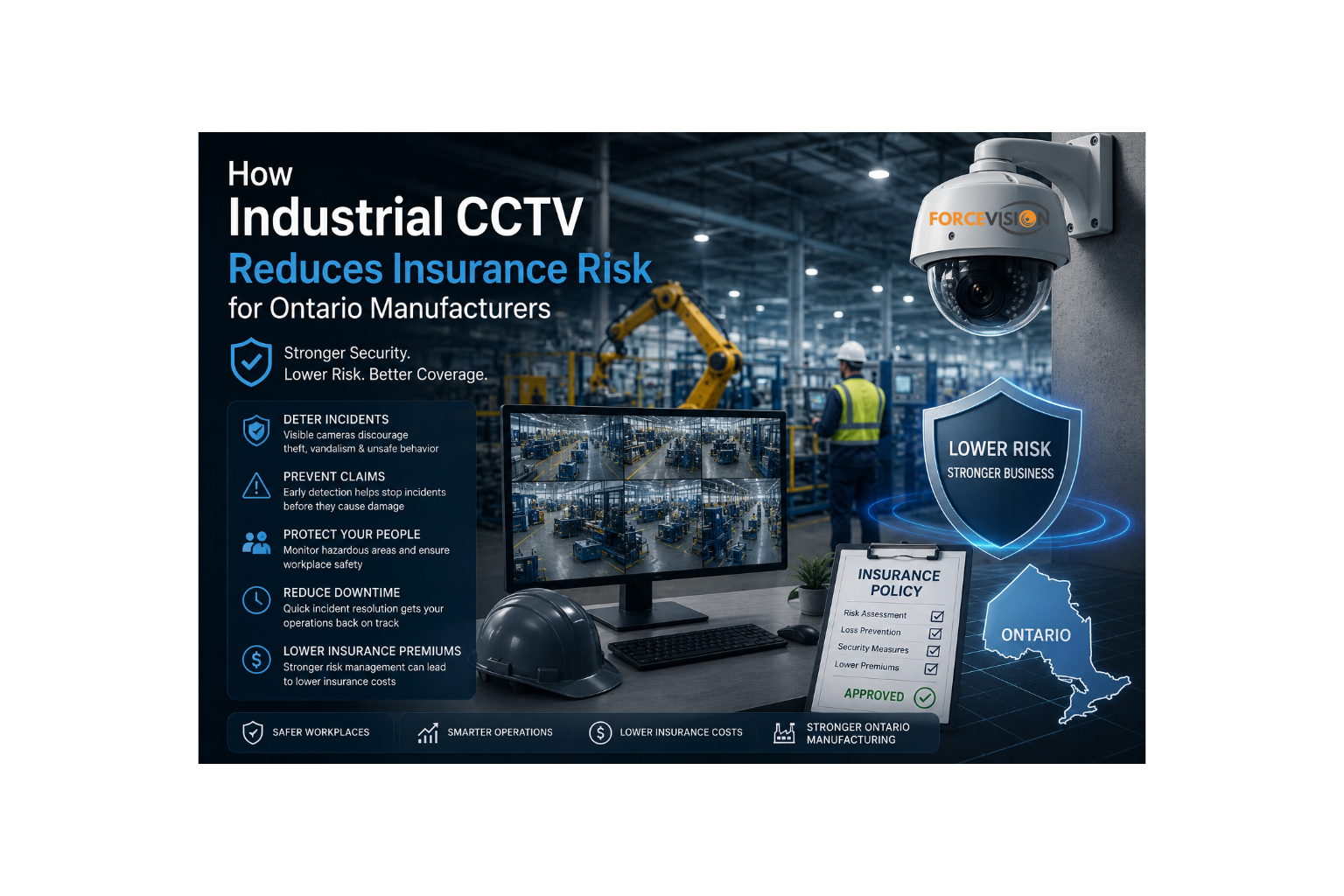
Insurance carriers in Canada are tightening underwriting standards for large industrial operators, driven by rising claims costs, increased cargo and equipment theft, and a growing number of workplace safety incidents. For manufacturers, rail operators, logistics hubs, and energy facilities across Southern Ontario, this means higher premiums, stricter policy terms, and greater scrutiny during claims processing. However, facilities that can demonstrate proactive risk management—through comprehensive CCTV coverage, documented safety protocols, and real-time incident response—are positioned to secure better rates, reduce liability exposure, and streamline claims settlements.
Cargo theft losses across Canada and the United States surged to nearly $725 million in 2025, up 60 percent from 2024, with the average theft value climbing to $273,990. Equipment theft rings recovered by Alberta RCMP in early 2026 involved over one million dollars in stolen machinery. For insurance carriers evaluating risk, these trends translate directly into loss models and premium calculations. Facilities without robust surveillance and asset-protection protocols are flagged as high-risk, while those with 64-camera or larger IP camera systems, video analytics, and documented monitoring practices receive preferential underwriting treatment.
How CCTV Systems Lower Premiums and Support Claims
Insurance carriers reward facilities that actively manage risk because proactive measures reduce both the frequency and severity of claims. A comprehensive CCTV platform demonstrates that a facility monitors perimeter security, tracks asset movements, enforces safety protocols, and maintains documentation for incident reconstruction. During the underwriting process, carriers review these capabilities as part of their risk assessment, often translating documented surveillance into premium discounts or better policy terms.
When a claim does occur—whether theft, property damage, workplace injury, or liability dispute—video footage provides objective evidence that clarifies what happened, who was involved, and whether the facility followed required protocols. This documentation accelerates claims processing, reduces disputes over liability, and protects the facility from fraudulent or exaggerated claims. In cases involving third-party contractors, delivery drivers, or visitors, video evidence can establish fault and prevent costly settlements.
Supporting Safety Audits and Regulatory Compliance
Large industrial operators in Ontario face strict safety and environmental regulations, including requirements from the Ministry of Labour, Transport Canada, and industry-specific oversight bodies. Comprehensive video documentation supports compliance audits by providing evidence that the facility monitors hazardous zones, enforces procedural requirements, and responds to safety violations in real time.
Insurance carriers increasingly expect facilities to maintain this level of documentation, recognizing that regulatory compliance and proactive safety management correlate with lower workers’ compensation claims, reduced liability exposure, and fewer catastrophic incidents. Facilities that can produce timestamped footage demonstrating lockout-tagout compliance, restricted-zone enforcement, or proper equipment operation during an audit or investigation strengthen their position with both regulators and insurers.
Reducing Liability in Workforce-Related Incidents
Workplace injuries, disputes over wrongful termination, and allegations of unsafe working conditions represent significant liability risks for large industrial operators. Video evidence provides clarity in these situations, protecting the facility from unfounded claims while ensuring that legitimate safety concerns are addressed through objective data. If an employee alleges that a supervisor ignored a safety violation, footage can confirm or refute the claim. If a contractor disputes the circumstances of an incident, video provides an unbiased record.
This transparency supports workforce retention by demonstrating that management takes safety seriously and enforces rules consistently. It also reduces the cost and disruption of legal disputes, as objective evidence often leads to faster resolutions and lower settlement amounts.
A Strategic Risk-Management Investment
If you’re wondering what the right surveillance system might look like for your plant, yard, or terminal, ForceVision can walk you through options with a no-pressure assessment. We’ve worked with large industrial operators across Southern Ontario to design camera systems that meet insurance carrier expectations, support regulatory compliance, and deliver the documentation needed for effective risk management.
Insurance premiums, claims outcomes, and liability exposure are all directly influenced by how well a facility manages and documents risk. Review your current CCTV coverage, ask whether it meets carrier expectations for comprehensive monitoring, and start a conversation with your risk-management and operations teams about what a properly designed platform would deliver for your facility.
FAQ SECTION
Q: How do insurance carriers evaluate CCTV systems during underwriting?
A: Carriers assess coverage scope, camera resolution, retention periods, analytics capabilities, and whether the facility has documented monitoring and incident-response protocols.
Q: Can comprehensive CCTV reduce workers’ compensation claims?
A: Yes. Video documentation of safety violations, near-misses, and incident circumstances helps clarify fault, supports proactive coaching, and reduces fraudulent or exaggerated claims.
Q: What role does video evidence play in third-party liability disputes?
A: Footage provides an objective record of contractor activity, delivery operations, or visitor behaviour, helping establish fault and protect the facility from costly settlements.
Q: How does CCTV support regulatory compliance audits?
A: Timestamped video demonstrates that the facility monitors hazardous zones, enforces safety protocols, and responds to violations—evidence that supports compliance with Ministry of Labour and Transport Canada requirements.


