

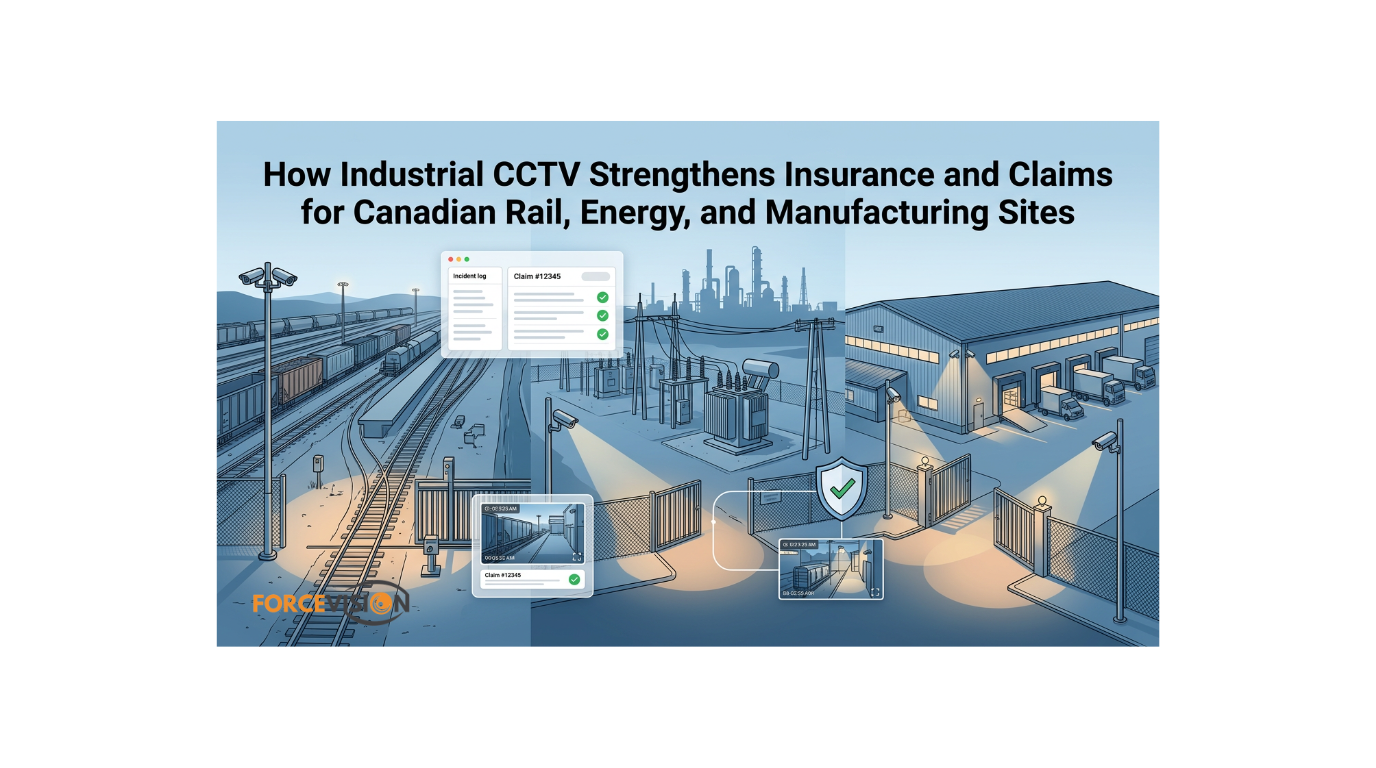
Insurance conversations have become tougher for large industrial operators across Canada. Railroads, energy producers, and major manufacturers face rising premiums, higher deductibles, and more probing questions about how they manage theft, accidents, and operational disruptions. In this context, industrial CCTV for insurance risk in Canadian heavy industry has moved from supporting evidence to central risk‑control measure.
Cargo and asset theft trends show significant increases in incidents, with Ontario in particular experiencing a notable spike. At the same time, regulators and customers expect stronger safety performance and more resilient operations. For CN‑scale rail yards, Suncor‑type energy sites, and Magna‑style plants, 64‑camera and larger CCTV systems now play a critical role in both preventing losses and proving that reasonable precautions were taken when something does go wrong.
How insurers view CCTV at large industrial sites
Insurance and risk advisory reports emphasise the importance of understanding supply chain vulnerabilities, mapping exposures, and implementing layered controls to counter strategic cargo theft and other emerging risks. For underwriters evaluating large industrial accounts, robust CCTV is one of the clearest signals that a client takes asset protection and safety seriously.
In practice, insurers want to know:
-
Whether cameras cover all critical perimeters, access points, and high‑value asset zones.
-
How long footage is retained and how quickly it can be retrieved.
-
Whether CCTV integrates with other controls, such as access control and telematics.
Industrial CCTV for insurance risk in Canadian heavy industry answers these questions by demonstrating that a site can not only deter events but also document them comprehensively.
Using CCTV to prevent losses before claims happen
While insurance often focuses on what happens after an incident, CCTV’s greatest value lies in preventing losses from occurring. Research on IoT‑based anti‑theft and surveillance systems highlights how real‑time sensing and alerts can stop theft as it unfolds or deter attempts altogether. For large industrial sites, that translates into:
-
Detecting unauthorized access to yards, tank farms, or high‑value storage.
-
Identifying suspicious behaviour near remote assets, such as pump stations or isolated sidings.
-
Monitoring for unsafe practices that could lead to injuries, fires, or environmental incidents.
By tying camera alerts to response protocols—such as dispatching supervisors, locking down gates, or notifying law enforcement—operators can turn potential claims into near‑misses. Over time, this proactive posture is exactly what risk professionals and insurers want to see.
How CCTV evidence streamlines and strengthens claims
Despite best efforts, incidents still occur. When they do, industrial CCTV for insurance risk in Canadian heavy industry provides objective, time‑stamped evidence of what happened. For cargo theft or yard break‑ins, footage shows how offenders entered, which assets were touched, and what security measures were in place. For workplace injuries, video may clarify whether PPE was used, whether procedures were followed, and whether environmental factors contributed.
Cargo theft guides recommend building a comprehensive record of events and control measures to support claims and negotiations. CCTV footage complements inventory records, telematics logs, and incident reports, making it easier to:
-
Establish timelines and narrow down windows of exposure.
-
Confirm or refute witness statements.
-
Demonstrate compliance with safety and security protocols.
For large claims, especially those involving business interruption or environmental impacts, this clarity can significantly shorten the time between loss and settlement.
Aligning 64‑camera CCTV systems with insurance expectations
To deliver maximum value, CCTV design should be aligned with the specific concerns of insurers and risk analysts. Industrial CCTV for insurance risk in Canadian heavy industry should prioritise:
-
Full coverage of perimeters, gates, loading areas, and high‑value asset zones.
-
Sufficient resolution to support identification and detailed incident review.
-
Reliable, redundant recording with retention periods that match contractual and regulatory requirements.
For rail and energy infrastructure, research into rail security and critical infrastructure protection underscores the need for continuous, high‑quality surveillance over extensive assets. 64‑camera systems provide the channel count needed to do this without sacrificing detail. When combined with video analytics, they can also generate records of near‑misses and safety interventions that demonstrate a strong risk‑management culture.
If your organization is heading into renewal discussions or facing higher deductibles, ForceVision can help you review your current CCTV posture through an insurance lens. ForceVision works with rail, energy, and manufacturing clients to align camera coverage, retention, and integration with what underwriters and risk engineers look for.
A productive next step is to conduct a joint review involving your security, operations, safety, and risk teams. Map recent losses and near‑misses, compare them against your current camera coverage, and identify where enhanced CCTV would make the biggest difference—not only in preventing incidents but in telling your story clearly if one occurs.
FAQ
Q1. Can better CCTV actually reduce our insurance premiums?
While results vary, demonstrating robust CCTV coverage, retention, and integration with other controls can support more favourable terms and reduce friction at renewal.
Q2. How long should industrial sites retain CCTV footage for insurance purposes?
Retention needs vary by industry and risk profile, but many large rail, energy, and manufacturing sites aim for at least 30–90 days, with longer retention in critical areas.
Q3. Do insurers prefer certain camera types or resolutions?
Insurers primarily care that footage is clear enough to support investigations and that critical zones are well covered; this typically implies modern IP cameras with adequate resolution and lighting.
Q4. How can we prove to insurers that we use CCTV proactively, not just for investigations?
Document how CCTV supports safety audits, near‑miss reviews, and operational improvements, and share anonymised examples of incidents that were prevented or mitigated thanks to camera insights.


