

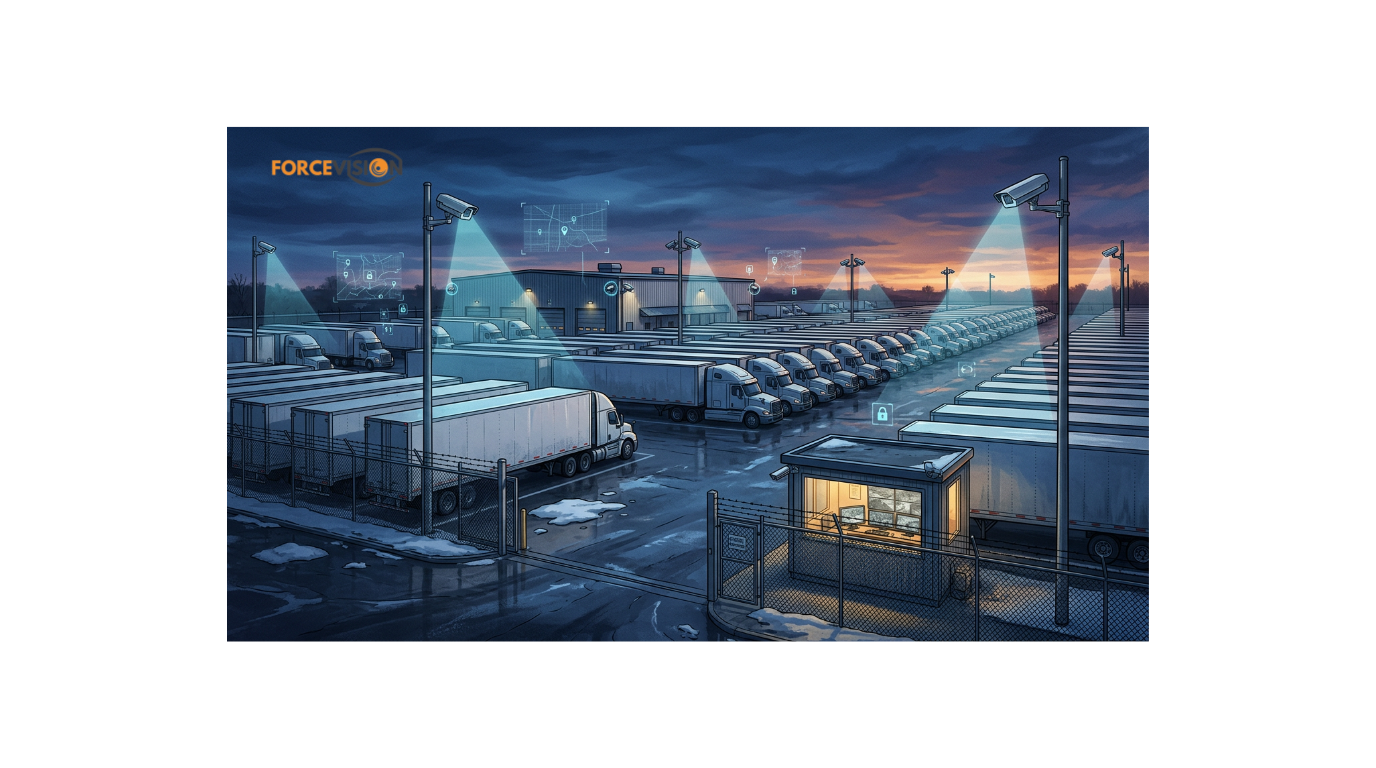
Cargo theft in North America is no longer a niche problem—it is a multi‑billion‑dollar drain on fleets, shippers, and insurers, and Canada is squarely in the crosshairs. Recent analysis suggests cargo theft losses reached an estimated 6.6 billion dollars in 2025, driven by increasingly sophisticated criminal networks. The Canadian Truck Operators Association (CTOA) has responded by planning a national freight security initiative to address a sharp rise in cargo, trailer, and equipment theft across the country.
At the same time, a new “2026 Blueprint” report warns that theft has entered the cyber era, with criminals exploiting digital blind spots, GPS spoofing, and AI‑powered fraud to remove cargo without force—often before a fleet even realizes a loss has occurred. For truck yards and logistics hubs across Southern Ontario—from Mississauga and Brampton to Kitchener and Hamilton—these trends raise a blunt question: is your yard surveillance keeping pace?
Why are Canadian truck yards being targeted?
Cargo theft follows opportunity, and Ontario offers plenty of it. High‑value loads, dense logistics clusters, and major highways converge around the GTA and Golden Horseshoe. As freight volumes have climbed, so have the number of dispersed yards, trailer drop lots, and temporary storage sites.
Several factors make these environments attractive to organized crime:
-
Large outdoor footprints with multiple gates and fence lines
-
Mixed use of owned, leased, and overflow yards
-
High trailer turnover, especially on weekends and holidays
-
Heavy reliance on third‑party drivers and contractors
-
Legacy surveillance systems focused on perimeters but blind to key operational zones
The 2026 Blueprint report notes that criminal groups increasingly use social engineering and digital manipulation—such as spoofed dispatch instructions and fake pickup orders—to gain lawful‑looking access to freight. If your yard’s security rests on “the guard might notice something odd,” you are playing a game you will eventually lose.
How should CCTV evolve for modern cargo threats?
Traditional yard cameras were often installed to tick an insurance box or to quickly resolve “who hit the gate post” incidents. That is no longer enough. CCTV for Ontario truck yards and logistics hubs needs to be designed around organized, often tech‑enabled theft, with a few key principles:
-
Comprehensive coverage of entry, exit, and choke points: Every gate, guardhouse, and weigh scale needs multiple angles, including license plate recognition where feasible.
-
Clear views of trailer identifiers: Cameras must capture trailer numbers and company markings as units enter, park, and leave.
-
Monitoring of key process steps: Areas where trailers are assigned, sealed, and handed off should have high‑resolution coverage.
-
Integration with telematics and yard management data: The goal is to know whether what your cameras see matches what your systems expect.
A 64‑camera or larger IP system, tied into an NVR security platform, becomes the nervous system for the yard. Fixed bullets and domes handle lane‑based coverage, while PTZ cameras oversee wide lots, outer perimeters, and blind corners behind buildings or stacked trailers.
What role do analytics and telematics play?
The Geotab report emphasizes that fleets best positioned against today’s threats are those that have made real‑time visibility part of everyday operations—not just something they check after a theft. For Ontario truck yards, that means combining CCTV with video telematics, smart locks, and operational analytics.
Some practical use cases:
-
Door‑open triggers for cameras: Cameras record high‑quality clips whenever a trailer door opens or a container is unsealed in the yard.
-
Route and yard‑stay anomalies: When telematics flag an unusual stop or long dwell time, the NVR auto‑pulls associated camera views for quick review.
-
Smart lock and seal integration: Electronic seals that send tamper alerts can simultaneously bookmark camera timelines, making investigations faster.
-
Virtual perimeters inside the yard: Video analytics can create “no‑go” zones for unauthorized movement near high‑value lanes or storage rows.
This is not about replacing people; it is about giving your security and dispatch teams better visibility, faster. CCTV for Ontario truck yards and logistics hubs becomes an operational tool, not just a security archive.
How can CCTV support the CTOA’s security push?
As the CTOA prepares a national freight security initiative, it is almost certain that best‑practice guidelines will emphasise layered security: physical, digital, and procedural. Well‑designed CCTV for Ontario truck yards and logistics hubs strengthens every layer:
-
Physical: Cameras verify that gates are closed when they should be, and that lighting levels support safe operations and clear imaging.
-
Digital: Video feeds integrate with access logs and telematics for cross‑checking, narrowing investigation windows.
-
Procedural: Footage can validate whether guards follow verification protocols when releasing trailers or granting yard access.
For fleets and logistics operators dealing with rising insurance premiums, being able to demonstrate this layered approach—with documented camera coverage and analytics workflows—can support discussions with insurers and potentially improve terms.
How should large yards prioritise camera placement?
No yard has infinite budget or bandwidth. Prioritisation matters. For large operations in Ontario, a practical starting point is to map your yard into zones:
-
Perimeter and gates – Where attackers enter, scout, or cut fencing.
-
Staging and parking rows – Where trailers sit unattended and are most vulnerable.
-
High‑value storage or cross‑dock areas – Where premium loads are handled.
-
Back‑of‑house zones – Staff parking, fuel islands, maintenance shops, and under‑observed corners.
Within each zone, ask: “What incident would hurt us most here, and what would we need to see on camera to investigate it?” That thinking quickly leads to specific views: close‑ups of kingpins, visibility under trailers, overhead views of seal application, and sightlines along fence lines, not just perpendicular to them.
ForceVision’s work across Southern Ontario often uncovers the same pattern: good coverage of main lanes but blind spots at corners, dead ends, and farthest rows—exactly where thieves prefer to operate.
How can ForceVision support without adding complexity?
ForceVision helps truck yards, distribution centres, and logistics hubs in the Golden Horseshoe design CCTV for Ontario truck yards and logistics hubs that matches their risk profile, not a generic template. A typical engagement includes:
-
Reviewing existing cameras, NVRs, and retention policies
-
Overlaying incidents (actual or near‑miss) on a yard map to identify blind spots
-
Proposing a phased path to 64+ camera coverage, with analytics at key choke points
-
Advising on integration with telematics, access control, and guard procedures
If you are unsure where to start, a no‑pressure assessment can highlight quick wins—such as repositioning a handful of cameras to cover seal‑handling areas—while giving you a roadmap for future upgrades.
What can Ontario logistics leaders do this quarter?
Given the pace of change in cargo theft tactics, waiting for the next insurance renewal is risky. Over the next quarter, logistics and fleet leaders can:
-
Benchmark their current yard incidents against national trends shared by groups like the CTOA.
-
Conduct a night‑time walk‑through of their yard while watching live camera feeds, noting where cameras fail to tell the full story.
-
Validate that trailer numbers and license plates are easily readable in recorded footage.
-
Ensure at least one PTZ camera can quickly zoom into any unexpected activity, guided by guards or remote monitoring.
The goal is not perfection overnight. It is progressive hardening—each improvement in CCTV for Ontario truck yards and logistics hubs reduces your attractiveness as a target and improves your odds of quick recovery when something happens.
FAQ
Q1: How many cameras does a typical Ontario truck yard need?
Medium‑to‑large truck yards often require 48–96 cameras to cover gates, lanes, parking rows, buildings, and high‑value areas, depending on size and trailer density.
Q2: Can CCTV deter sophisticated, organized cargo theft?
While no system is foolproof, visible cameras, strong lighting, and analytics can push organized thieves toward softer targets and provide crucial evidence when events occur.
Q3: How long should yard footage be stored?
For busy logistics hubs, 30 days is the bare minimum. Many operators move toward 60–90 days of retention to support delayed discovery of theft or fraud.
Q4: Do we need live monitoring, or is recording enough?
Live or remote monitoring significantly increases the value of analytics and enables real‑time intervention, but even unmonitored systems can become far more effective with thoughtful design and clear investigative workflows.


