

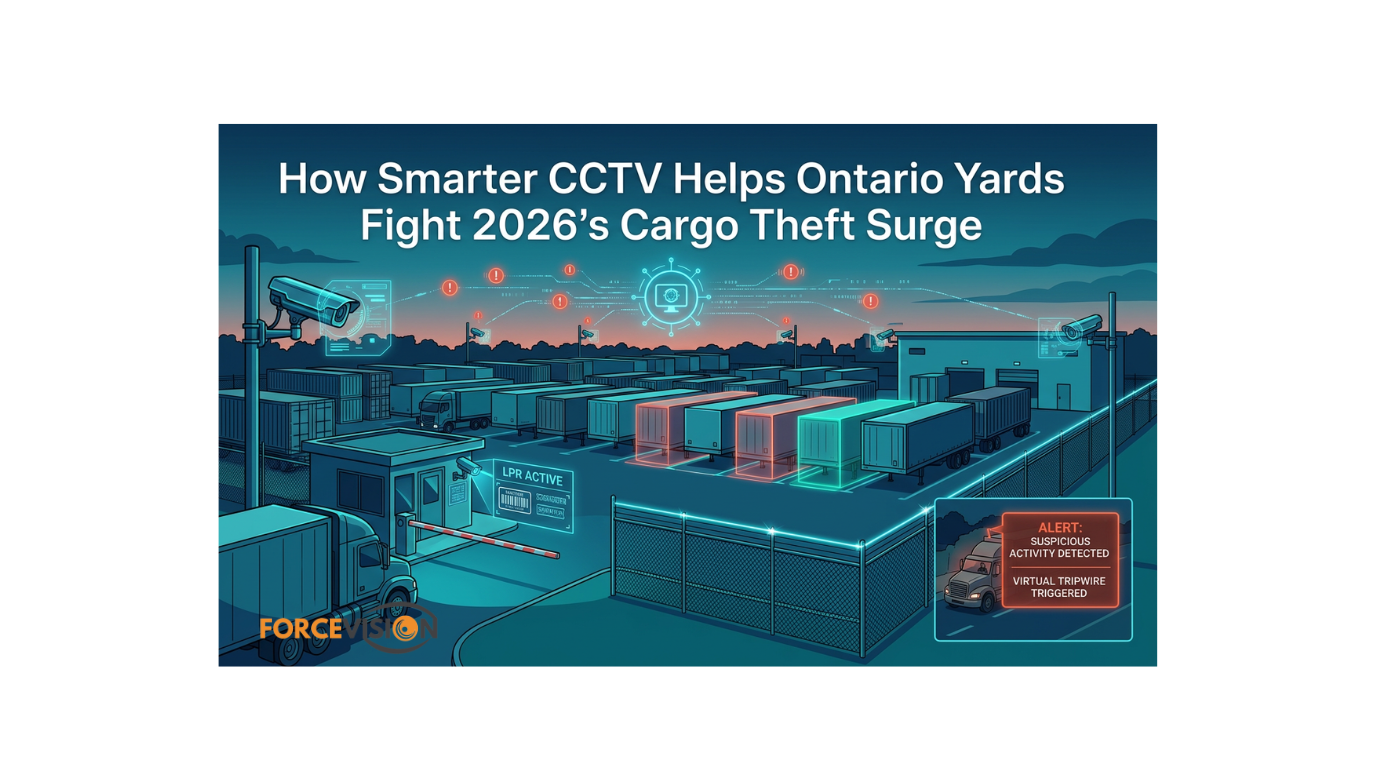
Cargo theft in North America is now a multi‑billion‑dollar problem, and Ontario is squarely in the middle of it. A recent blueprint report from Geotab warns that cargo theft losses reached an estimated $6.6 billion in 2025, with criminal networks increasingly exploiting “digital blind spots” to remove freight without force. At the same time, other reports show a 60% surge in cargo theft losses and a 38% rise in concern among industry leaders. For operators running large truck yards, intermodal terminals, and distribution centres across the Golden Horseshoe, these numbers are not academic—they represent real loads, real customers, and real reputational risk.
What is changing is not just the volume of theft, but the method. Criminal groups now combine falsified identities, GPS spoofing, and fraudulent dispatch messages with physical surveillance of yards and routes. They watch when gates are busiest, where trailers sit unmonitored, and which corners of a lot fall outside of camera coverage. To respond, Ontario logistics hubs need industrial CCTV for Ontario logistics hubs that is integrated, intelligent, and tied into operational workflows—not just a handful of cameras feeding a DVR in the guard shack.
How is cargo theft evolving in 2026?
The Geotab report describes a “cyber era” of cargo theft, where criminals use GPS spoofing and AI‑powered fraud to redirect loads or pose as legitimate carriers. At the same time, traditional yard theft—cutting fences, swapping tractors, or stealing trailers outright—has not disappeared. Instead, the two trends overlap; a load might be fraudulently picked up at a distribution centre, then parked temporarily in an unsecured yard before being moved again.
Another industry analysis reports that metals theft, especially copper, climbed 77% in 2025, reflecting the value of raw materials moving through industrial hubs. For Ontario, with its mix of auto manufacturing, steel, and construction materials, that risk runs from rail‑served warehouses in Hamilton and Brantford to cross‑dock terminals in Mississauga and Brampton. When criminals know that a particular yard’s cameras do not reach the far corners, or that video is rarely reviewed in real time, they can operate with confidence.
What should an industrial CCTV design look like for logistics hubs?
An effective industrial CCTV for Ontario logistics hubs starts with scale. A typical truck yard serving regional and cross‑border freight can easily justify 64 or more cameras to cover perimeter fencing, entry and exit lanes, parking rows, dock doors, and high‑value parking zones. Fixed bullet cameras provide long‑range views down fence lines and trailer rows, while domes cover cross‑traffic areas and dock doors. PTZ cameras can be used to patrol yard “hotspots,” zooming in on suspicious activity or parked vehicles after hours.
Placement is as important as count. Cameras should be positioned to capture licence plates and tractor numbers at all gates, trailer positions in designated high‑value zones, and the sides of buildings where trespassers might hide. Overlapping fields of view reduce single points of failure, and infrared or low‑light capabilities ensure that night‑time activity is recorded clearly. A robust NVR platform with redundant storage and at least 60 days of retention gives operators and insurers the visibility they need when an incident is discovered days after the fact.
How can CCTV integrate with telematics and access control?
The same Geotab research emphasizes that “real‑time visibility” is the key differentiator for fleets that are staying ahead of new theft tactics. Video telematics—cameras on tractors and trailers that activate on door opens, motion, or geofence breaches—can extend the reach of yard cameras by documenting what happens when a trailer leaves the gate. When integrated with an NVR and yard management system, operators can quickly correlate on‑site video with telematics events, such as an unexpected door opening in a neighbouring lot.
Access control integration adds another layer. Gate events (card swipes, PIN entries, remote openings) can be matched with camera footage to verify that the truck and driver associated with a credential are the ones actually entering. In high‑risk environments, two‑factor checks—such as licence plate recognition plus a valid gate credential—can reduce the risk of fraud.
What role do analytics and live monitoring play?
Cameras alone do not stop cargo theft; response does. Modern NVR and video analytics platforms can flag unusual activity such as pedestrians in the yard after hours, vehicles entering through secondary gates at odd times, or trailers being repositioned outside of scheduled windows. When paired with live monitoring—either on‑site or via a remote monitoring centre—those alerts can trigger real‑time interventions: voice warnings over speakers, outreach to on‑call supervisors, or police dispatch.
Recent announcements from security providers highlight how combining analytics with human operators can deliver a proactive model: suspicious activity is verified on video, then escalated to police with a live video feed to accelerate response times. For Ontario yards, this reduces “alarm fatigue” from false motion events and focuses attention on genuine threats.
How can ForceVision help logistics operators in Southern Ontario?
Designing industrial CCTV for Ontario logistics hubs involves more than picking camera counts from a catalogue. ForceVision works with truck yards, rail‑served warehouses, and distribution centres across Burlington, Mississauga, Brampton, Hamilton, and the wider Golden Horseshoe to map current risks, review incident history, and develop 64‑camera and larger systems that integrate with telematics and yard operations.
If you are trying to understand how CCTV, video telematics, and access control should fit together for your site, ForceVision can provide a no‑pressure assessment of your current infrastructure and a roadmap for phased upgrades. That might start with closing obvious blind spots, then expand into analytics and live monitoring as your risk profile and operations evolve.
What should Ontario industrial leaders do next?
Cargo theft is moving faster than many security programs, but the tools to counter it already exist. Over the next month, logistics and industrial leaders should review yard camera maps, telematics integrations, and incident logs to identify blind spots—both physical and digital.
Ask simple questions: Can we clearly see every trailer in our highest‑value zones? Do we know when a door opens unexpectedly? Do we get an alert when a truck enters the yard at 3 a.m.? If the answers are inconsistent, it may be time to invest in an integrated CCTV and telematics approach designed specifically for high‑throughput yards.
FAQ
Q1: Are 64 cameras really necessary for a logistics yard?
A1: For large multi‑acre truck yards with multiple access points and dense trailer parking, 64 or more cameras are often required to provide continuous, overlapping coverage of critical areas.
Q2: How can CCTV help with fraudulent carrier pick‑ups?
A2: High‑resolution gate and dock cameras, combined with licence plate recognition and access control logs, help verify that the tractor and driver match the expected carrier before a load is released.
Q3: Is live monitoring worth the cost for industrial yards?
A3: Live or remote monitoring, coupled with analytics, can prevent thefts before they occur and improve police response by providing real‑time, verified video, often making the investment cost‑effective for high‑risk sites.
Q4: How long should logistics hubs retain CCTV footage?
A4: Many industrial operators aim for 60 days or more of retention, allowing time for delayed loss discovery and thorough investigation, especially when cargo moves through multiple facilities.


