

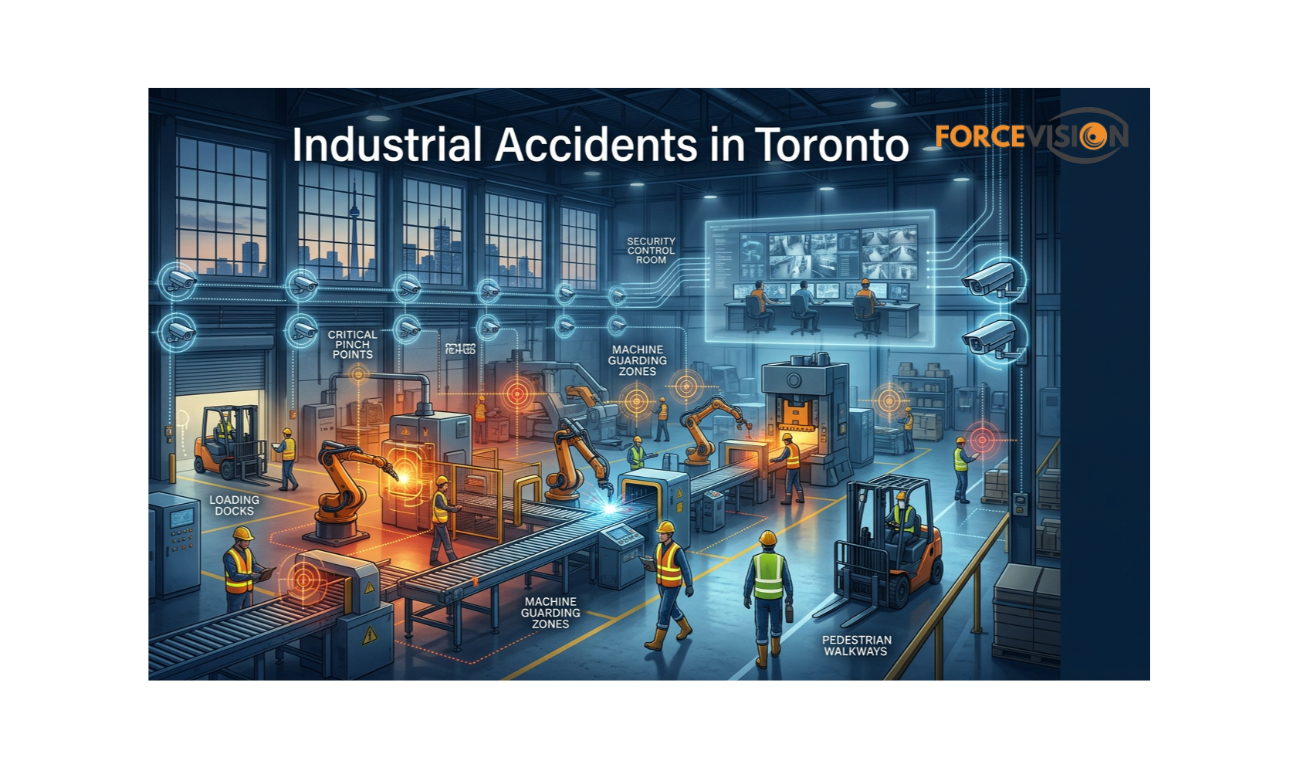
Recent Toronto Industrial Accidents Are a Warning Sign
Over the past year, several serious industrial accidents in Toronto have underscored how quickly routine work around high‑risk equipment can turn tragic. In March 2025, a hydro worker in his 30s died in hospital after an overnight incident in an underground vault near Queens Quay; power was cut to hundreds of customers while the Ministry of Labour launched an investigation. In June 2025, a worker in his 50s was killed when a concrete slab reportedly fell on him at a North York job site, prompting another Ministry of Labour probe. Other incidents have involved workers seriously injured at downtown and Eglinton‑area construction and industrial sites, often requiring emergency runs to hospital.
Each of these cases is different, but they share a common thread: high‑risk tasks, hazardous environments, and moments where something small—positioning, communication, timing—made a life‑changing difference. For large industrial operators across Southern Ontario, from manufacturing plants and warehouses to utilities and construction yards, these stories are a sobering reminder that policies and checklists alone are not enough. Increasingly, safety leaders are turning to 64‑camera industrial CCTV systems as a way to see and understand how work around high‑risk equipment is really being done.
Where Traditional Safety Programs Struggle Around High-Risk Equipment
Ontario’s occupational health and safety framework requires employers to identify hazards, train workers, and implement controls—but high‑risk zones often remain difficult to manage in practice. Examples include:
-
Electrical vaults and substations, where live equipment and confined spaces amplify any error.
-
Formwork, precast, and heavy concrete handling, where loads can shift or fail without warning.
-
Mobile equipment and construction vehicles, especially in tight urban sites with limited visibility.
-
Manufacturing cells and maintenance bays, where stored energy, moving parts, and manual intervention intersect.
In many of the Toronto incidents, investigations by the Ministry of Labour and other agencies have focused on whether procedures were followed, whether equipment was properly maintained, and whether foreseeable hazards were adequately controlled. But reconstructing those details after the fact is challenging if all you have are written statements and memory. That is where video becomes powerful.
How 64‑Camera CCTV Supports Worker Safety Around High-Risk Zones
A 64‑camera system, thoughtfully designed for an industrial environment, does much more than watch doors. It can create a visual record of how people, equipment, and materials interact in and around high‑risk zones. Key design principles include:
-
Multi‑angle coverage of critical tasks
Cameras positioned around vault entrances, lift zones, crane operations, and machine cells show not just the workface, but approaches, spotters, and exclusion zones. -
Clear visibility of traffic and interfaces
Views capturing how construction vehicles, forklifts, and trucks move relative to workers help identify blind spots and informal shortcuts that increase collision risk. -
Integration with control rooms and permit systems
When work in a vault, energized area, or heavy‑lift zone is authorised, supervisors can cross‑check camera views against permits and lockout/tagout records.
In an emergency, those same views give supervisors and first responders real‑time situational awareness: where injured workers are, what equipment is involved, and whether additional hazards (like live power or unstable loads) remain.
From Incident Reconstruction to Proactive Hazard Identification
CCTV is most obviously helpful after an accident, when investigators need to reconstruct what happened. In the Toronto hydro and North York slab incidents, for example, the Ministry of Labour assigned inspectors to examine the circumstances and compliance with safety laws. Had there been comprehensive camera coverage of those work areas, investigators could have reviewed video to see:
-
The sequence of events leading to the moment of failure.
-
Whether exclusion zones were respected and spotters were in place.
-
How communication occurred between workers and supervisors.
But the bigger value for industrial operators comes when video is used proactively. Research on computer‑vision‑based safety management shows that analysing CCTV feeds can help identify recurring patterns of unsafe behaviour—such as missing PPE, workers entering danger zones, or improper positioning around heavy equipment—before they cause serious injuries. When safety teams systematically review short clips from high‑risk areas, they can turn those observations into targeted training, engineering changes, and procedural updates.
AI and Computer Vision: The Next Layer of Protection
Recent advances in computer vision and deep learning are making it possible to automate some aspects of hazard detection from video. Studies have demonstrated models that can:
-
Detect whether construction workers are wearing helmets and high‑visibility vests.
-
Identify fall‑from‑height risks by analysing worker posture and location.
-
Recognise unsafe proximity between workers and moving equipment or hazardous zones.
In industrial settings, similar approaches are being tested to flag dangerous situations, such as workers entering restricted areas around machines, approaching overhead loads, or standing in the swing radius of cranes and excavators. While these systems are not a replacement for human judgment, they can act as an extra set of eyes—24/7—alerting supervisors when video patterns suggest an unfolding hazard.
For Ontario employers facing heightened expectations around due diligence in serious‑injury and fatality cases, having both traditional controls and AI‑assisted monitoring strengthens the argument that “all reasonable precautions” were taken.
Balancing Safety Insight with Worker Trust and Privacy
Using CCTV to monitor work around high‑risk equipment raises understandable questions from workers about surveillance and trust. Canadian guidance on workplace video monitoring emphasises that employers should be transparent about camera use, focused on legitimate purposes (such as safety and incident investigation), and respectful of privacy rights.
Best practices include:
-
Engaging joint health and safety committees (JHSCs) in discussions about where cameras are placed and how footage is used.
-
Clearly communicating that the primary goals are safety improvement, learning, and incident investigation, not micromanaging individuals.
-
Restricting access to safety‑relevant footage to trained personnel, with audit trails and defined retention periods.
Handled this way, many workers come to see cameras as an extra safety net—particularly in high‑risk environments like electrical vaults, heavy‑lift zones, and busy construction interfaces—rather than as a one‑sided monitoring tool.
How ForceVision Designs 64‑Camera Systems for High-Risk Industrial Work
ForceVision specialises in 64‑camera‑and‑larger industrial CCTV systems for utilities, construction yards, manufacturing plants, and logistics operations across Southern Ontario. When the focus is worker safety around high‑risk equipment, ForceVision works with safety and operations leaders to:
-
Map critical risk zones—vaults, heavy‑lift areas, confined spaces, mobile‑equipment routes, and high‑energy machines.
-
Design camera layouts that provide clear, practical views of those zones without overwhelming control rooms with unnecessary feeds.
-
Ensure NVR/VMS platforms support easy retrieval and secure export of footage for incident investigations, Ministry of Labour inquiries, and internal safety reviews.
If the recent Toronto accidents have you wondering how confidently you could reconstruct an incident—or demonstrate due diligence—around your own high‑risk equipment, ForceVision can walk your team through what a safety‑focused 64‑camera design would look like for your site, with a free, no‑pressure assessment.
FAQs: Industrial CCTV and Worker Safety Around High-Risk Equipment
Can CCTV footage help during a Ministry of Labour investigation?
Yes. Clear video showing how work was organised, what controls were in place, and how an incident unfolded can support both fact‑finding and a due‑diligence defence, alongside documents and witness statements.
Is 64 cameras too many for a single facility?
For large plants, yards, and multi‑storey construction or utility sites, 64 cameras is often the point where you can adequately cover high‑risk zones, traffic routes, perimeters, and key interiors without leaving major blind spots.
Do we need AI analytics from day one?
Not necessarily. Many sites start by using CCTV for incident review and coaching, then layer in AI models to detect PPE use, intrusion into danger zones, or unsafe proximity once the basics are in place.
How do we prevent cameras from being used only as a disciplinary tool?
Set policy that prioritises learning and system improvements, involve JHSCs in governance, and highlight examples where footage led to safer procedures or engineering fixes—not just individual discipline.


