

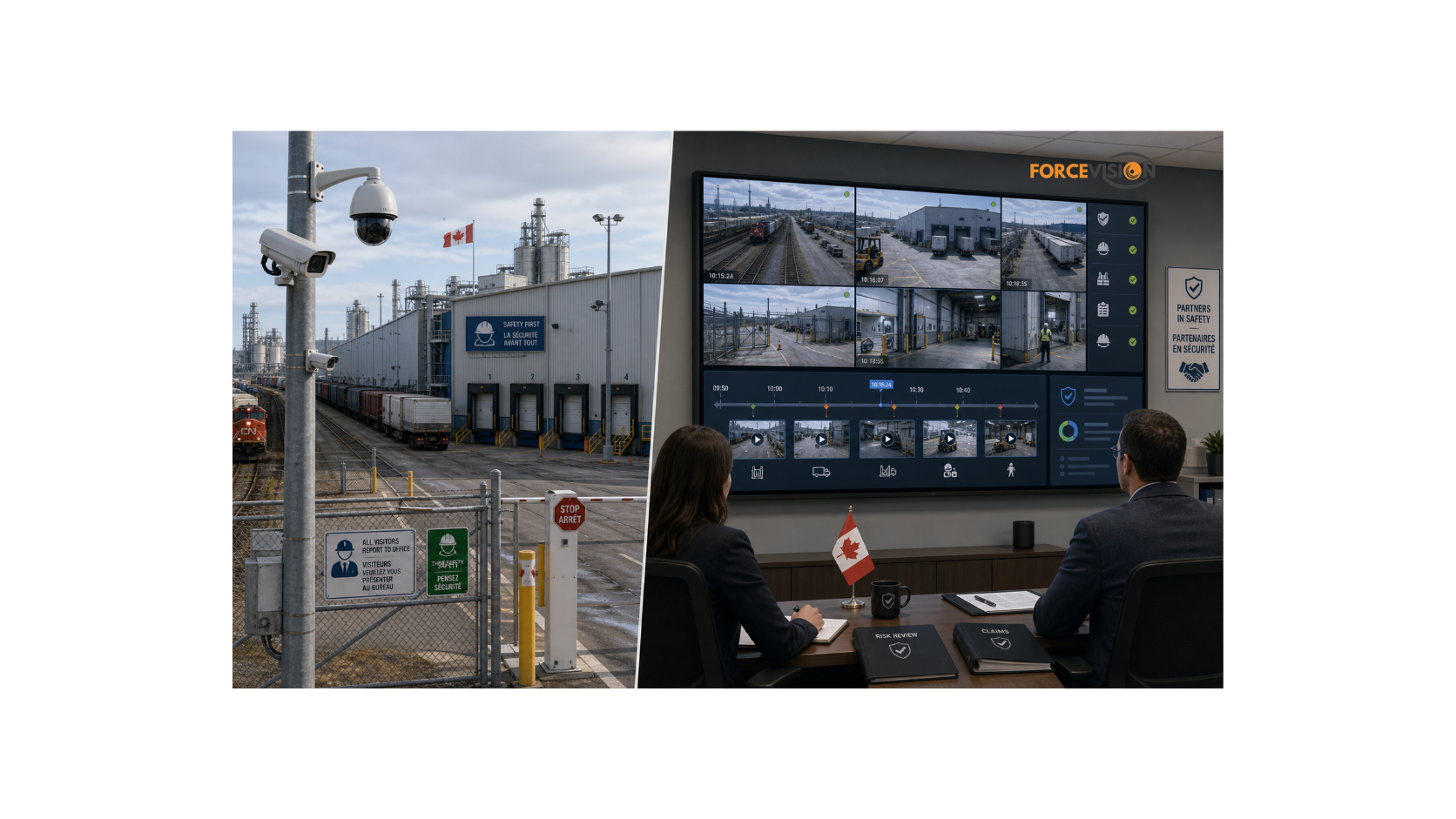
Insurers are watching cargo and industrial risks closely
Canadian and North American cargo‑theft data show that, even as incident volumes fluctuate, losses per event remain high and overall financial impact is substantial. Industry groups note that cargo theft in Canada alone likely totals billions of dollars annually when broader impacts are included. Insurers and trucking associations have responded by expanding cargo‑theft reporting programs and national databases to improve intelligence sharing.ontruck+3
For large industrial sites – rail yards, truck terminals, manufacturing plants, distribution centres, and energy facilities – this has a direct impact on insurance expectations. Underwriters now want evidence that operators are actively managing theft, arson, and liability risks with layered controls, including industrial‑grade CCTV.citt+2
Why industrial CCTV matters to insurers
Guidance from insurers and security firms stresses that video surveillance is a critical part of a comprehensive risk‑management plan for logistics and industrial sites. From an insurance perspective, industrial CCTV for Canadian insurance risk offers several benefits:citt+2
-
Loss prevention – visible cameras and signage deter some opportunistic offenders and help detect suspicious activity earlier.canadacartage+1
-
Loss reduction – when an incident does occur, quick detection can limit damage or loss, especially for fires, vandalism, or in‑progress thefts.abc7+1
-
Better claims evidence – clear, time‑stamped footage linked to alarms, access control, and yard or plant logs strengthens claims and reduces disputes.ontruck+1
Some security‑consulting case studies describe how investigations rely on surveillance footage to reconstruct events and coordinate with law enforcement, particularly after high‑value cargo thefts. Insurers see robust CCTV as a sign that a site takes risk seriously – and that claims are more likely to be well‑documented.citt+1
What insurers like to see in an industrial CCTV design
While each insurer has its own requirements, recurring themes appear in guidance from industry associations and risk consultants. For industrial CCTV for Canadian insurance risk, underwriters typically look for:canadacartage+2
-
Comprehensive coverage of perimeter, access points, load/unload zones, and high‑value storage areas.piotrservice+1
-
Adequate resolution to identify people, vehicles, and key actions, even at night or in challenging weather.mdpi+1
-
Retention periods aligned with the time it may take to discover losses or claims, often 30–90 days for high‑risk businesses.ontruck+1
-
Documented procedures for reviewing and preserving footage during incidents, audits, and claims.
For rail‑and‑road logistics hubs, insurers may also favour sites that integrate CCTV with alarms and access control, and that participate in reporting programs that share theft data with national databases.cargonet+1
Using CCTV to strengthen cargo‑theft and liability claims
Cargo‑theft investigations often hinge on when and where a trailer, container, or load was last confirmed secure. Industrial CCTV for Canadian insurance risk can provide that confirmation, allowing risk managers to:citt+2
-
See exactly when a trailer arrived, which tractor moved it, and when it left the yard.piotrservice+1
-
Correlate footage with gate logs, yard‑management data, and telematics reports.
-
Provide law enforcement with useful clips, including vehicle descriptions and sequences of events.canadacartage+1
In fraud, slip‑and‑fall, or workplace‑injury claims, CCTV can also offer objective insight into what actually happened, reducing the risk of inflated or unfounded claims. One case from Northern Ontario, for example, saw security‑camera footage play a key role in fraud and theft charges against a worker. For industrial sites, that same principle applies to a range of liabilities.northernontario.ctvnews
Beyond the camera count: governance and documentation
Insurers increasingly look beyond the simple presence of cameras to how they are used. Strong governance around industrial CCTV for Canadian insurance risk includes:cargonet+2
-
Written policies on camera placement, access to footage, and privacy considerations.
-
Clear responsibilities for who reviews footage after incidents and how evidence is preserved.
-
Regular audits of camera uptime, recording quality, and time synchronization across systems.
These elements reassure insurers that CCTV is part of a disciplined risk‑management program, not a “set and forget” installation. They also help avoid gaps that could undermine a claim – such as discovering that a critical camera was offline when an incident occurred.
Industrial CCTV as part of a broader risk‑management story
When negotiating insurance terms, operators can position their CCTV system as a key part of a larger loss‑control narrative. That narrative might include:ontruck+1
-
Participation in cargo‑theft reporting programs and industry associations.ontruck
-
Staff training on security awareness, including how to report suspicious activity in yards and plants.piotrservice+1
-
Use of analytics to detect unusual behaviour, such as after‑hours movement in high‑value areas.mdpi+1
-
Integration of CCTV with safety and HR processes for incident investigation and prevention.northernontario.ctvnews
ForceVision helps industrial operators across Southern Ontario document their CCTV designs and procedures in a way that speaks the language of insurers and risk engineers. If you are preparing for an insurance renewal or risk‑control visit, ForceVision can assist with gap assessments, design upgrades, and practical advice on how to present your video‑security posture.
FAQs
Q1. Can better CCTV actually lower insurance premiums?
While results vary, insurers often offer more favourable terms or deductibles to sites that demonstrate strong, documented loss‑control measures, including robust CCTV, especially in high‑theft sectors.citt+2
Q2. What retention period do insurers expect?
Many high‑risk operations are encouraged to maintain at least 30 days of footage, with longer retention for key zones where losses or injuries may be discovered late. Requirements can be negotiated.citt+1
Q3. How detailed should our CCTV policy be for insurers?
Ideally, it should cover camera coverage maps, retention settings, access controls, incident‑review procedures, and privacy considerations, showing that the system is actively managed.
Q4. Do insurers care about analytics, or just cameras?
Analytics are increasingly viewed as a positive differentiator because they improve detection and shorten response times, especially in large, complex yards and plants.cargonet+2


