

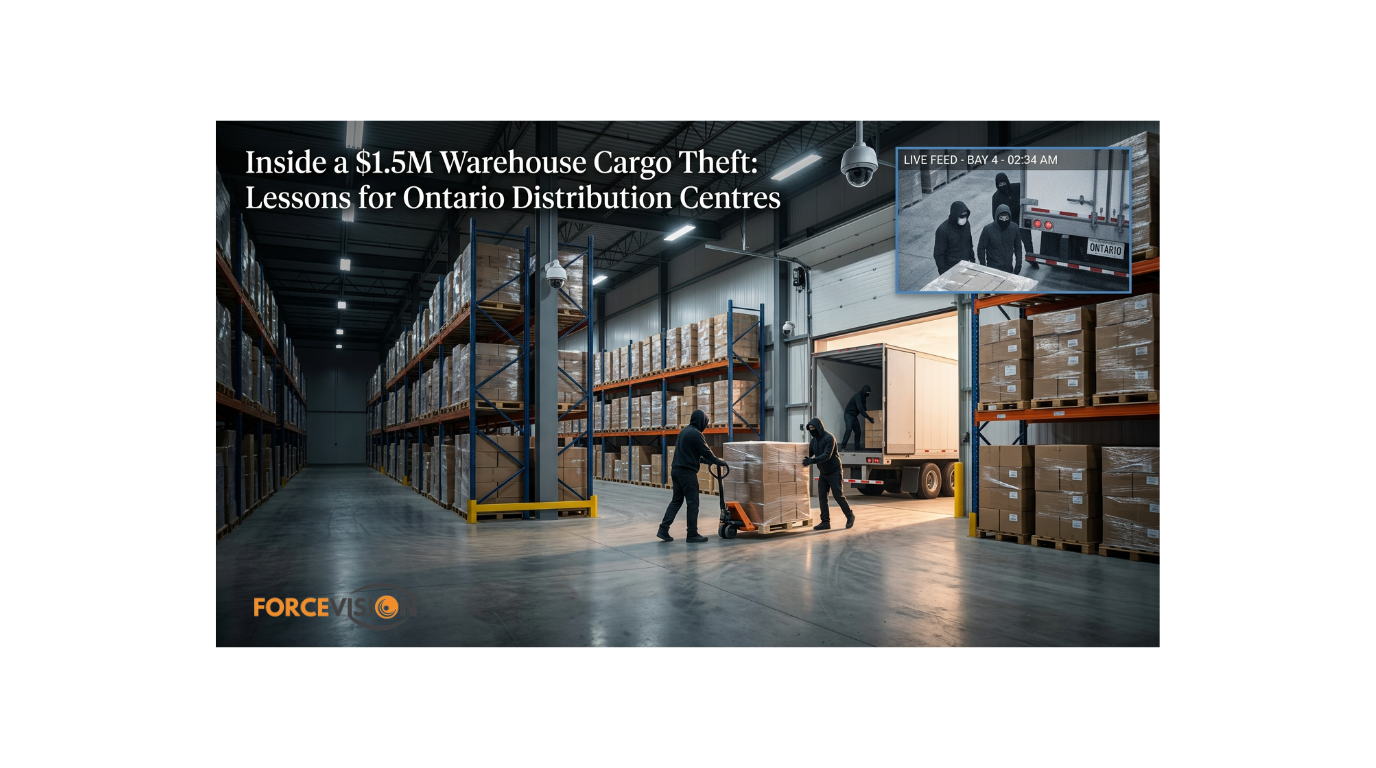
When investigators in California seized an estimated $1.5 million in stolen property from a sprawling warehouse in Ontario, the case underscored how organized cargo theft has evolved into a sophisticated, industrial‑scale problem. Authorities linked the facility to multiple cargo theft incidents, turning what looked like a normal distribution site into the heart of a regional theft operation.
For distribution centres and warehouses across Southern Ontario—from Brampton and Mississauga to Milton and Hamilton—the specific geography may differ, but the underlying risk is strikingly similar. The same playbook used to stage stolen freight in one jurisdiction can be—and is—replicated anywhere that high‑value cargo moves quickly and visibility is patchy.
How are cargo thieves exploiting warehouse and DC vulnerabilities?
Recent cargo theft trend reports highlight that fraud losses and theft‑related risks surged by roughly 60% in 2025, driven by increasingly sophisticated tactics. Common methods now include:
-
Surveillance of distribution centres and truck yards to learn patterns and blind spots
-
Use of master keys and cloned credentials to access trailers and facilities
-
Disabling or spoofing GPS before moving freight to secondary locations
-
Bogus pickups and fictitious carriers that blend into normal operations
In the Ontario warehouse case, investigators recovered a massive volume of stolen goods in a single location, pointing to an operation that had been running long enough to build inventory. That should be a warning sign for any Canadian distribution centre with:
-
High trailer turnover
-
Multiple third‑party carriers and temporary staff
-
Limited integration between access control, yard management, and surveillance
A handful of aging cameras at the dock doors will not keep up with this new level of threat.
Why is a 64‑camera CCTV baseline so important for large DCs?
For a modern Ontario distribution centre serving national or regional networks, a 64‑camera CCTV for Ontario distribution centres is less about extravagance and more about finally matching the complexity of the operation. The layout typically includes:
-
Dozens of dock doors on multiple sides of the building
-
A large yard with live spots, drop trailers, and visitor parking
-
Interior pick, pack, and high‑value storage zones
-
Mezzanines, maintenance areas, and returns processing
To get meaningful coverage, operators need to think in layers:
-
Perimeter and gate lines: High‑resolution bullets focused on gate lanes, licence plates, and driver cabs
-
Yard coverage: PTZs overlooking rows of trailers, combined with fixed cameras on key corners
-
Dock doors: Overhead cameras capturing trailer numbers, seal condition, and dock activity
-
Interior aisles: Dome cameras focused on high‑value zones, returns cages, and restricted racks
-
Ancillary areas: Cameras in maintenance rooms, battery charging areas, and employee entrances
A 64‑channel NVR or server‑based platform becomes the backbone that ties these views together, with room to grow to 96 or 128 channels as the operation scales.
How could better CCTV have helped in the $1.5M theft warehouse?
While details of the surveillance systems at the California warehouse have not been fully disclosed, authorities have noted that investigative work combined site searches, witness accounts, and other intelligence to piece the case together. Robust industrial CCTV would likely have strengthened that picture significantly:
-
Documenting how stolen goods arrived: which trucks, at which docks, and under which credentials
-
Capturing the involvement (or non‑involvement) of internal staff or contracted drivers
-
Providing time‑stamped evidence that links specific loads to specific dates and movements
For an Ontario‑based DC facing similar scrutiny from police, insurers, and brand‑name customers, that footage can make the difference between “we think this is what happened” and a provable, auditable chain of events.
Where do analytics and integration add value beyond security?
One reason 64‑camera CCTV for Ontario distribution centres has strong ROI is that video intelligence now touches more than just security. When integrated properly, the same camera system can:
-
Track dwell time for trailers at doors and yard spots, supporting throughput improvements
-
Flag congestion at key intersections or choke points, improving safety and efficiency
-
Verify that load securement and dock locks are used correctly, reducing safety incidents
-
Provide visual context for WMS/TMS exceptions and disputed shipments
Analytics can detect loitering near high‑value aisles, unusual after‑hours activity in returns cages, or repeated access to a particular rack by an unexpected badge. Operations and HR teams can then engage early, before small anomalies grow into multi‑million‑dollar theft rings.
How should Ontario operators respond after a major cargo theft scare?
Whether the headline is $1.5 million in stolen goods in California or a large internal theft case closer to home, the playbook for Ontario warehouses and distribution centres is similar. It starts with an honest risk and coverage assessment:
-
Map your current camera locations against actual risk points and workflows
-
Identify blind spots: side yards, rear corners, cross‑docks, and internal high‑value areas
-
Review how easily you can search and export video that aligns with load numbers and timestamps
-
Evaluate your retention period relative to how long it might take to notice a pattern
This is where working with a specialist integrator matters. ForceVision helps large warehouses and DCs across Southern Ontario design 64‑camera and larger systems that are tightly aligned with their loading patterns, labour model, and customer expectations. If you are unsure whether your site could fully reconstruct the story behind a missing trailer, ForceVision can provide a no‑pressure assessment focused on evidence quality, not just camera counts.
What is the practical take‑home for DC leaders?
The Ontario warehouse theft case is a reminder that cargo crime no longer lives only on the highway shoulder or at unsecured truck stops. It has moved inside the walls and fences of legitimate‑looking facilities, blending with normal operations until investigators connect the dots.
For distribution‑centre leaders in Brampton, Vaughan, Milton, and beyond, the practical steps are clear:
-
Treat surveillance as a core operational system, not a peripheral security gadget
-
Commit to a 64‑camera CCTV for Ontario distribution centres as a realistic baseline
-
Design coverage to match real freight flows and high‑value zones
-
Use analytics and integrations to spot anomalies early
A well‑planned industrial CCTV platform cannot eliminate the threat of organized cargo theft—but it can dramatically reduce the window in which bad actors can operate undetected, and give you the evidence you need when something goes wrong.
FAQ
Q1: Is a 64‑camera system overkill for a single warehouse?
A1: For large DCs with multiple dock walls and a sizeable yard, 64 cameras is often the minimum required to cover all critical zones with the clarity investigators and insurers expect.
Q2: How long should DCs keep CCTV footage related to cargo?
A2: Many logistics operators aim for 60–90 days of retention so they can investigate patterns of loss, disputed loads, and delayed claims without running out of history.
Q3: Can CCTV help with carrier and vendor disputes?
A3: Yes. Clear video that ties specific loads and seal conditions to timestamps and dock doors can resolve disputes faster and strengthen relationships with key partners.
Q4: How quickly can a DC upgrade to a 64‑camera platform?
A4: With a phased plan, many Ontario DCs can move from legacy systems to a modern, scalable platform in weeks, focusing first on highest‑risk areas before expanding coverage.


