

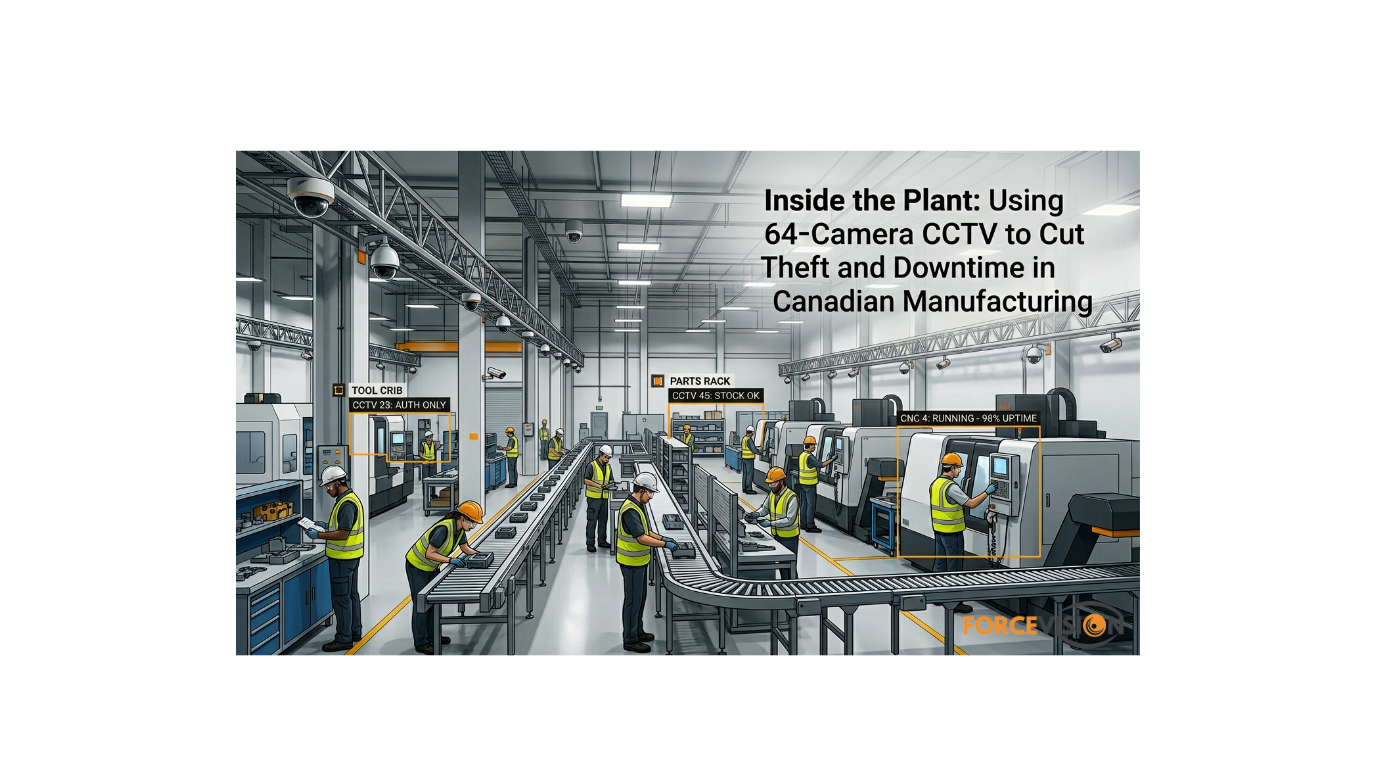
Canada’s largest manufacturers manage complex plants where a single hour of downtime can cost more than an entire year of security spend. From automotive suppliers in the GTA to heavy industry in Hamilton and Kitchener, these operations rely on expensive machinery, specialized tooling, and tight production schedules. When tools disappear, equipment is misused, or unsafe behaviour goes unchecked, production and safety suffer long before an insurance claim is ever filed.
Despite this, many plants still rely on a patchwork of legacy cameras focused on front doors, shipping doors, and maybe a few high‑value cages. The rest of the floor — where real value is created — often remains a blind spot. As manufacturers look to reduce theft, support safety culture, and retain skilled workers, the move toward 64‑camera CCTV for Canadian manufacturing plants is accelerating.
Why do large manufacturers need more than basic security cameras?
Large industrial manufacturers like Magna and other Canadian OEMs manage a mix of high‑value raw materials, work‑in‑progress inventory, and finished goods. They juggle permanent staff, contractors, and temp labour, often across multiple shifts. In this environment, losses rarely look like a Hollywood heist; they appear as small but repeated issues — missing tools, unexplained scrap, unauthorized after‑hours machine use, or unreported near‑miss injuries.
Basic security cameras might catch who comes through reception, but they rarely deliver insight into how assets are actually used on the floor. Without visibility into the plant itself, leaders must rely on reports and hearsay, which can make it harder to address problems early.
What does a 64‑camera plant‑wide CCTV layout include?
A 64‑camera CCTV for Canadian manufacturing plants is designed to create a complete operational picture, not just doors and gates. Typical coverage includes:
-
Exterior perimeter and yard cameras for loading docks, material yards, and employee parking.
-
Interior dome cameras over main production lines, assembly cells, and bottleneck stations.
-
PTZ cameras covering high‑risk zones like coil storage, press pits, and robot cells.
-
Focused cameras on tool cribs, maintenance shops, and high‑value inventory rooms.
By combining these views into an industrial‑grade NVR platform, plant leaders can follow the story of an asset or incident from the gate to the line and back. The 64‑camera capacity ensures there is room to add new views as operations change or new risks emerge.
How does CCTV help reduce theft and loss?
In manufacturing plants, theft can involve everything from hand tools and consumables to high‑value components and even intellectual property in the form of drawings or prototypes. A 64‑camera CCTV for Canadian manufacturing plants addresses this by:
-
Monitoring tool cribs and high‑value storage to log every entry and exit.
-
Watching staging areas where finished goods wait for shipping, a common point of disappearance.
-
Covering blind corners, back corridors, and staff exits where items can be concealed.
While most employees act in good faith, the combination of opportunity and limited oversight can create problems. The presence of visible, well‑positioned cameras reduces temptation and provides clear evidence when investigations are needed, which in turn supports fair, fact‑based HR decisions.
How does video support safety and workforce retention?
The Blog Targeting Guide stresses that employee retention and behaviour are central to the value of modern industrial video systems. For manufacturing plants, this means using footage proactively to improve safety and culture rather than only reacting after injuries.
With a 64‑camera CCTV for Canadian manufacturing plants, safety and HR teams can:
-
Review near‑miss events at conveyors, robot cells, or manual handling stations.
-
Identify recurring unsafe shortcuts that may indicate fatigue, poor training, or process pressure.
-
Use anonymized clips in toolbox talks to show real examples of hazards and best practices.
Research into industrial safety and asset tracking suggests that integrating surveillance with other smart systems improves incident detection and can help recover assets quickly when incidents occur. When employees see that video is used to make their work safer and more predictable — not just to “catch” them — it can support trust and retention.
How does video intelligence cut downtime and improve operations?
Plant managers often think of CCTV as a cost centre, but it can be a powerful tool for reducing unplanned downtime and improving throughput. By reviewing historical footage of line stoppages, congestion around changeover, or frequent jams, operations teams can identify root causes that might not be obvious in real time.
Examples include:
-
Discovering that material arrives too early or late to a bottleneck workstation.
-
Spotting frequent forklift congestion near a key line that slows material delivery.
-
Identifying repeated manual workarounds when machines fault, which could indicate training or maintenance gaps.
These insights align with broader research that frames industrial CCTV as a source of operational intelligence, not just security. For Canadian manufacturers under pressure to increase capacity without major capital spend, extracting this kind of value from existing 64‑camera CCTV for Canadian manufacturing plants can be a game‑changer.
Taking the next step: practical considerations
If your plant still runs on an assortment of older cameras, the idea of moving to 64 channels may sound daunting. In practice, many Canadian manufacturers phase in their 64‑camera CCTV for Canadian manufacturing plants by:
-
Upgrading the NVR first to a platform that can handle 64+ channels and higher resolutions.
-
Prioritising coverage in high‑risk areas — tool rooms, high‑value inventory, and main production lines.
-
Gradually adding cameras in support areas like maintenance, shipping, and remote yards.
ForceVision works with large manufacturing plants across Southern Ontario to design these phased roadmaps, ensuring each step delivers both security and operational value. If you are curious what a re‑designed system might reveal about your own bottlenecks and risk points, ForceVision can provide a plant walk‑through and draft layout without any sales pressure.
The larger point is that a 64‑camera CCTV for Canadian manufacturing plants is no longer just a security upgrade. It is a decision to treat video as shared infrastructure for security, safety, operations, and HR — the teams that collectively keep your plant productive and your workforce stable.
FAQ
Q1: Is a 64‑camera system overkill for a single plant?
A: For small facilities, it might be, but large Canadian manufacturing plants with multiple lines, yards, and warehouses often find that 64 cameras are the minimum needed for meaningful coverage.
Q2: How do unions typically react to expanded video coverage?
A: Clear policies are essential. When plants emphasise that 64‑camera CCTV for Canadian manufacturing plants is used for safety, fairness, and operational improvement — not micro‑monitoring — discussions with unions are generally more constructive.
Q3: Can video be integrated with machine data or MES systems?
A: Yes, many plants link CCTV events with maintenance logs or MES timestamps so teams can correlate faults, downtime, and operator actions, turning 64‑camera CCTV for Canadian manufacturing plants into a richer diagnostic tool.
Q4: What about privacy concerns in offices and locker rooms?
A: Sensitive areas should be excluded or treated carefully, with clear signage and strict access controls on footage, while still maintaining robust coverage in production and logistics zones.


