

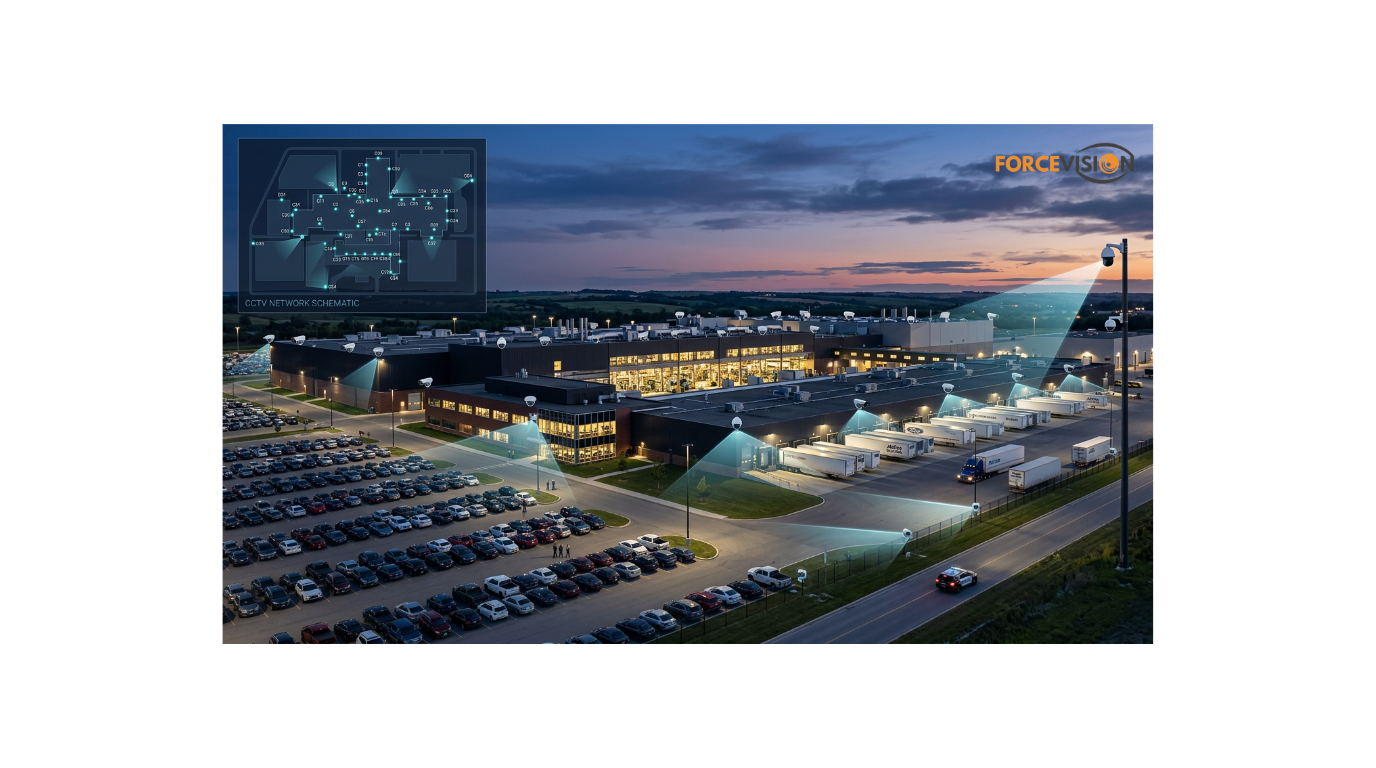
Canadian manufacturers like Magna International operate in a different universe from small factories or retail warehouses. They manage multi‑building campuses, high‑value tooling, and complex production lines, often spread across large sites in Southern Ontario. In that environment, a handful of legacy cameras on doors and loading bays simply cannot keep up with the realities of theft risk, downtime, and worker safety.
Over the past few years, theft and sabotage incidents at manufacturing and warehousing sites have become more sophisticated, ranging from internal product diversion to after‑hours yard intrusions and targeted equipment theft. At the same time, plant operators are under pressure to maintain uptime, improve safety performance, and show insurers and regulators that they are in control of their environments. This is where well‑designed 64‑camera CCTV systems for Canadian manufacturing plants move from “nice‑to‑have” to core infrastructure.
Why large manufacturers need more than “door cameras”
In a Magna‑scale facility, asset loss rarely looks like someone walking out the front door with a box. It might be a pallet of high‑value components “misplaced” between production and shipping, an unattended tool crib, or an after‑hours intrusion through a quiet yard gate. Traditional camera layouts, focused on entrances and reception areas, leave huge blind spots over:
-
Storage yards for raw materials and finished goods.
-
High‑value work cells and robotics zones.
-
Tool cribs, maintenance shops, and parts cages.
-
Shared truck lots and rail‑serving docks.
These gaps don’t just increase theft risk. They also make it difficult to investigate quality issues, near‑miss safety incidents, or unexplained downtime on critical lines. Without visual evidence, management is left relying on memory and reports, which are rarely complete when an incident spans multiple shifts or departments.
What a 64‑camera manufacturing design should include
A 64‑camera CCTV system for Canadian manufacturing plants is not simply “more cameras”; it is a different architecture. A typical design will include:
-
Exterior bullet cameras along fence lines, truck docks, and any rail‑connected spurs to capture vehicles, plates, and perimeter movements.
-
PTZ cameras overlooking large yards, loading zones, and outdoor storage so that supervisors can zoom in on unusual activity in real time.
-
Dome cameras in production areas, focused on line infeed/outfeed, quality inspection points, and forklift traffic lanes.
-
Fixed cameras in tool cribs, high‑value storage rooms, and maintenance workshops to track who accesses sensitive assets.
-
Interior corridor cameras covering restricted access routes between production, warehousing, and shipping.
All of these feed into a central NVR platform with sufficient storage for at least 30 days of continuous coverage, often more. This gives safety and HR teams time to investigate incidents that only surface days later, such as ergonomic injuries, recurring procedural violations, or repeated equipment misuse.
Turning video into a tool for downtime reduction
The real power of a 64‑camera system comes when operations teams treat it as a process‑improvement tool. By reviewing footage around unplanned downtime events, maintenance and engineering teams can see exactly what happened before a line stopped:
-
Was a forklift blocking a feed lane?
-
Did an operator bypass a guard or interlock?
-
Were materials staged properly, or did a shortage cause a line to starve?
In many large plants, simple process changes—repositioning staging areas, adjusting shift‑change routines, redesigning forklift routes—emerge from objective video evidence, not speculation. Over time, this can reduce chronic minor stoppages that add up to significant lost production.
Supporting safety and HR with objective evidence
For safety and HR leaders, CCTV can be the difference between conflicting stories and clear facts. Industrial footage helps them:
-
Investigate near‑misses, falls, or vehicle interactions with a precise visual record.
-
Identify recurring unsafe behaviours, such as shortcutting lockout/tagout, riding on forklifts, or entering restricted zones without PPE.
-
Coach employees using specific examples, rather than general reminders.
-
Protect both workers and the company when allegations arise about conduct on the shop floor.
Crucially, the goal is not to “catch people” but to support a safer, more accountable culture. When workers understand that cameras exist to protect them—to document unsafe conditions, support training, and verify that procedures are followed—they are more likely to view CCTV as a tool rather than a threat.
Integrating CCTV with manufacturing and warehouse systems
Modern 64‑camera CCTV systems for Canadian manufacturing plants do not stand alone. They can integrate with:
-
Access‑control systems on high‑risk rooms and exterior doors.
-
Warehouse‑management systems (WMS) to verify picks, loads, and staging.
-
Production monitoring systems to correlate downtime with specific events.
-
Visitor‑management platforms to track contractor activity.
When a pallet goes missing, security can filter video by the relevant dock door and time window. When a machine is damaged, maintenance can review footage to see whether a collision or misuse occurred. When insurers ask for evidence following an injury, safety teams can export high‑quality clips that demonstrate what was in place at the time.
How ForceVision supports Magna‑scale operations
Large manufacturers across Southern Ontario—from automotive and heavy equipment to food and consumer goods—face similar challenges but very different site layouts. That is why camera counts and models are the last decision, not the first.
If you are responsible for security or operations at a large plant or warehouse, ForceVision can help you step back and ask: What does a 64‑camera baseline look like for our footprint? Working with industrial clients, ForceVision maps coverage zones to asset value, process criticality, and safety risk, then designs layered CCTV and NVR platforms that serve security, operations, safety, and HR together. The result is not just better evidence after incidents—it is fewer incidents in the first place.
A practical next step for plant leaders
Take one recent downtime event, theft concern, or safety near‑miss from your own operation. Ask yourself: if we replayed our current camera footage, would we actually see what happened? If the answer is “probably not” or “only from one angle,” your CCTV system is under‑scaled for the value and risk on your site.
Over the next month, consider commissioning a camera‑coverage and retention audit. Whether you work with ForceVision or another partner, you should have a clear map of blind spots, overlapping fields of view, and how your 64‑camera (and larger) design will support the people who keep your plant running.
FAQ
Q1: Is 64 cameras always enough for a large manufacturing site?
Not always. For complex, multi‑building campuses, 64 cameras are often a starting point, with expansions to 96 or 128 cameras as additional zones and processes are brought under coverage.
Q2: How does CCTV help reduce downtime in manufacturing?
By reviewing footage around stoppages, operations and maintenance teams can see the exact sequence of events, identify root causes, and redesign processes or layouts to prevent repeats.
Q3: Will workers see expanded CCTV as “surveillance” rather than support?
When leadership clearly communicates that cameras are used to improve safety, investigate incidents fairly, and protect employees from false claims, acceptance is typically high.
Q4: What should manufacturers look for in an industrial NVR platform?
Look for scalable storage, easy retrieval by time and location, secure remote access for authorised teams, and the ability to integrate with access control, WMS, and production systems.


