

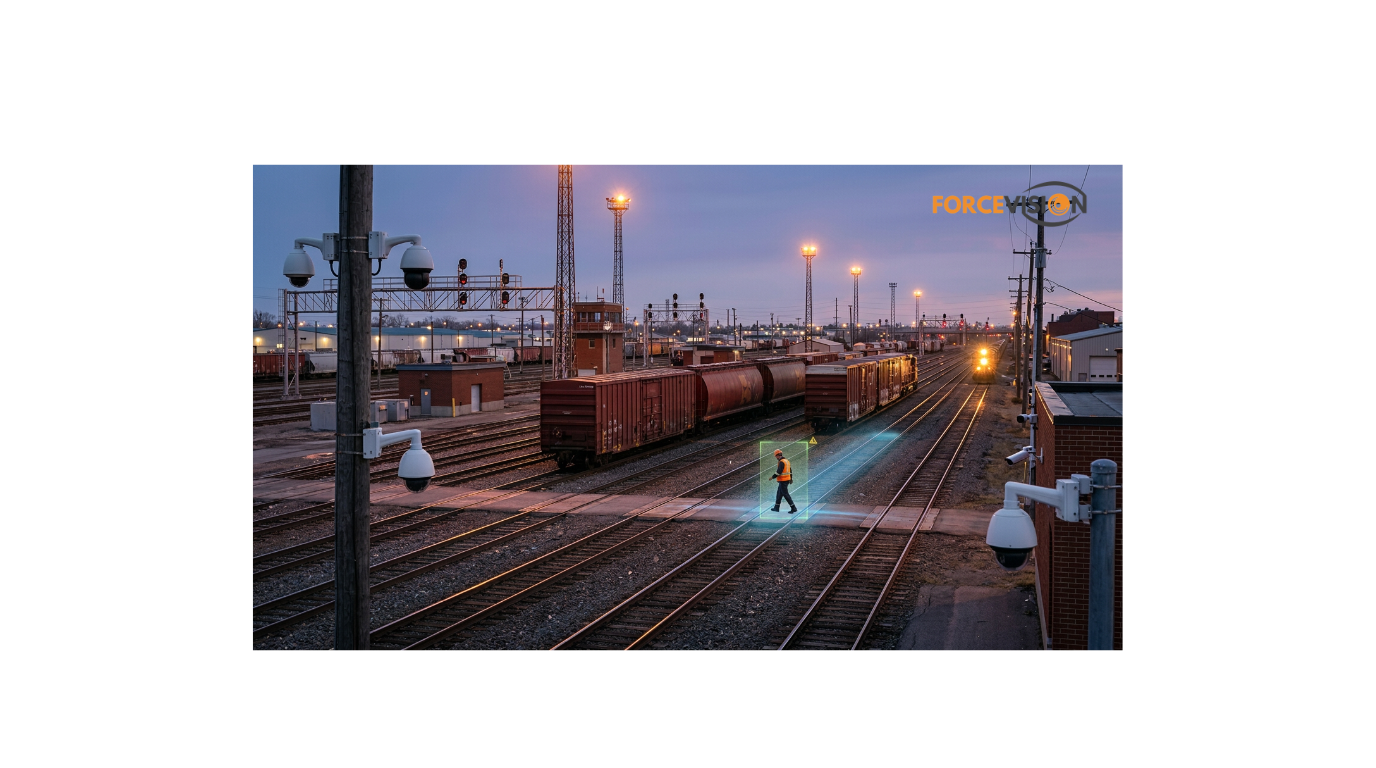
When a near‑miss happens in a rail yard—an employee stepping too close to a moving consist, a truck crossing tracks at the wrong time, or a shunting move that comes within metres of a collision—the outcome often comes down to luck. Recent near‑miss reporting and safety advisories in Canada have underscored how complex yard environments make it difficult to see and understand every risky behaviour in real time. For rail operators, the central question is no longer whether near‑misses are happening, but whether they are being captured, reviewed, and learned from before they turn into serious accidents.
Canadian railroads like CN and CPKC operate yards that span dozens of tracks, multiple lead lines, and maze‑like access routes for trucks, forklifts, and maintenance vehicles. In these environments, a traditional set of cameras focused on gates and building entrances cannot possibly capture the full safety picture. That is where 64‑camera CCTV for rail yard near‑miss and safety monitoring becomes a critical part of the safety toolkit.
What recent near‑miss investigations reveal
Investigations into near‑misses in rail environments often highlight similar themes: limited line of sight for supervisors, complex traffic patterns, and communication gaps between crews on the ground and control points. Even when railroads have strong rules on paper—restricted walkways, no‑go zones, and defined truck routes—human behaviour can drift over time, especially under schedule pressure or during night operations.
Without comprehensive video, safety teams may only hear about near‑misses through informal reporting, or not at all. Critical questions go unanswered:
-
Was the worker following the designated walking path?
-
Did a vehicle ignore a stop‑and‑proceed instruction?
-
Were lighting levels sufficient in the area?
-
Did the layout itself encourage risky shortcuts?
CCTV does not replace formal investigations, but it gives them a factual foundation. Footage shows what actually happened in the seconds and minutes leading up to an event, not just what people remember or are comfortable admitting afterwards.
Designing camera coverage for rail‑yard safety
A 64‑camera design for a CN‑scale or CPKC‑scale yard needs to be built around safety critical zones, not just high‑value assets. That typically includes:
-
Wide‑angle PTZ cameras covering ladder tracks, hump or flat‑switching areas, and main walkways used by ground crews.
-
Fixed cameras monitoring pedestrian crossings, vehicle crossings, and gate areas where trucks interact with trains.
-
Cameras at fuelling pads, locomotive servicing tracks, and RIP tracks, where multiple trades and vehicles converge.
-
Coverage of yard office approaches and crew‑call areas where staff assemble and move to job sites.
In addition, lighting and camera placement must work together so that safety‑critical behaviours—such as employees stepping between cars, walking near moving equipment, or riding in unauthorized positions—are clearly visible in recorded footage, day and night.
Using video to support coaching and culture, not punishment
The biggest change for many rail operators is cultural. If CCTV is seen only as a tool to discipline employees after incidents, near‑misses will continue to go unreported and unsafe practices will go underground. Instead, railroads can position video as a coaching tool by:
-
Regularly reviewing anonymized clips of unsafe and safe behaviours in safety briefings.
-
Involving union and workforce representatives in defining how footage will and will not be used.
-
Emphasizing that the goal is to prevent injuries and protect livelihoods, not to “spy” on workers.
When employees see that near‑miss footage leads to better lighting, clearer signage, revised procedures, or improved equipment—not just write‑ups—they are more likely to participate in the process. Over time, this creates a feedback loop where CCTV, reporting, and corrective action reinforce each other.
Integration with existing safety systems
Modern CCTV platforms can integrate with other safety systems in the yard. Examples include:
-
Tying camera views to track segments in the yard management system to quickly locate footage for a given move.
-
Linking video to incident reports and safety management systems so that investigators can review footage alongside written statements.
-
Using analytics to flag people or vehicles in restricted zones, triggering alerts in the control office.
While advanced analytics—such as automatic detection of people within a certain distance of moving equipment—are still evolving, even basic motion detection and virtual trip‑lines can highlight unexpected behaviours in low‑traffic areas. For railroads already investing in train control, yard automation, and digital dispatch, enhancing CCTV is a logical extension of their safety technology stack.
Where ForceVision fits in the rail‑yard picture
ForceVision focuses on industrial‑scale CCTV deployments, including CN‑size and CPKC‑size yards and rail‑serving terminals across Southern Ontario. Rather than starting with camera models, ForceVision begins with a map of safety‑critical zones, typical crew movements, and known near‑miss hotspots. From there, a 64‑camera (or larger) design can be built that supports both safety and asset protection.
If you manage rail assets—whether at a classification yard, an intermodal terminal, or a major industrial spur—it may be time to ask how many near‑misses are happening that you simply never see. ForceVision can help you design a CCTV system that doesn’t just record incidents, but helps you prevent the next one.
A practical step for rail safety leaders
Choose one area of your yard that worries you most: a busy crossing, a dense ladder track, or a fuelling pad with multiple movements. Review your existing cameras and ask, “If a near‑miss happened here tonight, would we see it clearly from multiple angles?”
If the honest answer is no, that is your starting point. Expanding coverage in even one critical zone can yield valuable insights and set the stage for a broader 64‑camera safety strategy.
FAQ
Q1: Are 64 cameras enough for a large classification yard?
For many medium to large yards, 64 cameras can provide strong baseline coverage of critical zones, but very large or multi‑site operations may require 96 or more cameras for full visibility.
Q2: How can CCTV footage be used in formal rail safety investigations?
Footage provides objective evidence of crew positions, vehicle movements, and environmental conditions, complementing interviews, logs, and physical inspections.
Q3: Will unions accept expanded CCTV in rail yards?
Acceptance is much higher when railroads involve employee representatives early, clearly define usage rules, and demonstrate that footage is used to improve safety and infrastructure, not just discipline.
Q4: Do analytics really work in complex rail environments?
Basic analytics like motion and virtual trip‑lines already add value, and newer AI‑based tools can help flag people or vehicles in restricted zones, especially when tuned for specific yard layouts.


