

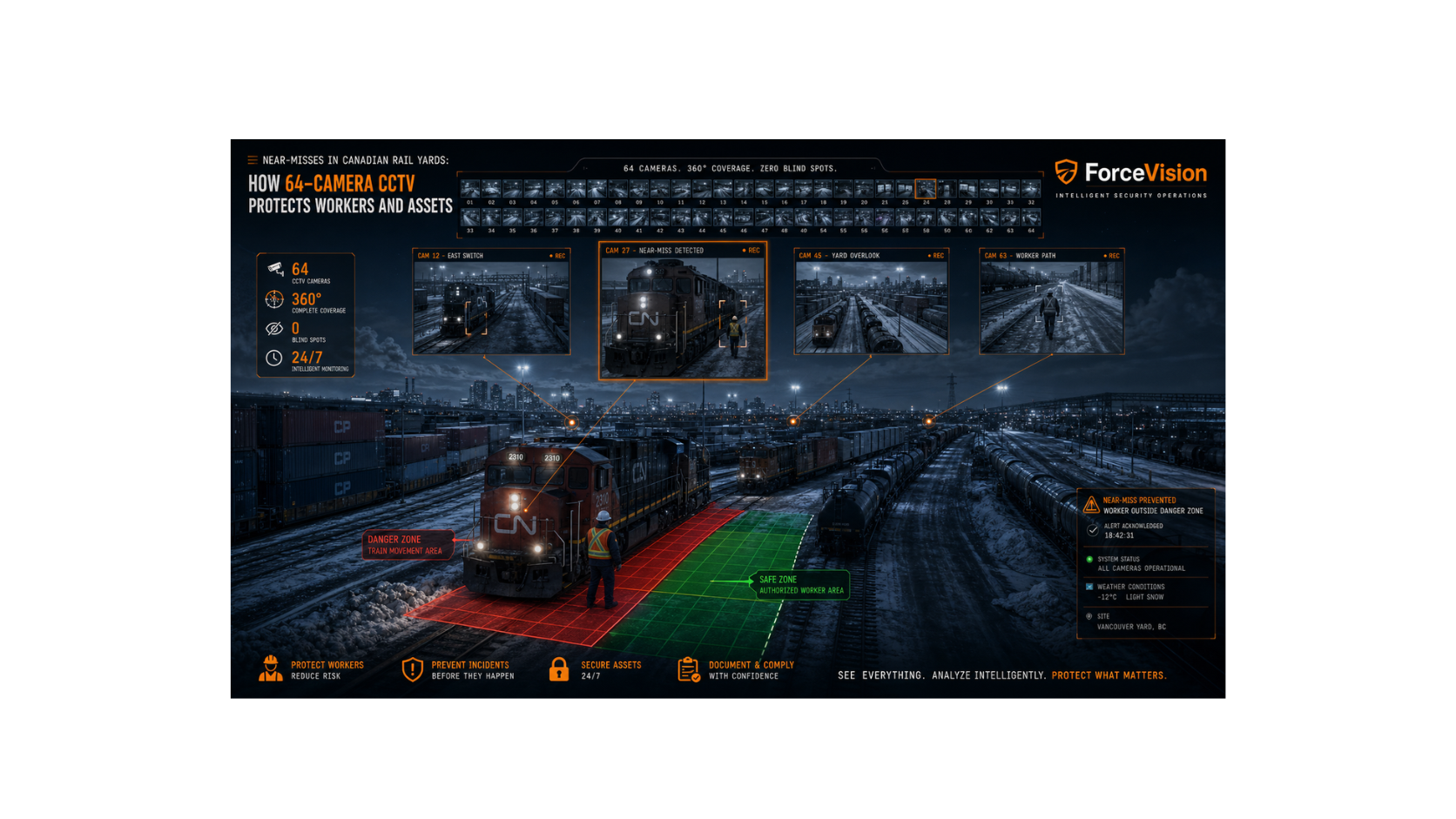
Across Canada’s rail network, yards are where the risk concentrates: locomotives shunting, trains being built, contractors and employees moving between tracks, and trucks loading containers at intermodal terminals. In these complex environments, a single misstep can result in severe injury, damage to rolling stock, or days of service disruption.
Recent Transportation Safety Board (TSB) reports and union briefings have described near‑miss events in Canadian rail yards where crew members were almost struck by moving equipment or where rail cars rolled unexpectedly in busy switching zones. While each incident had its own causes, one theme appears repeatedly—limited visibility for supervisors trying to manage large, multi‑track yards in real time.
Why traditional rail yard surveillance falls short
Historically, rail yards relied on a mix of spotters, radios, and a handful of cameras positioned near main buildings, fuel pads, or gatehouses. These systems were often installed incrementally, focused on loss prevention or perimeter security rather than holistic operational oversight.
The challenge is scale. Large facilities used by operators like CN and CPKC can span dozens of tracks, multiple ladder tracks, and several kilometres of internal roads. A few fixed cameras pointed at critical junctions cannot give safety managers the complete picture they need to understand where crews, locomotives, and contractors are at any given moment.
When a near‑miss occurs—a switch thrown at the wrong time, a worker stepping into a foul zone, a truck cutting across a track—investigators frequently find that no usable footage exists of the moments leading up to the event. That makes it harder to address root causes and design better protections for crews.
How 64‑camera CCTV changes the safety baseline in rail yards
A 64‑camera CCTV system for Canadian rail yards is not about watching more screens; it is about building a visual map of how your yard actually operates. With a thoughtful design, those 64 cameras can be positioned to capture:
-
Ladder tracks and key switching zones where rolling stock is constantly on the move
-
Pedestrian walkways, crew change points, and parking areas where workers transition into the live yard
-
Fueling, servicing, and inspection tracks where locomotives spend significant time
-
Intermodal pads and loading areas where trucks interact closely with rail equipment
High‑mounted PTZ cameras can oversee entire zones, while fixed dome and bullet cameras fill in blind spots near structures, bridges, and signal towers. Crucially, the system is integrated into an NVR platform that allows safety teams to replay events from multiple angles and synchronize video with dispatch logs, radio recordings, and locomotive telemetry.
From incident reconstruction to proactive safety coaching
Once yard leadership has this level of visual coverage, the conversation can shift from “What happened?” to “How do we prevent this from happening again?”
Incident reconstruction becomes much more precise. Investigators can see:
-
The exact path a worker took through the yard
-
How close a shunting move came to a parked locomotive or work crew
-
Whether lighting, signage, or snow build‑up contributed to impaired visibility
-
How long rolling stock was left unsecured on a particular grade
But the real value emerges when supervisors and safety trainers use this footage to coach crews. Rather than relying on abstract rules, they can review real scenarios from their own yard during safety briefings, showing how small deviations from procedure create significant risk. This kind of concrete, local example has far more impact on safety culture than generic training videos.
Where video analytics fit into rail yard operations
Video analytics add another layer of protection for rail yards that already operate at high capacity. With the right configuration, analytics can help detect:
-
Unauthorized pedestrian presence in active track zones after certain hours
-
Vehicles crossing tracks at non‑designated locations
-
Individuals entering restricted areas such as signal huts, control rooms, or dangerous goods sidings
-
Abnormal activity around parked locomotives or high‑value cargo
Alerts can be routed to a central operations centre, on‑site security, or even directly to yardmasters, providing another set of eyes when radio traffic is heavy and crews are stretched. Some operators are also exploring analytics that flag potential obstructions on tracks or unusual dwell times for rolling stock in certain zones, helping operations teams detect issues before they impact mainline traffic.
Importantly, analytics are not a replacement for rule books or good supervision. They are a force multiplier that supports the people already responsible for safety.
Integrating CCTV with rail, safety, and HR workflows
For 64‑camera CCTV to deliver maximum value in Canadian rail yards, it needs to be integrated into more than just the security department.
-
Safety teams use footage to analyse near‑misses, validate corrective actions, and adjust training.
-
Operations management reviews busy periods to identify bottlenecks and redesign track usage or staffing.
-
HR and labour relations teams use video carefully, with clear policies, to understand patterns of unsafe behaviour or repeated procedural violations—focusing on coaching first, not punishment.
This whole‑yard view supports the long‑term goal that both management and unions share: sending every worker home safely while keeping trains and cargo moving reliably.
For rail operators, the cost of a 64‑camera rail yard system is small compared to the potential liability of a single serious incident involving injury, environmental damage, or major equipment loss.
What rail operators in Ontario should do now
Rail yards in Southern Ontario—from Hamilton and the Niagara region through the GTA up to Kitchener‑Waterloo and Barrie—face a mix of high traffic, harsh weather, and growing proximity to urban development. That combination makes clear, objective visibility more important than ever.
If you are responsible for a yard or intermodal terminal, now is the time to:
-
Map your current camera coverage against real risk areas—tracks, walkways, and busy crossings.
-
Identify zones where near‑misses have occurred and verify whether any usable footage existed.
-
Engage both safety and operations teams in defining what a “useful view” looks like in their part of the yard.
-
Consider how video analytics might help you monitor off‑hours activity and restricted infrastructure.
ForceVision works with large rail and intermodal operators across Southern Ontario to design 64‑camera and larger CCTV systems that align with real rail‑yard workflows, not just generic security checklists. If you are reassessing how your yard manages risk after recent near‑misses or incidents, ForceVision can help you explore options through a practical, no‑pressure yard assessment.
The key is to treat your CCTV platform as part of your safety system—not an afterthought. When cameras, analytics, and procedures work together, you create a yard where crews have the best possible chance to spot hazards early, and leaders have the insight they need to keep people and assets safe.
FAQ
Q1: Does installing more cameras mean more surveillance of employees?
A1: The goal in rail yards is not constant monitoring of individuals but better visibility into hazardous zones and high‑risk movements, with footage used primarily for safety improvements and incident analysis.
Q2: How does weather affect CCTV performance in Canadian yards?
A2: Industrial‑grade cameras with proper housings, heating, and lens selection are designed to handle snow, ice, and temperature swings, but placement and maintenance are critical to keep images clear.
Q3: Can existing yard radios and dispatch systems be tied into CCTV?
A3: Many modern NVR platforms can integrate with operations logs and even certain SCADA or dispatch tools, making it easier to align video timestamps with train movement and crew communication records.
Q4: How long should rail yards keep video recordings?
A4: Many industrial sites target 30–90 days of retention to cover delayed incident reporting and investigations, with specific durations guided by corporate policy and regulatory or insurance requirements.


