

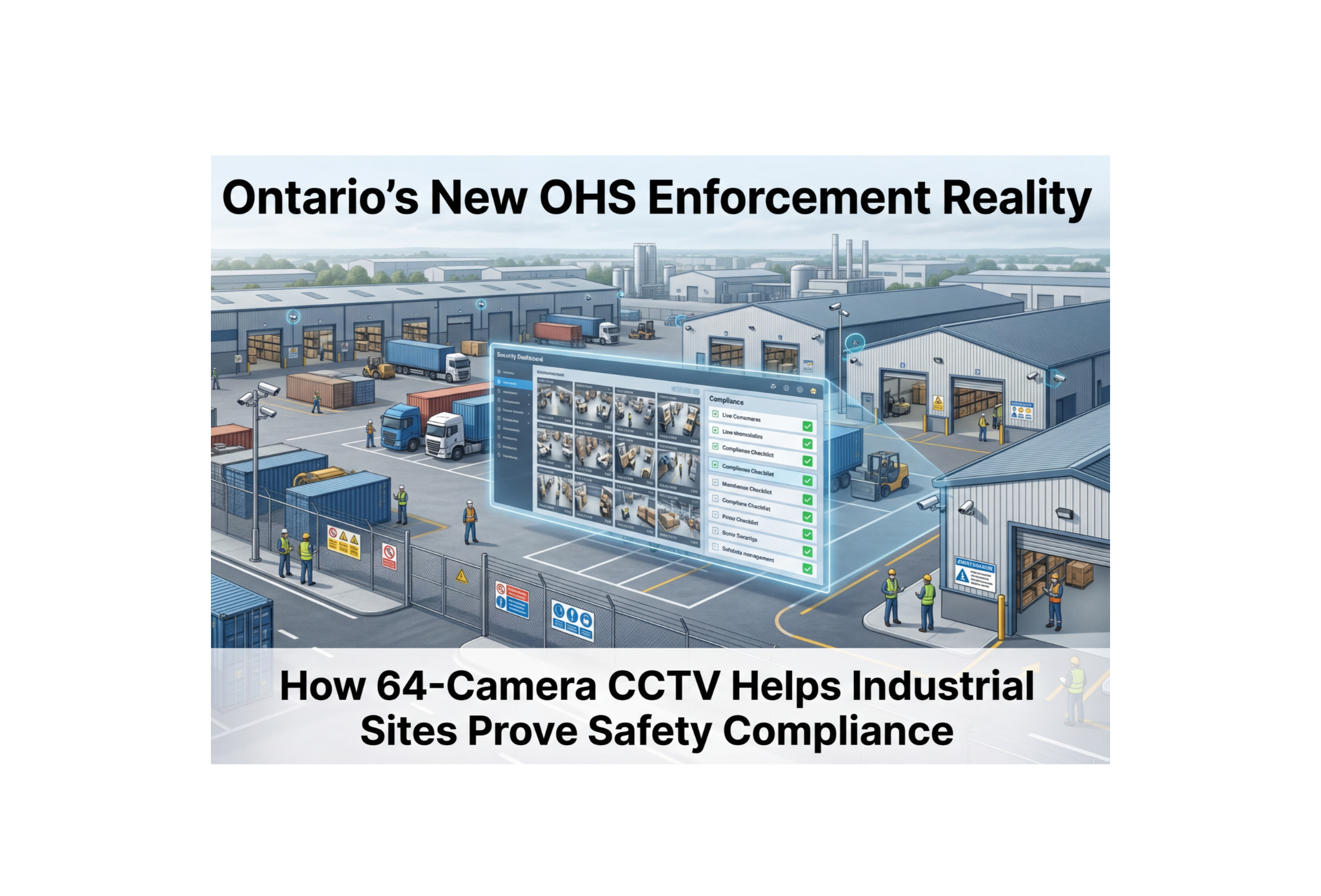
Ontario’s Tougher OHS Era: Why Documentation Is No Longer Optional
Ontario employers are entering a new era of occupational health and safety enforcement in 2026, with higher fines, expanded enforcement tools, and a sharper focus on due diligence. New administrative monetary penalties, increased maximum fines, and more proactive inspections mean safety leaders at large industrial operations can no longer rely on paper checklists and incident reports alone. When something goes wrong, regulators and courts will expect clear evidence of what you did to prevent it—and that is where industrial‑grade CCTV becomes a powerful ally.
For rail yards, manufacturing plants, energy facilities, and logistics hubs, the stakes are massive. A single serious injury or fatality can trigger investigations, stoppages, reputational damage, and seven‑figure cost exposure once fines, legal fees, and downtime are tallied. In this environment, a 64‑camera industrial CCTV system is not just a security tool; it is a safety and compliance instrument that can help prove, in detail, how work is really being done across your site.
What Has Changed in Ontario’s OHS Enforcement Landscape?
Recent updates to Ontario’s Occupational Health and Safety Act and related regulations have expanded the toolbox available to the Ministry of Labour, Immigration, Training and Skills Development (MLITSD). Key trends safety and operations leaders should be aware of include:
-
Higher maximum fines for corporations and individuals, making serious violations much more expensive.
-
Greater use of administrative monetary penalties (AMPs), allowing faster financial consequences for non‑compliance without a full prosecution.
-
Increased emphasis on due diligence—what proactive, reasonable steps employers took to identify and control hazards before an incident.
In practice, this means inspectors and courts are asking more detailed questions: How do you verify that machine guarding is in place? How do you know contractors followed confined space procedures? How do you demonstrate that vehicles and pedestrians are separated in the yard? Written policies help—but they are no substitute for hard evidence of day‑to‑day behaviour.
Due Diligence and the Role of Visual Evidence
Under Ontario law, due diligence is the defence that you took all reasonable precautions in the circumstances to protect worker health and safety. Safety training logs, hazard assessments, and inspection records are key components of that defence, but they rely heavily on what people remember and record.
CCTV adds something different:
-
Objective visual records of how work actually happened at specific times.
-
The ability to reconstruct events leading up to an incident, not just the moment itself.
-
Proof that controls—barriers, signage, PPE use, traffic patterns—were in place and being followed, or clear evidence of deviations that can be corrected.
In serious cases, video has been a decisive factor in showing whether an employer’s efforts were genuine and consistent or confined to policy binders. For large industrial sites that span yards, shops, and process areas, a 64‑camera system is often what it takes to get meaningful, incident‑ready coverage.
Where Industrial CCTV Should Focus to Support OHS Compliance
To support OHS compliance, camera placement needs to follow risk, not just doors. At CN‑style rail yards, Magna‑scale manufacturing plants, and major logistics or energy sites, that means focusing on:
-
High‑risk operations: loading docks, rail sidings, crane operations, high‑traffic intersections, fuel or chemical transfer points, and confined space entry zones.
-
Pedestrian–vehicle interaction zones: yard roadways, forklift aisles, trailer yards, and parking areas where collisions are a major hazard.
-
Machine‑intensive production areas: assembly lines, packaging cells, and maintenance bays where contact with moving parts or stored energy can cause severe injuries.
-
Emergency routes and muster points: exits, stairwells, and gathering areas used during drills and real evacuations.
A 64‑camera layout allows you to cover these critical zones with overlapping views, ensuring you can see not just what happened, but how people and equipment moved in the seconds and minutes before an event. That context is invaluable for root‑cause analysis and for demonstrating to inspectors that you understand and monitor your risk profile.
Turning Camera Footage into Safety Intelligence
CCTV becomes far more valuable when safety and operations teams use it proactively, not just after a serious injury. Many industrial operators are starting to:
-
Review clips of near misses to identify recurring patterns—forklifts cutting corners, pedestrians taking unofficial routes, or crews bypassing guarding for speed.
-
Audit compliance with critical procedures, such as lockout/tagout, working at heights protocols, or hot work permits, using random video samples to validate inspection checklists.
-
Use anonymised footage in training to show real examples of both safe and unsafe behaviours drawn from the site itself.
Research on OHS interventions shows that feedback tied to real work situations is more likely to change behaviour than generic slides alone. When a supervisor can say, “This is what actually happened last week in our yard, and here’s how we’re going to fix it,” the message lands differently.
How CCTV Supports Inspections, Investigations, and Joint Health & Safety Committees
Ontario’s joint health and safety committees (JHSCs) and worker representatives play a growing role in identifying hazards and tracking corrective actions. Video can support those efforts in several ways:
-
Pre‑inspection review: supervisors and JHSC members can scan recent footage from high‑risk zones to spot issues before an MLITSD inspector arrives.
-
Post‑inspection follow‑up: if an order is issued, CCTV can help verify that new controls (e.g., barriers, signage, traffic patterns) are actually being used as intended.
-
Incident investigations: JHSCs can use footage to support root‑cause analysis, ensuring corrective actions address real behaviours and conditions rather than assumptions.
This collaborative use of CCTV reinforces a culture where cameras are understood as tools for joint problem‑solving, not one‑sided monitoring. That cultural piece matters when enforcement intensity is rising—worker buy‑in can make or break your ability to sustain safer practices.
Addressing Privacy and Surveillance Concerns
As enforcement tightens, there can be a temptation to “point cameras everywhere,” which risks clashing with privacy expectations and labour law. Industrial employers in Ontario need to strike a balance:
-
Provide clear notice and policies explaining why CCTV is used, where cameras are located, and how footage may support safety investigations.
-
Avoid cameras in private spaces such as washrooms and change rooms, and limit views in break areas to what is reasonably necessary for safety and security.
-
Set access controls and retention rules so video is only used by trained individuals for legitimate purposes, with audit trails.
Handled correctly, this transparency can turn CCTV into something workers see as part of a broader safety effort rather than a “big brother” tool, which in turn makes it easier to leverage footage for coaching and investigations.
How ForceVision Designs 64‑Camera Systems with OHS in Mind
ForceVision specialises in 64‑camera‑and‑larger systems for industrial clients—rail operations, energy terminals, manufacturing plants, and logistics hubs—where asset protection and worker safety go hand in hand. Rather than just covering doors and fences, ForceVision works with safety and operations teams to:
-
Map camera coverage directly to OHS risk hotspots and critical tasks.
-
Ensure NVR and VMS platforms support easy retrieval and secure sharing of clips for inspectors, investigators, and insurers.
-
Plan phased upgrades from smaller, security‑only systems to multi‑department platforms that serve operations, safety, and HR.
If Ontario’s new OHS enforcement landscape has you re‑examining whether you can prove due diligence across your rail yards, plants, or terminals, ForceVision can walk your team through what an OHS‑aware 64‑camera design would look like for your specific sites with a free assessment. The aim is straightforward: strong safety performance you can see—and prove.
FAQs: Industrial CCTV and OHS Compliance in Ontario
Can CCTV footage really help with a due‑diligence defence?
Yes. While it is only one piece of the puzzle, clear video showing that guards, procedures, and supervision were in place can strongly support a claim of due diligence in Ontario OHS prosecutions.
How long should industrial sites keep safety‑relevant video?
Retention should match your risk profile, but many large operators keep 30–90 days of footage for high‑risk zones so they can investigate incidents, respond to inspector questions, and support internal reviews.
Will inspectors expect us to have cameras everywhere now?
No regulation mandates CCTV, but as enforcement tightens, inspectors will increasingly expect robust evidence of how work is performed in high‑risk areas; industrial CCTV is a practical way to provide that evidence for large, complex sites.
How do we avoid CCTV becoming just a disciplinary tool?
Set clear policies that prioritise safety, coaching, and incident investigation, involve JHSCs in governance, and share examples where video helped improve conditions rather than just punish workers.


