

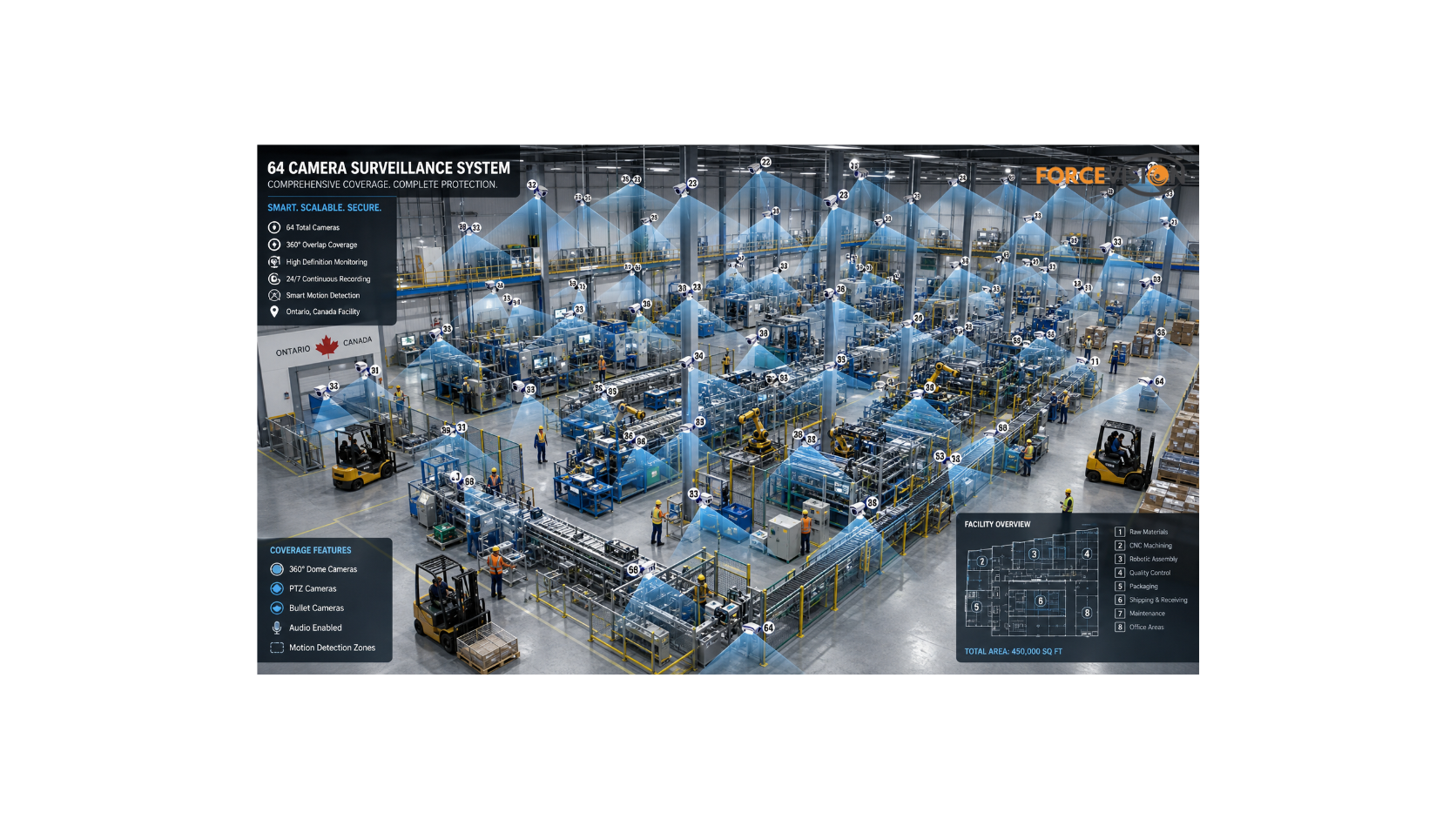
Large manufacturing plants in Southern Ontario are under growing pressure to protect high‑value inventory, maintain safe work environments, and find new efficiencies on crowded shop floors. Internal theft rings, cargo losses, and unauthorized after‑hours access have all made recent headlines in Canadian industrial settings. At the same time, insurers and corporate risk teams are asking tougher questions about how well sites can reconstruct incidents and demonstrate control.
For many plant managers, the challenge is that their current camera system grew organically: a few analog units over time clocks, some IP domes near loading docks, and maybe a PTZ in the yard. That patchwork rarely adds up to a coherent 64‑camera CCTV platform for large Ontario manufacturing plants — and it often fails when a serious theft, injury, or quality dispute lands on their desk.
Why think in terms of a 64‑camera platform?
The shift from “a few cameras” to a “platform” is about aligning your video system with the real risk and process map of the plant. Once you map production lines, material flow, finished‑goods storage, and external yards, it becomes clear how quickly camera counts rise:
-
Exterior perimeters, parking, and yards.
-
Raw material receiving and main docks.
-
High‑risk production cells and assembly areas.
-
Finished goods storage and shipping.
-
Critical infrastructure rooms (server, electrical, compressor).
When you take a structured approach, 64 cameras often emerge as a realistic baseline for medium‑to‑large manufacturing sites, not an extravagance.
How should plants prioritize coverage zones?
A practical starting point is to rank zones by a blend of value, risk, and activity:
-
High value, high risk (HVHR): Tool rooms, finished goods cages, high‑value intermediate storage, dock doors handling premium product.
-
High value, medium risk (HVMR): High‑throughput lines, QC labs, specialized material areas.
-
Medium value, high risk (MVHR): Areas with significant safety risk such as mixing vessels, presses, or heavy‑lift zones.
HVHR areas usually get dedicated fixed cameras, sometimes in pairs for redundancy, with angles chosen to clearly capture who enters, what they handle, and where items move next. MVHR areas may prioritize wider views for incident reconstruction and safety analysis.
Exterior coverage should not be an afterthought. Yard views, trailer staging, and employee parking lots can all be relevant in theft and safety investigations, and they are often easier to equip with higher‑mounted bullet and PTZ cameras.
What role do analytics play on the plant floor?
Video analytics developed for rail and other industrial environments can also be applied inside plants to monitor people and vehicles, detect abnormal behaviour, and highlight congestion.
Common manufacturing use cases include:
-
Virtual perimeters around restricted areas such as chemical storage or robot cells, triggering alerts when unauthorized personnel enter.
-
Line‑crossing detection at emergency exits or unauthorized shortcuts, identifying risky or non‑compliant behaviour.
-
People counting or occupancy analytics in high‑traffic areas to support ergonomics and layout improvements.
Analytics also aid investigations. If a high‑value component keeps going missing from a particular staging area, analytics can quickly surface all off‑hours visits to that zone, rather than requiring staff to manually scrub hours of video.
How can a CCTV platform support safety and HR, not just security?
Plant leaders are increasingly using CCTV not just as a deterrent, but as a tool to support safety culture and fair HR processes. By giving safety and HR teams controlled access to relevant views, they can:
-
Review near‑misses and incidents to understand root causes and refine training.
-
Validate or refute conflicting accounts in a way that is seen as impartial and fact‑based.
-
Identify patterns of unsafe shortcuts before they result in injuries.
Of course, this must be balanced with clear policies, privacy considerations, and union or workforce communication, but when handled transparently, video can reinforce a shared commitment to safety and fairness.
How can ForceVision help plants move from patchwork to platform?
Moving from a scattered camera set‑up to a 64‑camera CCTV platform for large Ontario manufacturing plants is best approached as a structured upgrade, not a one‑off purchase. That means:
-
Starting with a risk and operations assessment: mapping zones, flows, and pain points.
-
Designing a camera layout and NVR or enterprise platform that can scale as the plant evolves.
-
Deciding where analytics and remote monitoring make sense today, and where conduits and mounting points should be pre‑positioned for future expansion.
ForceVision works with manufacturers across Southern Ontario to build these plans, focusing on systems that integrate with existing networks, respect IT and OT requirements, and deliver value to security, safety, and operations teams. If you are looking at an aging camera system and wondering where to start, a no‑pressure design review can quickly reveal which investments will move the needle.
FAQ
Q1: How long does it take to deploy a 64‑camera system in an operating plant?
A1: Timelines vary, but many projects can be phased over weeks or months, aligning installation with scheduled downtime and minimizing disruption.
Q2: Do we need 4K cameras everywhere?
A2: Not necessarily. High‑resolution cameras are best reserved for identification zones (entries, docks, cages), while overviews and safety monitoring often work well at lower resolutions.
Q3: Can existing analog cameras be integrated?
A3: Yes, encoders and hybrid NVRs can bring analog feeds into a modern IP platform, allowing gradual replacement as budgets allow.
Q4: Who should “own” the CCTV platform internally?
A4: Successful deployments usually involve shared ownership between security, operations, IT, and safety, with clear governance on access and usage.


