

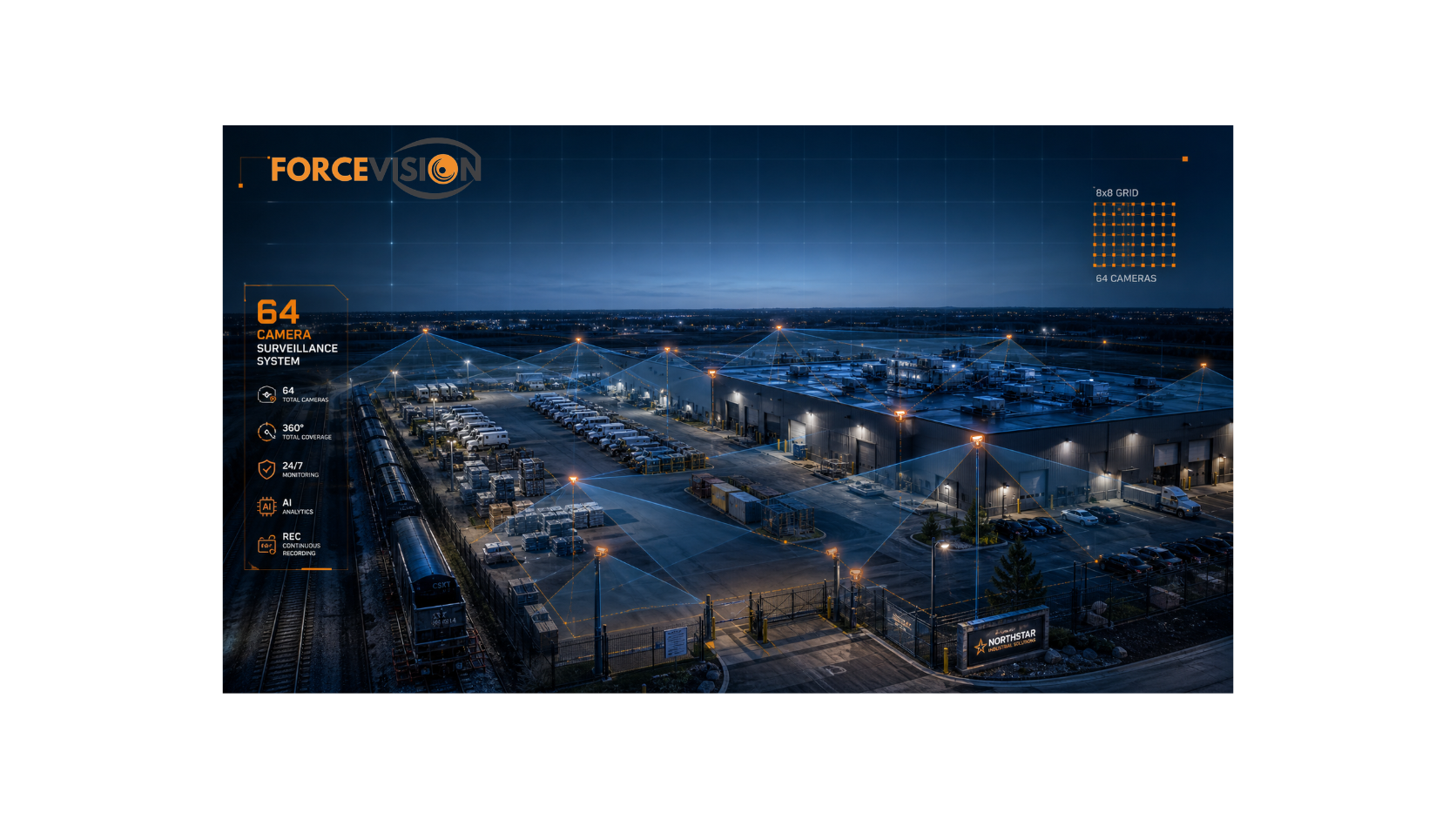
Large industrial operators across Southern Ontario—rail yards, manufacturing plants, logistics hubs, and energy facilities—are increasingly finding that 16 or 24 cameras simply are not enough. As sites grow and risks evolve, many are now planning a 64‑camera CCTV system as their new baseline for asset protection and safety. The challenge is knowing where to start and how to make sure that investment delivers more than just more screens in a control room.
Unlike retail or small commercial installations, large industrial sites must blend security, safety, and operational needs into a single video strategy. Rail operators want to see who touches rolling stock, manufacturers want to understand the flow of materials and people, and logistics hubs need to verify every trailer move. A well‑planned 64‑camera layout can satisfy all three if it is built around risk and process, not just building footprints.
What makes industrial CCTV planning different?
The first difference is scale. A single CN‑size rail yard, an auto plant, or an intermodal terminal can span dozens of acres, with multiple gates, large open yards, and complex building layouts. Planning a 64‑camera CCTV system for large industrial sites in Ontario means thinking in zones—perimeter, yard, production, loading, storage—rather than simply “inside” and “outside.”
The second difference is the variety of stakeholders. Security cares about intrusions and theft; operations cares about bottlenecks and delays; safety teams focus on near‑misses and rule compliance; HR is concerned with conflict and behaviour patterns. If CCTV is only designed for one of these groups, the system will never deliver its full value.
Step 1: Map risks, not just buildings
Planning should start with a risk map rather than a floor plan. Ask cross‑functional stakeholders to identify:
-
Where high‑value assets are stored or moved.
-
Where people and heavy equipment intersect.
-
Where past incidents—injuries, thefts, near‑misses—have occurred.
-
Where the greatest uncertainty or “gut feel” concerns exist.
This exercise typically reveals that some of the most important areas (like back corners of yards, internal corridors between buildings, or staging areas) have little or no coverage today. Those become priority targets for new cameras as part of a 64‑camera CCTV system for large industrial sites in Ontario.
Step 2: Choose the right mix of camera types
Most industrial deployments blend three main camera types:
-
Bullet cameras for long, fixed views along fences, lanes, or conveyor lines.
-
Dome cameras for general area coverage in warehouses, bays, and corridors.
-
PTZ cameras for flexible, operator‑driven views across yards or production areas.
In some outdoor or low‑light environments, thermal cameras can fill gaps where visible‑light cameras struggle. The right mix depends on the site, but a common pattern is to use fixed cameras to ensure continuous coverage and PTZs to zoom in when something happens.
Step 3: Design for evidence and analytics
A 64‑camera system should be designed with tomorrow’s analytics in mind, not just today’s recording needs. That means:
-
Ensuring sufficient resolution and frame rates to capture faces, plates, and key actions.
-
Avoiding extreme wide‑angle views that dilute detail.
-
Providing consistent lighting or IR illumination at night.
When planning a 64‑camera CCTV system for large industrial sites in Ontario, it is worth thinking about how you will use footage as data. Can analytics reliably distinguish people from vehicles? Can you set virtual tripwires along restricted zones? Will your NVR platform support future AI modules? Building in that headroom now avoids costly retrofits later.
Step 4: Integrate CCTV with your wider security and operations stack
Standalone systems are harder to manage and often underused. Integration with access control, alarms, and operational systems makes it easier for teams to act quickly. Examples include:
-
Pulling up camera views automatically when a door alarm goes off.
-
Linking badge swipe data to video clips near sensitive storage.
-
Using video to validate sensor alarms before dispatching responders.
For large industrial operators, this integration also makes reporting and auditing easier. When insurance carriers or regulators ask for evidence of an incident or proof of controls, you can produce a coherent record spanning physical and logical events.
Step 5: Plan for growth and lifecycle
Industrial sites change: new lines, expanded yards, reconfigured docks. A well‑designed system anticipates this by leaving spare NVR capacity, extra network ports, and flex in camera placement. Planning a 64‑camera CCTV system for large industrial sites in Ontario should include a three‑ to five‑year roadmap: what zones are essential today, and which are likely to be added as capital projects roll out?
It also means planning for lifecycle: cameras, servers, and storage will need refresh cycles. Standardising on industrial‑grade, enterprise‑supported equipment helps reduce surprise failures and makes maintenance predictable.
How ForceVision supports planning and design
ForceVision specialises in designing 64‑camera‑and‑above systems for large industrial yards and plants across the Golden Horseshoe. Our design process typically includes:
-
Site walks and risk mapping with security, safety, and operations teams.
-
Draft camera layouts and coverage simulations for key zones.
-
Recommendations for NVR platforms, storage, and retention policies.
If you are beginning to plan an upgrade—or replacing a patchwork system grown over many years—ForceVision can provide a structured assessment and practical options, without pressure. The objective is to build a camera platform that supports asset protection, safety, and employee retention, not just a grid of lenses.
A useful internal conversation to kick‑off planning
A simple way to start is to ask your leadership team three questions:
-
What recent incident would have been easier to handle with better video?
-
Which areas of your site worry you most after hours?
-
Who outside of security could benefit from regular access to video insights?
The answers will quickly clarify where a 64‑camera system can make the biggest difference in the next 12–24 months.
FAQ
Q1: Is 64 cameras overkill for a single site?
A: For small facilities, yes. But for large yards, plants, and hubs, 64 cameras is often the minimum needed for meaningful coverage of perimeters, operations, and safety hotspots.
Q2: Do we need to rip and replace our existing system?
A: Not necessarily. Many industrial sites phase upgrades, integrating existing cameras where feasible while adding new IP units and NVRs to extend coverage.
Q3: How do we avoid overwhelming operators with too many feeds?
A: Use analytics, alarm‑driven views, and clear SOPs so operators focus on events and investigations rather than passively watching every camera.
Q4: What about budget constraints?
A: Phased deployment—prioritising highest‑risk zones first—allows many operators to spread capital costs while still gaining immediate risk reduction.


