

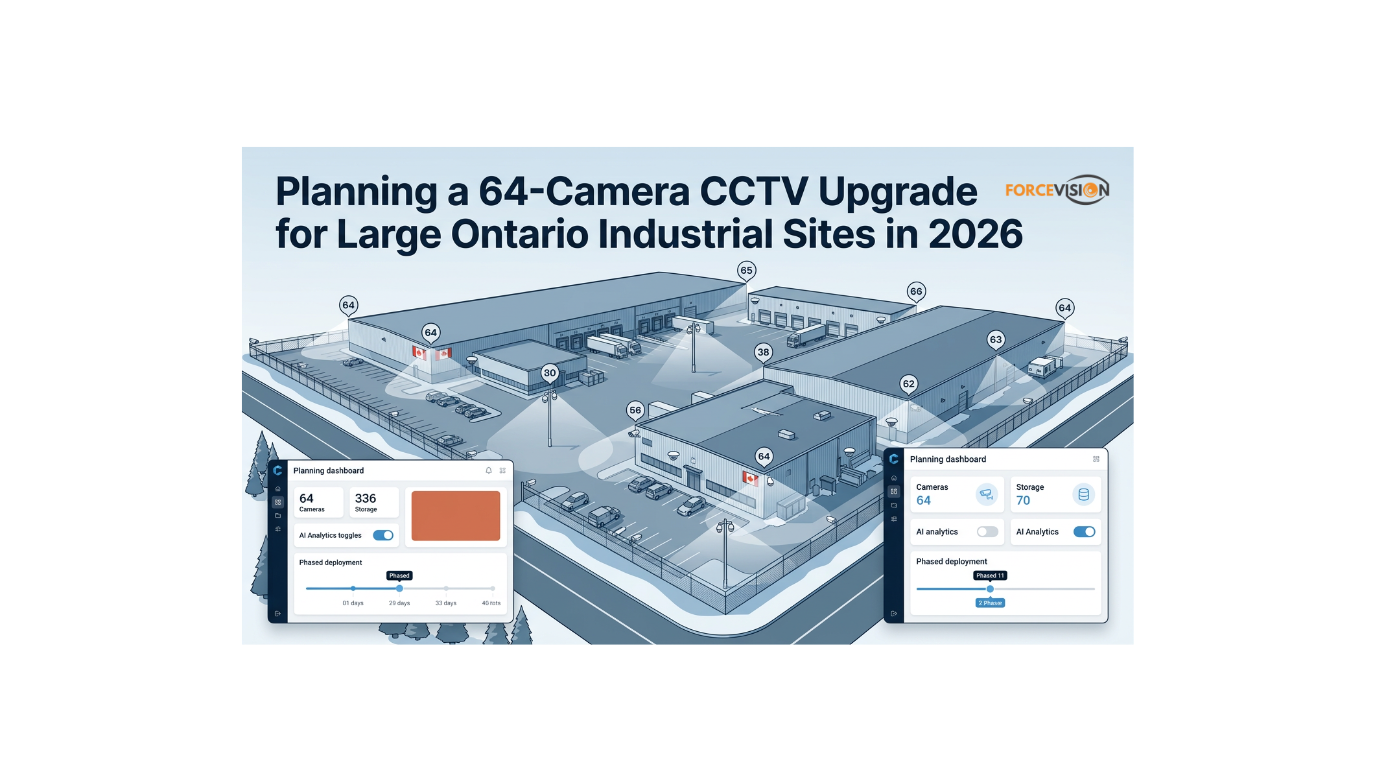
Many large industrial operators in Southern Ontario are sitting on the same uncomfortable truth: their CCTV systems were designed for a very different era. A handful of analogue cameras aimed at doors and a yard gate may have been adequate 15 years ago, but they do little to protect a multimillion‑dollar rail yard, manufacturing plant, or energy facility in 2026.
At the same time, the idea of jumping straight to a 64‑camera or 128‑camera upgrade can feel overwhelming—technically, financially, and culturally. The good news is that planning a 64‑camera industrial CCTV upgrade in Ontario doesn’t have to mean ripping everything out at once; with a structured approach, operators can phase upgrades and start realising value quickly.
Why are legacy systems failing large industrial sites?
Industrial risk has changed. Rail yards now handle higher volumes with tighter schedules, manufacturing lines are more automated, and energy facilities face increased regulatory scrutiny and cyber‑physical concerns. Legacy systems struggle because they:
-
Lack the resolution to support investigations or analytics.
-
Cover only a fraction of the real risk surface—ignoring yards, loading areas, and high‑value processes.
-
Have limited retention, making it hard to review incidents after they surface.
-
Cannot easily integrate with access control, SCADA, or yard/warehouse management systems.
The result is a system that technically “exists,” but offers little operational, safety, or HR value.
What should be the first step in planning an upgrade?
Before talking about brands or budgets, start with a risk‑based camera map:
-
Identify your most valuable assets (locomotives, tank farms, CNC lines, transformers, high‑value inventory).
-
Map the paths those assets take—through yards, bays, assembly stages, or pipe racks.
-
Highlight interfaces where people and assets interact: loading docks, maintenance bays, control rooms, rail crossings.
This exercise often reveals that many existing cameras are watching low‑risk zones, while critical movements are uncovered. It sets the stage for deciding where your first 32–64 upgraded cameras will deliver the highest impact.
How can operators phase a 64‑camera upgrade to manage budget and disruption?
A practical approach is to break the upgrade into manageable phases:
-
Core risk coverage: Replace or add cameras around your highest‑risk assets and interfaces (for example, rail crossings, tank farms, main production lines, and primary yards).
-
Perimeter and access: Expand coverage to gates, fences, parking areas, and secondary yards.
-
Operational visibility: Add cameras to support process optimisation—bottleneck areas, traffic flows, staging yards.
-
Fine‑tuning and analytics: Enable advanced analytics and refine views based on incident data and feedback.
Each phase should deliver tangible value—reduced theft, faster incident investigations, fewer safety near‑misses—so the business case for the next phase becomes easier to justify.
How important is NVR and platform selection?
The camera count gets most of the attention, but the NVR and management platform are the backbone of the system. For large industrial sites, look for:
-
Support for current and future camera counts (64+ channels with headroom).
-
Robust retention and redundancy to meet your policy and regulatory needs.
-
Integration paths with access control, HR systems, and operational platforms.
-
User‑friendly search and export tools so safety, HR, and operations can use footage without IT bottlenecks.
Choosing a scalable NVR platform early prevents the “second upgrade” problem where you outgrow your system long before the hardware is due for replacement.
How can operators ensure they’re designing for more than security?
A 64‑camera upgrade is an opportunity to reposition CCTV as a cross‑functional asset:
-
Operations can use footage to study congestion in yards or along conveyor lines.
-
Safety teams can review near‑misses around cranes, forklifts, or confined spaces.
-
HR can use objective context to resolve disputes and support return‑to‑work plans after injuries.
When these stakeholders are involved in the design, camera placement naturally shifts toward areas that deliver 10x value across the organisation, not just traditional “security hot spots.”
Where does ForceVision fit into planning a 64‑camera upgrade?
ForceVision works with rail, manufacturing, energy, and logistics operators across Southern Ontario who are planning a 64‑camera industrial CCTV upgrade in Ontario, often from fragmented legacy systems. We help clients build phased roadmaps that align with budget cycles, union considerations, and operational realities.
Rather than pushing a one‑size‑fits‑all solution, we start with risk‑mapping workshops and on‑site walkthroughs, then translate those into camera layouts, NVR architectures, and rollout plans. If you’re wondering how to move from a 16‑camera patchwork to a true industrial‑grade platform, ForceVision can provide a no‑pressure assessment grounded in your specific site.
What should industrial leaders do this budgeting cycle?
As you prepare annual budgets and capital plans, carve out time to:
-
Review incident reports from the past 12–24 months and note where video helped—or where it was missing.
-
Ask each department (operations, safety, HR, security) how they would ideally use video.
-
Prioritise one or two sites for a 64‑camera upgrade pilot that can set the standard for the rest of the portfolio.
By treating CCTV as core infrastructure rather than a discretionary security add‑on, industrial operators can build a long‑term platform that protects assets, supports people, and strengthens operations.
FAQ
Q1: How long does a 64‑camera upgrade typically take?
A: Timelines vary, but many Ontario sites can complete design, procurement, and phased installation over several months, scheduled around shutdowns or low‑traffic periods.
Q2: Can we mix old and new cameras during the transition?
A: Yes, hybrid approaches are common; the key is ensuring your NVR platform can manage both legacy and new IP cameras while you phase out older units.
Q3: How do we justify the cost beyond security?
A: Document savings from faster investigations, reduced shrink, fewer safety incidents, and improved process efficiency; these benefits often far exceed the initial capital outlay.
Q4: Are there regulatory considerations for video retention?
A: Requirements vary by sector, but many industrial operators choose retention policies that align with incident reporting timelines, union agreements, and insurance expectations.


