

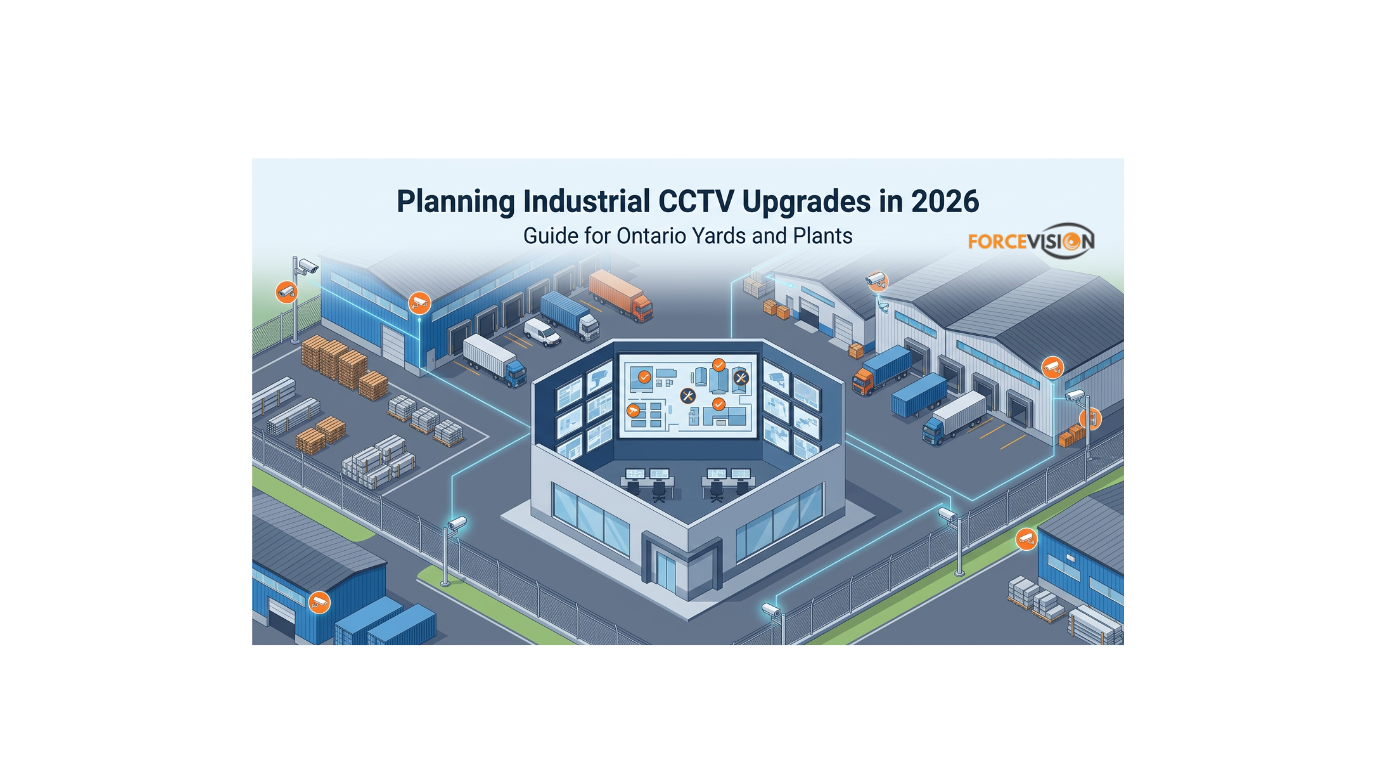
Across Southern Ontario, large industrial operators are re‑evaluating their security and operations technology stacks. In the past year alone, high‑profile thefts, insider incidents, and major industrial fires have highlighted just how exposed complex yards, plants, and logistics hubs can be without modern CCTV. At the same time, advances in video analytics and NVR platforms make it possible to extract far more value from camera deployments than many sites currently do.
If you are responsible for a rail‑serving warehouse in Mississauga, a large manufacturing plant in Hamilton, or a regional distribution hub around Barrie, 2026 is an ideal time to plan industrial CCTV upgrades in Ontario. The key is to move beyond “more cameras” and design systems that deliver yard‑wide visibility, support safety culture, and provide a clear return on investment.
Why 2026 Is a Turning Point for Industrial CCTV
Several forces are converging for Ontario’s industrial operators:
-
Incident pressure: Recent heavy equipment thefts and large‑scale fires have exposed weaknesses in perimeter security, insider monitoring, and evidentiary documentation.
-
Insurance scrutiny: Insurers increasingly ask detailed questions about camera coverage, retention periods, and monitoring practices before underwriting large industrial risks.
-
Technology maturity: Video analytics, cloud‑connected NVRs, and high‑resolution IP cameras are now mature enough to deploy at scale in harsh industrial environments.
As a result, executives are asking whether their current systems—often a patchwork of legacy analog cameras and small NVRs—can truly support their asset‑protection and safety obligations. For many, the answer is no.
Step 1: Map Risk, Not Just Buildings
The first step in planning industrial CCTV upgrades in Ontario 2026 is to map risk, not just physical structures. A rail yard, for example, may have minimal buildings but multiple high‑risk zones: classification tracks, road crossings, fuel points, and perimeter access along public rights‑of‑way. Similarly, a manufacturing plant includes outdoor yards, indoor production lines, high‑bay storage, and critical utilities.
When mapping risk, consider:
-
Where are the highest‑value assets stored or moved (locomotives, trailers, specialized tooling, hazardous materials)?
-
Where have incidents actually occurred in the last three to five years (thefts, near‑misses, injuries, suspicious activity)?
-
Where do people and vehicles interact most intensely (gates, crossings, docks, fuelling points, shipping lanes)?
These answers should drive camera placement and coverage decisions more than simple floor plans or building outlines.
Step 2: Set a 64‑Camera Baseline and Plan for Growth
For large industrial sites, 64 cameras is a practical baseline: enough to cover key risk areas inside and outside, while still manageable within a single enterprise NVR platform. Many operators will quickly grow beyond that, especially if they manage multiple adjacent yards or a mix of plant and warehouse operations.
Key planning tasks include:
-
Prioritizing critical zones: Assign cameras first to high‑impact areas where incidents would have the greatest operational or financial consequences.
-
Balancing fixed and PTZ cameras: Fixed cameras provide consistent coverage of specific zones; PTZ units add flexibility and zoom but should supplement, not replace, fixed viewpoints.
-
Considering phased deployment: If budget is constrained, roll out upgrades in phases—starting with perimeter, high‑value asset zones, and known trouble spots—while designing infrastructure (conduit, bandwidth, NVR capacity) for future expansion.
This approach ensures that early investments deliver immediate risk reduction while laying the groundwork for full yard‑ or plant‑wide visibility.
Step 3: Integrate Analytics and Monitoring from Day One
New industrial CCTV deployments should be analytics‑ready from the start. Retrofitting analytics later is possible, but much easier when camera placement, resolution, and angles are chosen with machine interpretation in mind.
Best practices include:
-
Specifying cameras with sufficient resolution and low‑light performance for analytic algorithms to work reliably.
-
Designing clear zones for intrusion and behaviour rules to avoid cluttered scenes that generate false alarms.
-
Integrating feeds into a monitoring workflow—whether in‑house or via a third‑party centre—so that alerts are verified quickly and escalated appropriately.
In parallel, define use cases beyond security: yard congestion mapping, dock utilization, near‑miss detection, and process verification. When operations leaders see immediate value from the new system, it becomes much easier to justify future expansion and maintenance budgets.
Step 4: Align CCTV with Safety, HR, and Compliance
Industrial CCTV upgrades in Ontario are most successful when safety, HR, and compliance teams are involved early. These groups can help identify:
-
High‑risk tasks where video evidence would be valuable for training and incident review.
-
Areas where documented safety compliance (PPE, lock‑out/tag‑out, safe walking routes) matters most for regulators and insurers.
-
Policies required to ensure fair use of video for investigations and performance management, including defined retention periods and access controls.
Involving these stakeholders not only improves system design but also builds trust with front‑line employees, who see CCTV as a tool for safer, better‑managed work rather than constant surveillance.
ForceVision’s Role in 2026 Upgrade Programs
ForceVision partners with large industrial operators across Southern Ontario—rail yards, manufacturing plants, logistics hubs, and energy facilities—to plan and execute industrial CCTV upgrades in Ontario 2026. Rather than selling isolated camera packages, ForceVision looks at your whole risk and operations picture: assets, people, processes, and regulatory pressures.
If you are considering an upgrade in the next budget cycle, ForceVision can provide a no‑pressure assessment that benchmarks your current system against best practice for a 64‑camera industrial deployment and outlines a phased roadmap. That roadmap covers camera types and placement, NVR design, analytics integration, and governance policies needed to unlock 10x operational value from your video investment.
A useful way to start is by listing your top five worries—asset loss, major safety incidents, bottlenecks, claims disputes, or insider threats—and asking how your current cameras contribute to each. If the list reveals more gaps than answers, your 2026 plan should put CCTV modernization near the top.
FAQ
Q1: How long does a major CCTV upgrade typically take?
For large industrial sites, planning and deployment can span several months, especially when trenching, network upgrades, and integration with existing systems are required.
Q2: Can we reuse any of our existing cameras and cabling?
Often yes; many upgrades mix new IP cameras and NVRs with selected legacy hardware, but careful assessment is needed to ensure old components do not become the weakest link.
Q3: How do we justify the cost of a 64‑camera system?
By quantifying avoided incidents, reduced claims, improved uptime, and greater operational efficiency, many industrial operators find the payback period is much shorter than expected.
Q4: Should we consider cloud or hybrid storage?
Hybrid models that combine on‑site NVRs with selective cloud backup for critical footage can balance bandwidth, resilience, and evidentiary needs for large industrial operations.


