

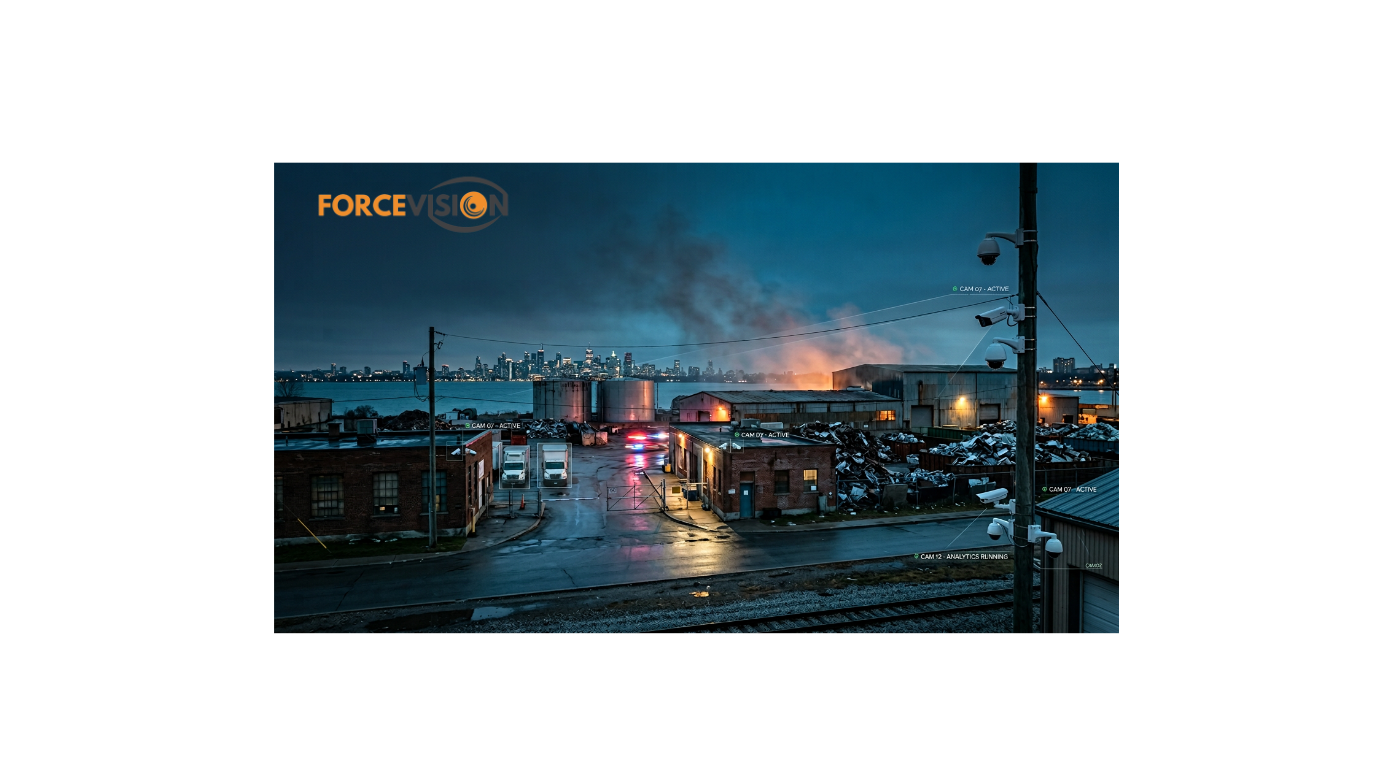
Shortly after midnight on April 9, 2026, a fire broke out at a GFL facility in Toronto’s Portlands, adding to a series of incidents involving the waste‑management company. While full investigation details are still emerging, any blaze in a facility handling high volumes of waste, recyclables, or industrial by‑products is a serious wake‑up call for energy and waste operators across Ontario. These sites concentrate flammable material, heavy equipment, and critical infrastructure in one place—often right next to major urban areas.
For utilities, waste‑to‑energy plants, transfer stations, and industrial recyclers operating in Hamilton, Mississauga, Burlington, and Toronto, the Portlands incident underscores a hard truth: reactive measures and basic cameras are no longer enough. Industrial CCTV for Ontario energy and waste facilities needs to be designed to catch ignition points, unsafe behaviour, and intrusions in real time, not just document the aftermath.
Why are energy and waste sites uniquely vulnerable?
Energy and waste facilities share a combination of characteristics that amplify fire and safety risks:
-
Large volumes of combustible material—including paper, plastics, yard waste, and light industrial waste—in constant motion.
-
Heavy equipment operating for long hours, generating heat, sparks, and friction.
-
Outdoor stockpiles exposed to wind, extreme temperatures, and sometimes unauthorized access.
-
Locations near water, rail, or residential areas, raising environmental and community impact.
The Portlands fire, occurring overnight when staffing is often thinner, reminds operators that ignition can happen when eyes are off the yard. When that ignition is not detected early, it can quickly escalate beyond what on‑site resources can handle.
What should industrial CCTV cover at energy and waste facilities?
Designing industrial CCTV for Ontario energy and waste facilities starts with mapping the full life cycle of material and energy on site, from gate to processing to storage and outbound movement. Key coverage zones include:
-
Tipping floors and incoming waste bays
Overhead cameras and wall‑mounted units should capture unloading activity, spotting unsafe dumping, smouldering loads, or unauthorized materials entering the stream. -
Sorting lines and processing equipment
Cameras aimed along conveyors and processing lines can identify smoke, jams, and unsafe worker behaviour. -
Outdoor stockpiles and bunkers
High‑mounted fixed cameras and PTZs should provide clear views across piles, with zones configured for smoke or unusual glow at night. -
Fuel storage, transformers, and generators
Dedicated cameras should monitor critical energy assets, wiring, and enclosures for tampering or visible anomalies. -
Perimeter fencing and water/rail interfaces
Intrusions by trespassers can lead to theft, vandalism, or intentional damage, especially in remote corners.
A 64‑camera or larger system gives operators enough channels to treat each of these zones separately, rather than sacrificing coverage in one area to protect another.
How can analytics enhance fire and safety detection?
Modern industrial CCTV for Ontario energy and waste facilities goes well beyond simple motion detection. When combined with thermal cameras and intelligent analytics, operators can:
-
Detect movement in stockpiles after hours, potentially indicating trespassers or spontaneous ignition events.
-
Use AI‑assisted smoke and flame detection to escalate alerts before traditional sensors trigger.
-
Monitor restricted zones around transformers, switchgear, and fuel tanks for line‑crossing events.
-
Track vehicle and loader paths, identifying risky patterns such as repeated near‑misses or driving in prohibited areas.
These capabilities are especially important at night, when the Portlands fire occurred, and when manual observation is at its weakest.
What about integration with operations and emergency response?
The real power of an advanced CCTV platform lies in integration. For energy and waste facilities, that means:
-
Linking cameras to fire detection and suppression systems so alarms automatically pull up relevant video feeds for operators and first responders.
-
Providing remote access to real‑time and historical footage for fire services en route, improving their understanding of material types and access points.
-
Feeding video into incident reporting workflows so safety, environmental, and operations teams share a common visual record.
In an event like the Portlands fire, having video that clearly shows the fire’s origin, early growth, and response actions can substantially improve debriefs and future risk reduction.
How should Ontario operators respond to the Portlands incident?
Even with limited public details, the Portlands fire is a useful prompt for self‑assessment. Operators should consider:
-
Running a “midnight scenario” tabletop exercise
Assume a fire starts in a remote stockpile or tipping area at 1 a.m. How soon would your current cameras and monitoring see it? Who gets alerted and how? -
Auditing blind spots
Walk your facility at night and identify areas where cameras cannot clearly see ignition points, equipment, or storage. -
Reviewing retention and export policies
Confirm that you can retain and share video easily with regulators, insurers, and emergency responders when necessary. -
Re‑evaluating off‑site infrastructure
For operators with multiple sites, ensure that remote locations receive the same CCTV attention as flagship plants.
ForceVision’s role for energy and waste facilities
ForceVision supports energy producers, waste‑to‑energy sites, and industrial waste operators across Southern Ontario in designing and upgrading industrial CCTV for Ontario energy and waste facilities. That includes mixing thermal and optical cameras, designing coverage around stockpiles and critical equipment, and integrating video with safety and operations platforms. If you are unsure how well your site would handle a Portlands‑style event, ForceVision can help you model scenarios and build a camera plan that prioritizes early detection and clear evidence.
A practical takeaway for this quarter
Pick one high‑risk area on your site—perhaps a tipping floor, outdoor pile, or transformer yard—and ask three questions: Can we see everything that matters? Can we find footage quickly if something goes wrong? Can we share it easily with the people who need it? If any answer is “no,” it may be time to rethink your industrial CCTV for Ontario energy and waste facilities before the next overnight incident tests your resilience.
FAQ
Q1: Are thermal cameras necessary for energy and waste sites?
A: They are not mandatory, but thermal units paired with standard cameras can significantly improve early detection of hot spots in stockpiles and around critical equipment.
Q2: How many cameras do we need for a mid‑sized transfer station?
A: Many operators find that once they cover tipping floors, processing lines, stockpiles, perimeters, and key equipment, 48–64 cameras is a realistic starting point.
Q3: Can CCTV footage be used in regulatory investigations?
A: Yes. High‑quality, well‑retained footage often becomes central evidence for environmental agencies, fire marshals, and insurers looking to understand cause and response.
Q4: Is remote monitoring realistic for multiple sites?
A: With modern IP‑based systems and NVRs, many organizations centralize monitoring of several facilities, escalating only the most critical events to on‑call staff.


