

A Tragic Mississauga Crossing Fatality That Raises Tough Questions
In March 2026, a 13‑year‑old boy riding a motorized bike was fatally struck by a GO train on the Lakeshore West line in Mississauga. Police say the train’s horn sounded and lights and gates were activated, but witnesses reported the rider went around the lowered barrier before the collision. The incident sparked heartbreak in the community and renewed calls for more safety features at that crossing, with local voices asking whether additional measures—like more cameras, lighting, and warning systems—could help prevent similar tragedies.
For many industrial operators across Southern Ontario, this story feels uncomfortably close. Rail crossings often sit beside or within rail‑served industrial corridors, where heavy truck traffic, employee commuting, and train movements intersect. When something goes wrong at these interfaces, the consequences are human and operational: a life lost, trains delayed, freight disrupted, and entire yards locked down. That is why rail‑adjacent plants, yards, and logistics hubs are increasingly looking at 64‑camera industrial CCTV systems as part of a broader strategy to improve crossing safety and visibility.
Why Rail Crossings Near Industrial Sites Are So High-Risk
Level crossings near industrial zones face unique pressures compared to quiet residential crossings. Heavy vehicles, shift changes, and complex traffic patterns make them inherently more dangerous:
-
High truck and trailer volumes moving to and from plants, warehouses, and intermodal yards.
-
Employee vehicles and pedestrians crossing tracks at predictable shift‑change times.
-
Limited sight lines created by nearby buildings, fences, parked trailers, or stored materials.
-
Distracted or hurried road users, especially in busy industrial areas where schedules and delivery slots matter.
Studies of level‑crossing safety have shown that risk increases where visibility is poor, traffic volumes are high, and users underestimate train speed and distance. When a tragic incident occurs, investigators, regulators, and communities look hard at whether the crossing design and surrounding operations did enough to mitigate that risk.
Where 64‑Camera CCTV Fits Into Rail-Crossing Safety
CCTV is not a substitute for good engineering—gates, lights, bells, medians, and grade separations—but it is a powerful complement when deployed intelligently around rail‑served corridors. For industrial operators whose yards and plants connect directly to rail lines, 64‑camera systems can:
-
Provide continuous visual records of how vehicles and people actually behave at crossings over time.
-
Help identify near misses and risky behaviours, such as vehicles stopping on the tracks, pedestrians cutting around gates, or drivers queuing too close to the rails.
-
Support real‑time monitoring during peak times, weather events, or unusual train operations, giving safety and operations teams better situational awareness.
This is especially relevant in environments where industrial traffic patterns may interact with public crossings immediately adjacent to plant entrances or yard access roads—exactly the kind of context seen along parts of the Lakeshore West corridor.
Designing a 64‑Camera Layout Around Crossings and Corridors
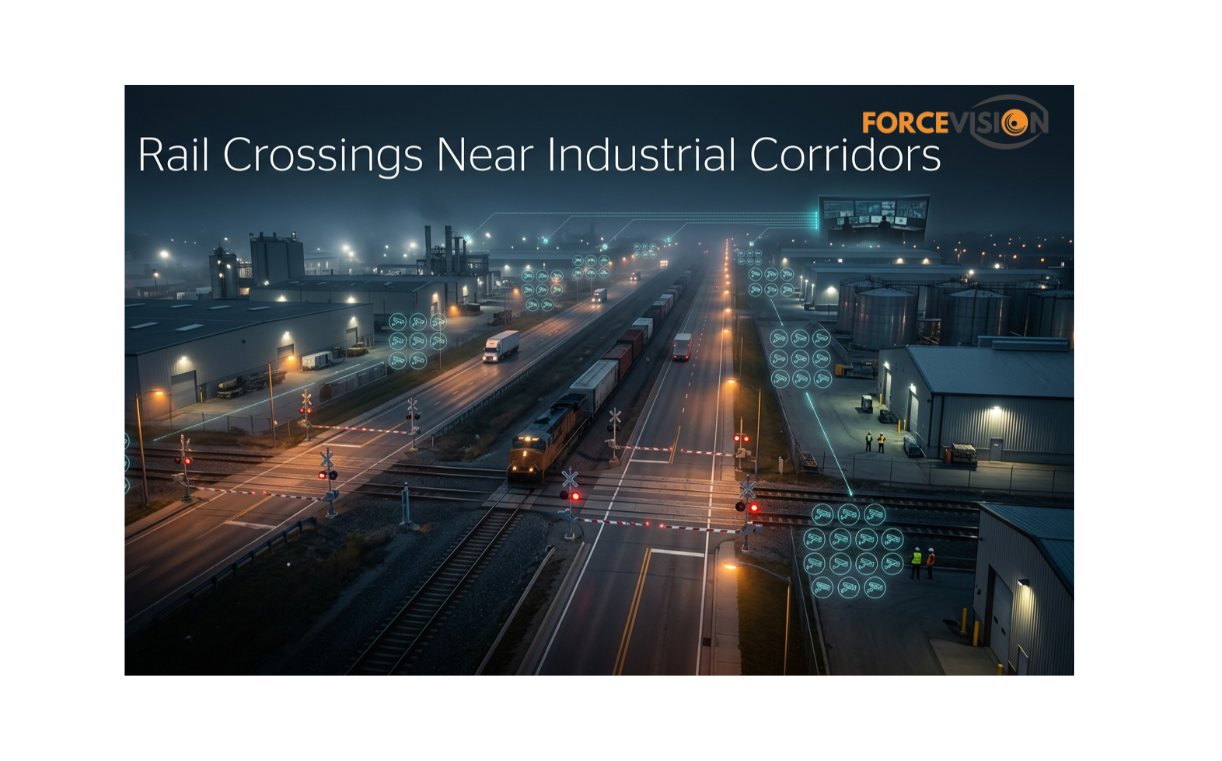
For a large rail‑adjacent industrial site, a rail‑aware 64‑camera design typically extends coverage beyond the fence line to capture the full picture of how your operations interact with nearby crossings:
-
Approach roads and plant driveways
Cameras watching the build‑up to crossings show whether trucks or employee vehicles are queuing over, or too close to, the tracks, and how traffic behaves when gates activate. -
Crossing interfaces and gates
High‑resolution views on the crossing itself help document gate operation, pedestrian and cyclist behaviour, and any obstructions near the tracks. -
Yard leads and internal tracks
Cameras on internal rail leads, spur connections, and yard switches provide context about train movements, shunting operations, and how industrial equipment interacts with the main line. -
Perimeter and fence lines
Coverage along the boundary between public right‑of‑way and private industrial property helps identify trespass routes and informal desire lines where people may cross tracks outside designated crossings.
Together, these views give safety and operations teams a continuous visual record of how road, rail, and industrial traffic collide—or nearly collide—every day. That evidence is invaluable for making the case for crossing upgrades, re‑routing traffic, or adjusting plant procedures.
From Incident Footage to Proactive Risk Reduction
In the aftermath of the Mississauga GO‑train tragedy, family members and local residents called for more to be done to protect people around the crossing. CCTV can help sites move from reacting to tragedies to proactively reducing risk:
-
Near‑miss analysis
Reviewing video of trains passing and road users interacting with gates helps identify patterns: frequent queuing over tracks, common illegal manoeuvres, or confusion about signal timing. -
Targeted interventions
With clear video evidence, site leaders can work with municipalities, Metrolinx, and railways to support changes such as improved signage, altered signal timing, lane markings, or even physical barriers. -
Training and toolbox talks
Anonymised clips from your own crossings are powerful tools for driver and employee training—making the risk real in a way that generic stock footage cannot.
Rail‑network research shows that combining technology (like cameras and analytics) with engineering and education produces better safety outcomes than any one approach on its own.
Analytics and Advanced Rail-Corridor Monitoring
Recent advances in video analytics for rail networks are opening up new ways to monitor crossings and corridors. For industrial operators, this means CCTV can evolve from “eyes on” to “early warning” in several ways:
-
Object detection and tracking
Detect vehicles or pedestrians lingering within defined danger zones near the tracks, or objects left on the right‑of‑way. -
Trespass and suicide‑prevention analytics
Some systems can flag unusual behaviours—such as loitering along tracks or repeated attempts to cross at non‑authorised points—supporting interventions and outreach. -
Integration with crossing warning systems
In more advanced deployments, camera analytics can interface with warning systems to trigger alerts when vehicles are stuck on crossings as trains approach.
While these capabilities are still emerging, large Canadian rail operators and infrastructure managers are actively exploring them, particularly in high‑risk urban and industrial corridors.
How ForceVision Helps Industrial Operators Safeguard Rail-Adjacent Sites
ForceVision specialises in 64‑camera‑and‑larger CCTV systems for industrial rail, logistics, energy, and manufacturing environments, with a focus on asset protection and safety. Around rail‑adjacent sites and crossings, that means:
-
Working with safety and operations leaders to map all points where road, rail, and plant traffic intersect.
-
Designing camera layouts that provide clear, multi‑angle coverage of crossings, approaches, yard leads, and perimeters.
-
Ensuring your NVR/VMS platform makes it easy to retrieve and share incident and near‑miss footage with railways, municipalities, and investigators when needed.
If the Mississauga GO‑train incident has you re‑examining how your own operations interact with nearby rail crossings, ForceVision can walk your team through what a rail‑aware 64‑camera design would look like for your facility, with a free, consultative assessment. The goal is simple: protect both the public and your people where industrial operations meet the main line.
FAQs: Industrial CCTV and Rail Crossing Safety in Ontario
Can an industrial site really influence public rail crossing safety?
Yes. While crossings are ultimately managed by railways and road authorities, clear CCTV evidence of recurring hazards or near misses at industrial‑adjacent crossings can strengthen the case for upgrades and procedural changes.
Do cameras replace engineering upgrades at crossings?
No. Engineering controls—gates, lights, medians, grade separations—remain fundamental. CCTV complements these measures by documenting real‑world behaviour and providing insight into how crossings are actually used.
How long should we keep footage from cameras watching crossings and yard leads?
Because investigations and negotiations around crossings can take time, many operators retain 60–90 days of footage for key views, with longer retention for cameras covering persistent risk zones, subject to storage and policy.
Can analytics really detect risky behaviour at crossings?
Research and pilot deployments show that modern video analytics can identify objects and people in danger zones and flag unusual patterns, providing earlier warnings and richer data for safety planning.


