

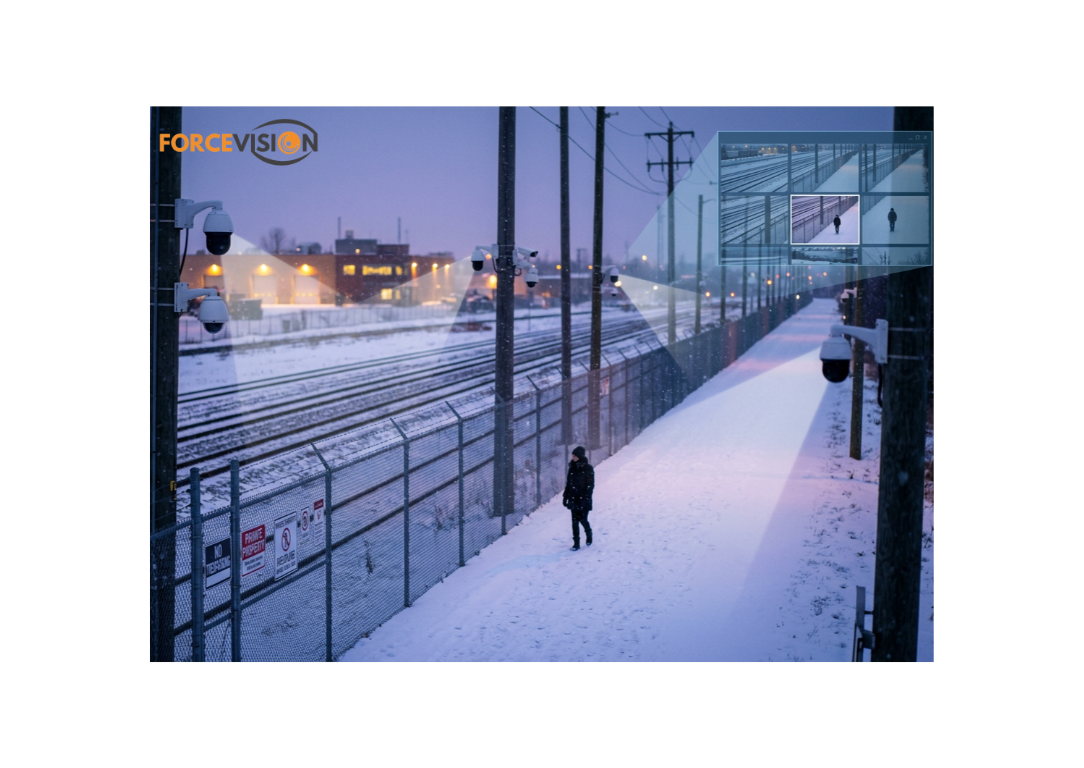
Trespass and Suicide on the Rails: A Quiet but Serious Risk
Trespass and suicide are among the leading causes of death on rail networks worldwide, including in Canada. Unlike high‑profile derailments, many of these tragedies happen quietly—often on open tracks near communities, industrial corridors, or access paths that have evolved over time. A Canadian scoping review notes that about two‑thirds of railway suicides occur on open track segments rather than at stations, with another significant share at crossings.
For industrial operators whose yards, spurs, and plants sit along busy freight and commuter lines, this is not just a distant rail‑operations problem. When an incident occurs near a yard entrance, siding, or rail‑served industrial park, it can halt train movements, lock down sites, expose workers and first responders to trauma, and raise difficult questions from regulators and communities. In this context, 64‑camera industrial CCTV systems—combined with emerging video analytics—are increasingly seen as part of a broader prevention toolkit alongside fencing, signage, public awareness, and lighting.
What the Research Says About Cameras and Rail Suicide/Trespass Prevention
A major 2022 survey of rail‑network video analytics found that CCTV and computer vision are now being used to detect trespass, unusual behaviour, and potential suicide risk on and near tracks. The study highlights how modern machine‑learning models can analyse closed‑circuit feeds to automatically detect people, objects, and behaviours that deviate from normal patterns, triggering alerts for operators.
Other research from Canadian and international teams shows that:
-
Surveillance cameras can help identify at‑risk behaviours in public transit environments, giving staff the chance to intervene before an attempt.
-
Cameras, when combined with motion or heat detection, can verify alarms from sensors installed along tracks or at hotspots.
-
Effectiveness depends heavily on having enough eyes on screens or using automated analytics to support human observers.
These findings align with broader work on rail suicide and trespass prevention, which recommends a mix of physical barriers, targeted surveillance at known hotspots, education, and better data to guide interventions. For rail‑adjacent industrial corridors, that means combining yard‑focused CCTV with an understanding of how people move along nearby tracks.
Why Industrial Corridors Matter in the Trespass and Suicide Conversation
Railway suicide‑prevention experts note that many fatalities occur away from stations and formal crossings, often in open‑track segments that run behind neighbourhoods, industrial parks, and utility corridors. These are exactly the kinds of places where:
-
Workers, contractors, or local residents may use tracks as informal walking routes.
-
Photographers and social‑media users may seek “edgy” shots near freight trains or industrial backdrops.
-
Isolated spaces near yards and plants may attract people in distress, far from busy public areas.
From a prevention standpoint, rail‑adjacent industrial zones can be both risk areas and opportunities. Operators already deploying 64‑camera CCTV systems for theft, perimeter security, and operations have an existing visual infrastructure that, with the right design and governance, can also support safer rail corridors.
How a 64‑Camera System Can Help Detect and Deter Risky Behaviour
A rail‑aware 64‑camera design for an industrial corridor goes beyond gates and fences. It deliberately provides visibility over:
-
Trackside edges of yards and plants where fences, ditches, or berms meet mainline or siding tracks.
-
Access paths, cut‑throughs, and culverts that people use to reach or cross the tracks informally.
-
Bridge, embankment, or underpass areas near industrial zones that may be attractive but unsafe gathering spots.
When paired with analytics, these cameras can support:
-
Trespass detection: flagging people entering defined danger zones near tracks, especially outside working hours.
-
Loitering and unusual behaviour alerts: identifying individuals who remain near the right‑of‑way for extended periods, potentially indicating distress.
-
Object detection: spotting items left on or near the tracks that could be used for vandalism or self‑harm.
Alerts can go to control rooms, remote monitoring centres, or designated railway contacts, who can then assess the situation and, where appropriate, slow trains, dispatch security, or contact local police and crisis services.
CCTV as One Layer in a Multi-Layer Prevention Strategy
Researchers and rail‑safety organisations are clear that cameras alone cannot solve trespass and suicide risks. The most effective strategies combine several measures:
-
Physical barriers such as fencing, anti‑trespass panels, and, in some cases, platform screen doors at busy stations.
-
Environmental changes and lighting, which can discourage risky behaviour and improve visibility for both drivers and cameras.
-
Signage, phones, and crisis‑support information at known hotspots, making it easier for people in distress to reach help.
-
Public‑awareness campaigns that discourage dangerous behaviours like track photography and short‑cutting across rails.
CCTV fits into this picture as a verification and early‑warning tool. It helps confirm whether people are bypassing barriers, using dangerous shortcuts, or showing signs of distress—evidence that can guide where to invest in additional fencing, lighting, or outreach.
Ethical and Practical Considerations: Privacy, Staffing, and Automation
Using cameras to detect suicide risk and trespass raises serious ethical questions. Experts from CRISE (the Centre for Research and Intervention on Suicide and Euthanasia) and others stress that:
-
Constant, manual monitoring of hundreds of cameras is rarely feasible; staff can become fatigued or miss key signs.
-
Automated analytics must minimise false positives and avoid stigmatising normal behaviours.
-
Any intervention must respect privacy laws and focus on support and safety, not criminalising distress.
For industrial operators in Ontario, this means:
-
Being transparent about where cameras are and how footage may be used in coordination with railways and public agencies.
-
Prioritising high‑risk segments (true hotspots) for advanced analytics, rather than trying to cover an entire network.
-
Working with rail partners to ensure that if an alert is raised, someone has the authority and capacity to respond quickly.
Handled with care, this approach allows CCTV to support humane, evidence‑based prevention rather than simply expanding surveillance.
How ForceVision Helps Rail-Adjacent Industrial Operators Support Prevention
ForceVision designs 64‑camera‑and‑larger CCTV systems for rail‑served industrial clients—manufacturing plants, warehouses, terminals, and yards—across Southern Ontario. When rail trespass and suicide‑risk prevention are part of the mandate, ForceVision works with stakeholders to:
-
Identify track‑adjacent segments and informal paths near the site that may be higher risk.
-
Position cameras for clear, usable views of those segments while also supporting core security needs.
-
Integrate with, or prepare for, analytics capable of detecting trespass and unusual behaviour along the rail edge, in line with emerging best practices from rail‑network research.
If you operate along a busy freight or commuter corridor and are concerned about both safety and community impact, ForceVision can help you explore how your next 64‑camera deployment can contribute to a safer rail environment—not just inside your fence line, but along the tracks that run beside it.
FAQs: Industrial CCTV for Rail Trespass and Suicide Prevention in Ontario
Can cameras really help prevent rail suicides, or only record them?
Research suggests that CCTV—especially with trained observers or analytics—can identify some at‑risk behaviours early enough to slow trains or send staff to check on people, potentially preventing attempts in certain settings.
Is it realistic to monitor long stretches of track with cameras?
Not across an entire network, but targeting urban and industrial hotspots where incidents cluster is considered feasible, particularly when automation helps filter alerts.
How should industrial sites share footage with railways and investigators?
Well‑designed NVR/VMS platforms make it straightforward to export time‑stamped clips securely to rail police, investigators, or safety teams, supporting both incident response and long‑term prevention studies.
What about privacy obligations when monitoring public‑facing rail edges?
Transparency, limited retention, clear purpose (safety and prevention), and strong access controls are key. Guidance from suicide‑prevention and privacy researchers stresses responsible use and avoiding unnecessary identification where possible.


