

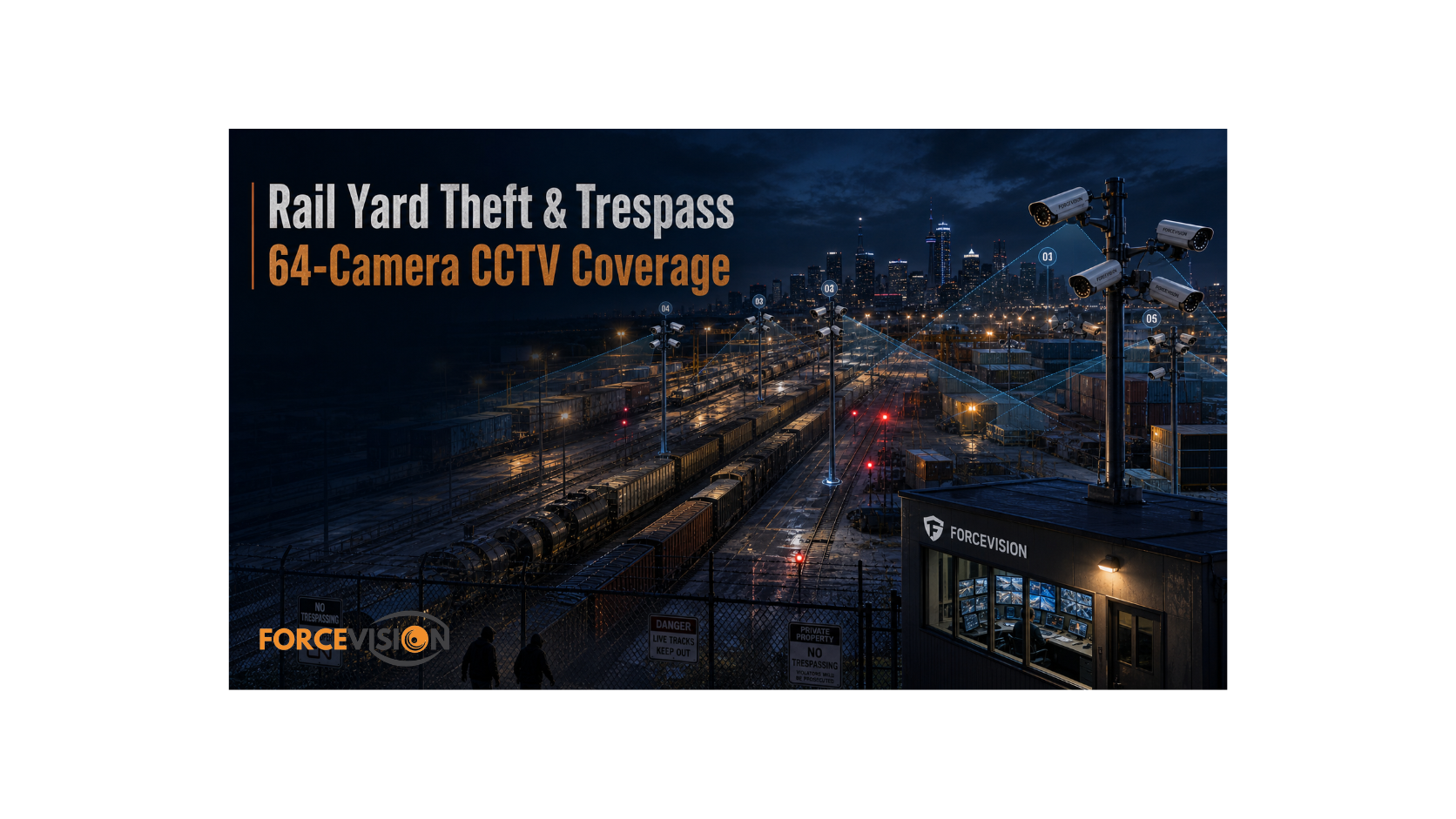
Rail theft and trespass pressures are mounting
Rail networks across North America continue to face theft and trespass challenges, from pilfered containers to vandalism and dangerous track incursions. Media coverage has shown thieves climbing onto freight trains and opening containers while trains are stopped in yards or moving slowly through urban areas. Rail operators and cargo owners are under pressure to protect high‑value goods, minimize disruptions, and improve safety for workers and surrounding communities.
In Canada, large freight and intermodal yards share many of the same vulnerabilities, even if incident patterns differ by region. Long track stretches, busy switching operations, and limited staff on the ground make it difficult to maintain constant visual awareness—especially at night or in poor weather.
Why traditional surveillance struggles in rail environments
Rail yards are a unique surveillance challenge. Tracks and trains create long, narrow sightlines with frequent occlusions as cars move and block views. Infrastructure such as towers, buildings, and stacked containers further complicates coverage, creating blind spots where trespassers or thieves can operate out of view.
Traditional camera layouts based solely on design experience often miss these complexities. Research on camera placement in rail environments shows that intuitive layouts can leave surprisingly large blind areas and low monitoring efficiency, especially in complex stations and yards. Without a systematic approach to placement and field‑of‑view modelling, even large camera counts may fail to deliver the situational awareness operators need.
How 64‑camera CCTV platforms change the rail yard picture
A modern 64‑camera CCTV for Canadian rail yards is less about a specific number and more about a system scale that allows true coverage of critical zones. In a large freight yard, this typically includes:
-
Perimeter fencing and access roads
-
Gatehouses and truck processing lanes
-
Main classification tracks and bowl areas
-
High‑value container stacks and auto compounds
-
Fuel pads, maintenance zones, and hazardous materials areas
By combining fixed cameras along perimeters and key cross‑overs with PTZ cameras on towers or poles, operators can maintain continuous monitoring while also zooming in on emerging issues. Analytics help automate detection of people or vehicles in restricted zones, such as walkways around live tracks or container stacks outside of normal operating hours.
Video analytics for theft, trespass, and safety
Recent advances in video analytics are particularly well‑suited to rail environments. Research surveys show that modern systems can automatically detect static objects, loitering, and unusual movement patterns around tracks and platforms. More recent work highlights the potential of multimodal sensor fusion—combining video with other sensors—to detect and classify critical events such as trespassing, vandalism, and potential sabotage.
For Canadian freight yards, a 64‑camera CCTV for Canadian rail yards can be configured to:
-
Detect individuals entering track zones where they do not belong
-
Flag vehicles stopped in unauthorized areas near container stacks
-
Monitor perimeters for climbing, cutting, or suspicious lingering
-
Alert operators when containers or railcars are opened or accessed after hours
These capabilities allow security teams to respond quickly, often before incidents escalate into theft, injuries, or service disruptions.
Integrating CCTV with rail operations and safety programs
Effective rail yard surveillance is not just a security project. When CCTV is integrated with yard operations, safety, and asset management systems, it becomes a multi‑purpose tool. Operators can review footage to understand near‑misses, shunting incidents, or unsafe behaviours in switching areas. Video clips support safety briefings and training, helping crews visualise real incidents rather than hypothetical scenarios.
Integration with access control and yard management systems allows cameras to track movements of specific trains, containers, or vehicles. When a high‑value shipment enters the yard, operators can ensure that relevant cameras and analytics rules are active along its route, providing an auditable visual record for cargo owners and insurers.
Planning a 64‑camera deployment for a Canadian freight yard
Designing a 64‑camera CCTV for Canadian rail yards starts with a detailed site survey and, ideally, a digital yard model. Research into camera placement optimisation has shown that using tools like building information modelling (BIM) and algorithmic placement can significantly improve coverage and reduce blind spots. Even without full BIM, mapping fields of view over scaled yard drawings helps identify overlaps and gaps before hardware is installed.
Key planning steps include:
-
Defining security and safety objectives (theft, trespass, worker safety, incident review)
-
Prioritising zones based on risk, asset value, and activity levels
-
Selecting camera types (fixed, PTZ, thermal) suited to each zone
-
Planning network and power infrastructure that can handle future expansion
Phase‑in strategies are common. Yards often start with perimeters, gates, and high‑value storage zones, then expand coverage as benefits are demonstrated and budgets allow.
ForceVision’s approach to rail yard CCTV
ForceVision supports large industrial operators across Southern Ontario, including logistics hubs and rail‑adjacent facilities, with the design and deployment of scalable CCTV platforms. For freight yards and intermodal terminals, that typically involves working alongside operations and safety teams to understand current pain points—whether theft hotspots, trespass routes, or recurring near‑misses.
From there, ForceVision helps build a practical roadmap to a 64‑camera or larger system, selecting IP cameras, NVRs, and analytics that can integrate with existing rail control and yard management tools. If you oversee a yard or intermodal terminal and are considering upgrades, a no‑pressure planning conversation can help clarify the options and trade‑offs before you commit capital.
Turning surveillance into a continuous improvement tool
When rail yard CCTV is designed and used well, it becomes a continuous improvement engine rather than a static security expense. Regularly reviewing clipped footage of incidents, near‑misses, and operational bottlenecks helps yard managers fine‑tune procedures, adjust signage and markings, and refine training.
Over time, the same 64‑camera CCTV for Canadian rail yards that helps catch trespassers and deter thieves can also reduce injuries, improve asset utilisation, and support smoother interactions with regulators and customers. That is how surveillance begins to pay for itself—not just through avoided losses, but through daily operational value.
FAQ
Q1: Is 64 cameras enough for a large freight yard?
It depends on yard size and complexity. For many Canadian freight yards, 64 cameras provide a solid foundation for perimeters, key operational areas, and high‑value storage, with additional cameras added for expansion.
Q2: Can analytics handle complex rail environments with constant movement?
Modern analytics can be tuned to rail environments, focusing on human detection in specific zones and ignoring expected train movements or switching activity. Careful configuration and ongoing adjustment are critical to avoid alarm fatigue.
Q3: How do we justify investment to non‑security stakeholders?
Beyond theft reduction, rail yard CCTV supports worker safety, incident investigation, operational optimisation, and stronger customer confidence. These combined benefits often provide a compelling business case.
Q4: Do we need 24/7 live operators watching all feeds?
Not necessarily. Event‑driven monitoring based on analytics can significantly reduce the need for constant human observation, focusing attention on genuine anomalies and high‑risk periods.


