

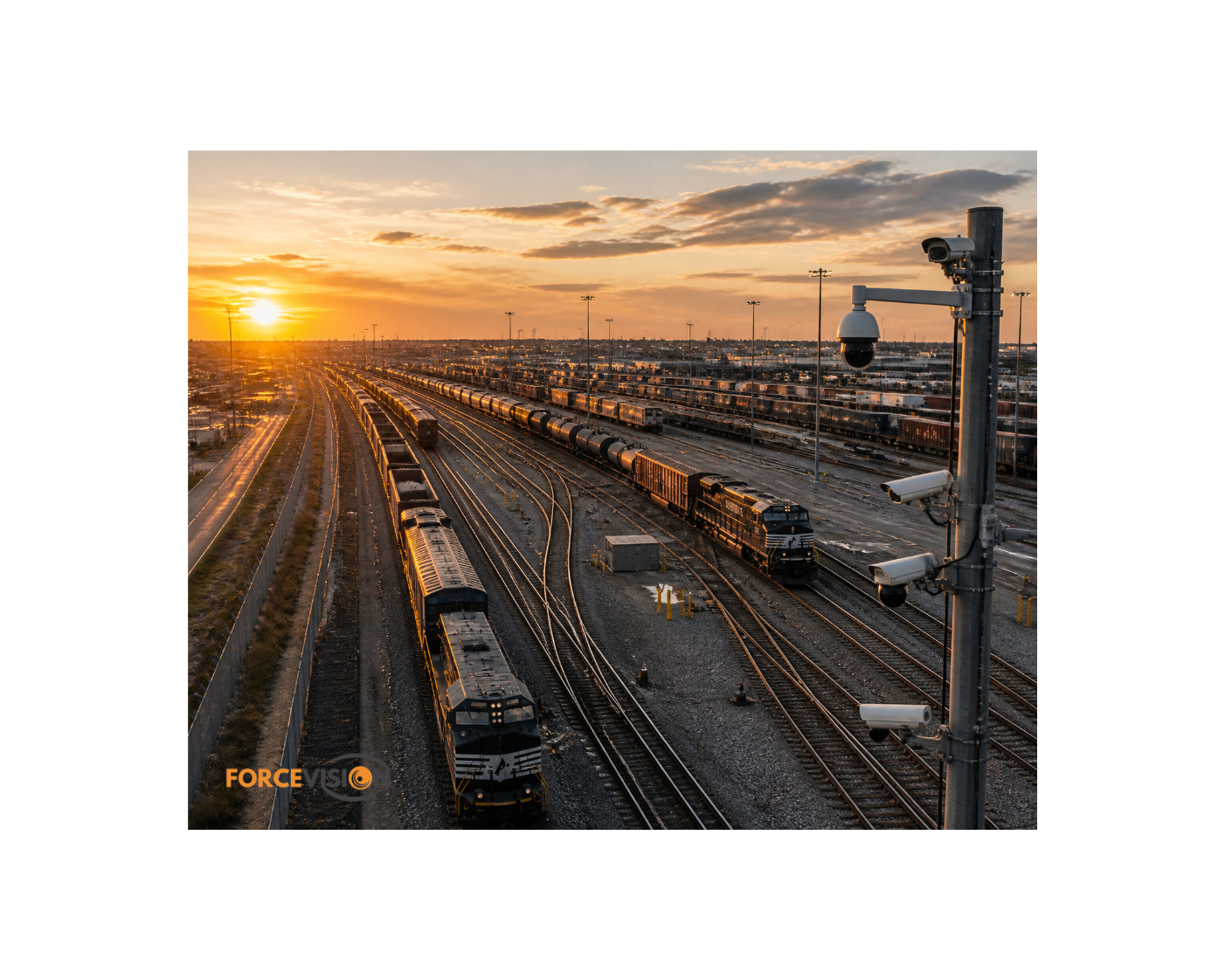
Across Canada, rail safety advocates keep repeating the same warning: railway yards, bridges, and tunnels are private property, and trespassing on them can be deadly. Near‑miss incidents are still far too common, especially in urban areas where tracks intersect with residential neighbourhoods and industrial sites.
CN Rail has reinforced that its police service actively enforces the Railway Safety Act, and works with communities to educate the public on the consequences of trespassing. Yet from a yard manager’s perspective, education and enforcement must be matched by better visibility into what is actually happening across the site — in real time, not just after an incident.
Why Canadian rail yards struggle with situational awareness
Many Canadian rail yards already have dozens of cameras spread across main lines, classification tracks, and perimeter fencing, but still rely heavily on manual monitoring. Operators sit in control rooms with video walls, trying to watch multiple views at once while juggling radio chatter, paperwork, and operational decisions.
A recent ForceVision social post captured the issue well: many rail yards have cameras, but use them primarily for after‑the‑fact review, missing opportunities to prevent trespassing and reduce near‑misses. In practice, that means cameras record a trespasser crossing between cars or cutting through a yard — but no one sees it until a supervisor pulls footage after an event.
Where 64‑camera CCTV systems fit in Canadian rail yards
For a CN‑ or CP‑scale yard or a major regional facility in Southern Ontario, 64‑camera CCTV systems for Canadian rail yards are quickly becoming the baseline rather than a luxury. With long linear perimeters, multiple entrances, and complex track layouts, anything less often leaves long stretches of blind spots.
A 64‑camera design for a typical classification yard might look like this:
-
20–24 cameras on main walkways, employee access routes, and crossovers.
-
16–20 cameras on entry gates, road crossings, and perimeter fencing.
-
12–16 cameras dedicated to key operational zones such as hump towers, switch zones, and locomotive servicing areas.
-
4–8 mobile‑ready or PTZ cameras to cover temporary risk areas such as construction zones, seasonal storage tracks, or areas with repeated trespass complaints.
Where older systems used analogue cameras feeding separate DVRs, modern rail yards are standardizing on IP cameras, hardened NVR security systems, and centralised video platforms that can be tied to yard management systems.
Turning rail cameras into a safety and operations platform
The real shift is not just more cameras but smarter use of them. With video analytics layered over a 64‑camera CCTV system, Canadian rail yards can automate much of the detection that used to rely on a dispatcher’s eyes.
Practical analytics use cases include:
-
Person detection in restricted zones, triggering alarms when someone walks along tracks or inside fenced areas where there should be no pedestrian movement.
-
Vehicle detection and wrong‑way alerts on internal roadways and level crossings within the yard.
-
Loitering alerts near dangerous curves, underpasses, or popular “shortcuts” that people use to cross the yard.
-
Congestion analytics in key switching zones, helping reduce bottlenecks that can cause crews to improvise unsafe walking routes around parked rolling stock.
CN has stated that safety is a core value and that enforcement, education, engineering, and engagement are all part of their approach to trespassing. A modern CCTV and analytics platform is a concrete example of “engineering” — designing the environment to reduce risk and give personnel actionable information.
Integrating CCTV with rail police and community relations
CN Police and other railway police services in Canada already use video evidence extensively after incidents, but real‑time access to yard cameras can materially change how they respond. With the right network architecture, selected CCTV feeds can be securely shared with rail police or local law enforcement during an incident, improving coordination and reducing response time.
When yards experience repeated trespassing in a specific area, historical video data can also inform community engagement. Instead of relying on anecdotal reports, safety teams can show local councils or neighbours concrete examples of where people cross and at what times of day. That evidence can support new fencing, signage, or grade separation projects designed to reduce temptation and improve safety.
Benefits beyond safety: operations and labour relations
It is easy to frame 64‑camera CCTV systems for Canadian rail yards as purely a safety or security expense, but the business case often lands in operations. High‑quality coverage across receiving tracks, hump operations, and outbound staging makes it easier to reconstruct how dwell times built up, why a particular cut of cars was delayed, or where a miscommunication occurred.
From a labour perspective, reliable video evidence can help protect crews when accusations arise after an incident. Clear footage showing that a conductor followed procedures, or that a trespasser ignored signage and verbal warnings, gives everyone a more objective footing in investigations and hearings. Used transparently and with proper policies, video becomes a tool for fairness, not surveillance for its own sake.
A practical path for Ontario yards
For rail yards in Hamilton, Toronto, Pickering, or other Southern Ontario hubs, the path forward usually starts with an audit of the current camera map and incident history. Questions to ask include:
-
Where have trespassing complaints or near‑misses occurred in the past 12–24 months?
-
Which of those locations currently have camera coverage, and how good is it at night or in winter?
-
How many cameras are dedicated to live monitoring versus forensic review (for example, focused on key switches or road crossings)?
-
Where would analytics‑ready cameras have the biggest impact if you could only upgrade 10–15 positions in the first phase?
ForceVision works with Canadian rail and yard operators to design 64‑camera CCTV systems for Canadian rail yards that address both safety and operational goals, not just compliance. If you are responsible for yard safety or operations, a no‑pressure camera and analytics assessment can help identify quick wins and longer‑term design improvements tailored to your site.
Trespassing and near‑misses will not disappear overnight, but a smarter, analytics‑enabled camera system can mean the difference between “we saw it later on video” and “we got an alert in time to act.”
FAQ
Q1: Do we really need 64 cameras for a mid‑sized rail yard?
Most mid‑sized yards end up needing 48–96 cameras once you cover perimeters, crossings, walking routes, and operational hotspots; 64 channels is a practical platform size to grow into.
Q2: Can analytics handle snow, rain, and night‑time conditions?
Modern analytics are designed for challenging weather and lighting, especially when paired with IR‑capable cameras and careful positioning to avoid direct headlight glare and blowing snow zones.
Q3: How does CCTV integrate with existing rail safety systems?
CCTV platforms can tie into access control, intrusion sensors, yard management, and radio dispatch, allowing alarms from one system to automatically pull up relevant camera views.
Q4: What about privacy for workers in the yard?
Clear policies, focused camera placement, and consultation with worker representatives help ensure CCTV is aimed at safety‑critical areas and trespass hotspots, not break rooms or private spaces.


