

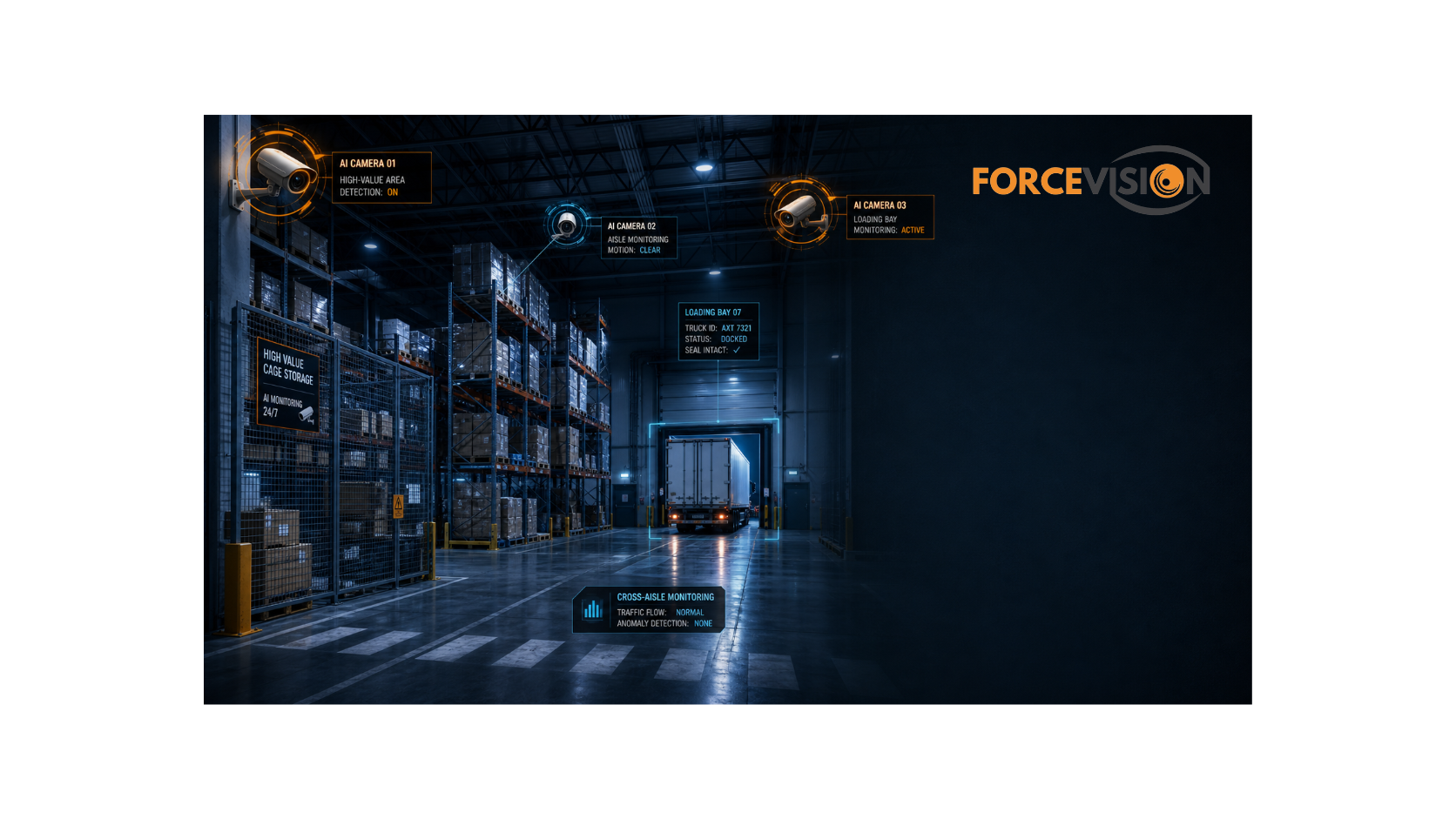
Cargo theft across North America has surged in recent years, with reports showing a 49% increase in incidents in Canada and the United States in one recent period. Distribution centres, intermodal terminals, and truck yards are at the centre of this trend, with thieves targeting trailers, containers, and high‑value pallets in yards that often span dozens of acres. For logistics operators across the Greater Toronto and Hamilton Area, this is no longer a theoretical risk—it is a weekly operating concern.
Recent supply chain risk reports show that while the number of reported incidents may fluctuate quarter to quarter, total losses remain stubbornly high, with well over one hundred million dollars in estimated losses in just a few months. These numbers do not account for the indirect costs: service failures, emergency re‑routing, chargebacks, and strained customer relationships. At large distribution centres in places like Brampton, Mississauga, and Milton, those downstream impacts can easily eclipse the sticker price of stolen goods.
Why are distribution centres such a target?
Distribution centres operate on tight schedules and rely on high‑movement yards, with constant flows of tractors, chassis, containers, and trailers. This complexity creates ideal cover for sophisticated theft crews who understand how to blend into normal activity patterns. Industry analysts now talk about “strategic” cargo theft—fraudulent carriers, altered paperwork, and stolen loads disguised as legitimate moves.
At the same time, many yards still rely on legacy camera layouts designed when the facility handled a fraction of today’s volume. A few fixed cameras at the gates and dock doors cannot track which trailer moved where, who hooked to it, or how long it sat unattended in a dark corner of the yard. In practice, that means that when a trailer disappears, investigators are left piecing together fragments instead of reconstructing a clear, time‑stamped story.
How 64‑camera systems change the game for logistics hubs
An industrial CCTV for Canadian logistics hubs needs to reflect modern yard reality: hundreds of parking spots, multiple ingress/egress points, and mixed rail‑truck operations. A 64‑camera baseline allows operators to divide coverage into logical zones:
-
Perimeter fencing and external road approaches.
-
Gatehouses, guard shacks, and credential checkpoints.
-
Trailer parking lots and overflow areas.
-
Rail spurs and intermodal transfer pads.
-
High‑value cargo zones or bonded storage.
By combining high‑resolution fixed cameras with PTZ units and appropriate lighting, security teams gain the ability to follow a trailer from arrival to departure. When a load goes missing, they can track every move—who dropped it, who picked it up, and whether any suspicious vehicles lurked nearby. This level of detail is crucial when working with law enforcement and insurers after a major loss.
The role of video analytics in detecting suspicious activity
Modern industrial CCTV for Canadian logistics hubs increasingly incorporates video analytics to tame information overload. Instead of relying solely on guard attention, analytics can watch for patterns that correlate with theft risk:
-
Vehicles loitering near fence lines or parked trailers.
-
Unauthorized movement of trailers after hours.
-
Unusual pedestrian activity in truck‑only zones.
-
Tampering with doors or locks in restricted areas.
Cargo theft experts emphasize that visibility and situational awareness are now key pillars of prevention. Video analytics feed that awareness by turning hours of footage into a small stream of actionable alerts. Logistics supervisors can review exception clips in the morning and quickly spot patterns—like a particular gate consistently seeing tailgating vehicles or a corner of the yard that attracts after‑hours trespassers.
How CCTV supports insurance and claims at industrial scale
From an insurance perspective, distribution centres that can demonstrate strong, documented security controls are often better positioned when negotiating premiums and handling claims. Detailed CCTV evidence helps in three ways:
-
Clarifying what actually happened, reducing disputes with carriers and shippers.
-
Showing that reasonable prevention measures were in place, which can affect coverage.
-
Identifying internal control failures (for example, a gate left open) so they can be fixed.
For large operators running multiple sites across Southern Ontario, a standardised CCTV design and centralised NVR platform also make it easier to enforce consistent security policies. Risk managers can compare footage from different facilities, identify best practices, and support internal audits without physically visiting every yard.
Integrating CCTV with yard management and operations
The biggest gains come when industrial CCTV for Canadian logistics hubs is integrated with yard management systems (YMS), access control, and telematics. When a trailer is checked in at the gate, its ID and photos can automatically link to video clips. If a yard check reveals a discrepancy—a trailer missing from where the system says it should be—operators can jump straight to relevant footage rather than hunting manually.
Some operators are also using CCTV as an operational tool, not just a security measure. Video helps identify congestion peaks at gates, inefficient backing patterns at docks, or unsafe pedestrian behaviours in busy loading areas. Safety and HR teams can then use real examples to coach drivers, yard workers, and contractors, reinforcing a culture of safety and accountability. Over time, this dual use of video—security plus operations—delivers far more value than a traditional, guard‑only monitoring model.
How ForceVision helps Ontario logistics leaders
Designing a camera system for a 60‑acre distribution centre or logistics campus takes more than a spec sheet. ForceVision works with logistics and distribution operators across Southern Ontario to map yard flows, high‑value zones, and historic incidents before recommending camera counts and placements. The goal is to build a 64‑camera‑plus platform that:
-
Closes known blind spots around trailer parking and fence lines.
-
Provides clear, evidentiary video suitable for investigations and claims.
-
Integrates with existing access control, YMS, and telematics platforms where possible.
If you are responsible for security, risk, or operations at a logistics hub and you are concerned about theft trends, ForceVision can provide a no‑pressure review of your existing coverage and outline practical upgrade options. Many sites can phase in improvements, starting with the highest‑risk yards or zones before scaling across the network.
A practical checklist for your next security review
Before your next insurance renewal or internal risk review, consider a short CCTV audit at each major site:
-
How many cameras do you have versus how many trailers you can park?
-
How quickly can you reconstruct the last theft or major discrepancy using video?
-
Which parts of the yard are effectively invisible at night?
-
Do operations, safety, and HR teams actively use footage, or is it “security‑only”?
If the answers reveal gaps, that is an opportunity to evolve from legacy systems to industrial‑grade surveillance designed for today’s cargo theft landscape. With the right camera grid and analytics, distribution centres can move from reactive investigations to proactive risk management.
FAQ
Q1: Are 64 cameras always enough for a distribution centre?
A: For many mid‑ to large‑scale sites, 64 cameras is a solid baseline, but campuses with multiple buildings or adjacent yards may need 96 or more to achieve full coverage.
Q2: Can video analytics replace security guards?
A: Analytics reduce manual monitoring and improve focus, but most industrial sites still benefit from a combination of analytics, remote monitoring, and on‑site personnel for response.
Q3: How long should distribution centres retain footage?
A: Many logistics operators retain footage for 30–90 days, but high‑risk sites or those handling hazardous cargo may opt for longer retention to support investigations and claims.
Q4: What about cyber security for IP cameras and NVRs?
A: Modern systems should be segmented from general IT networks, kept patched, and protected with strong authentication and logging to reduce the risk of compromise.


