

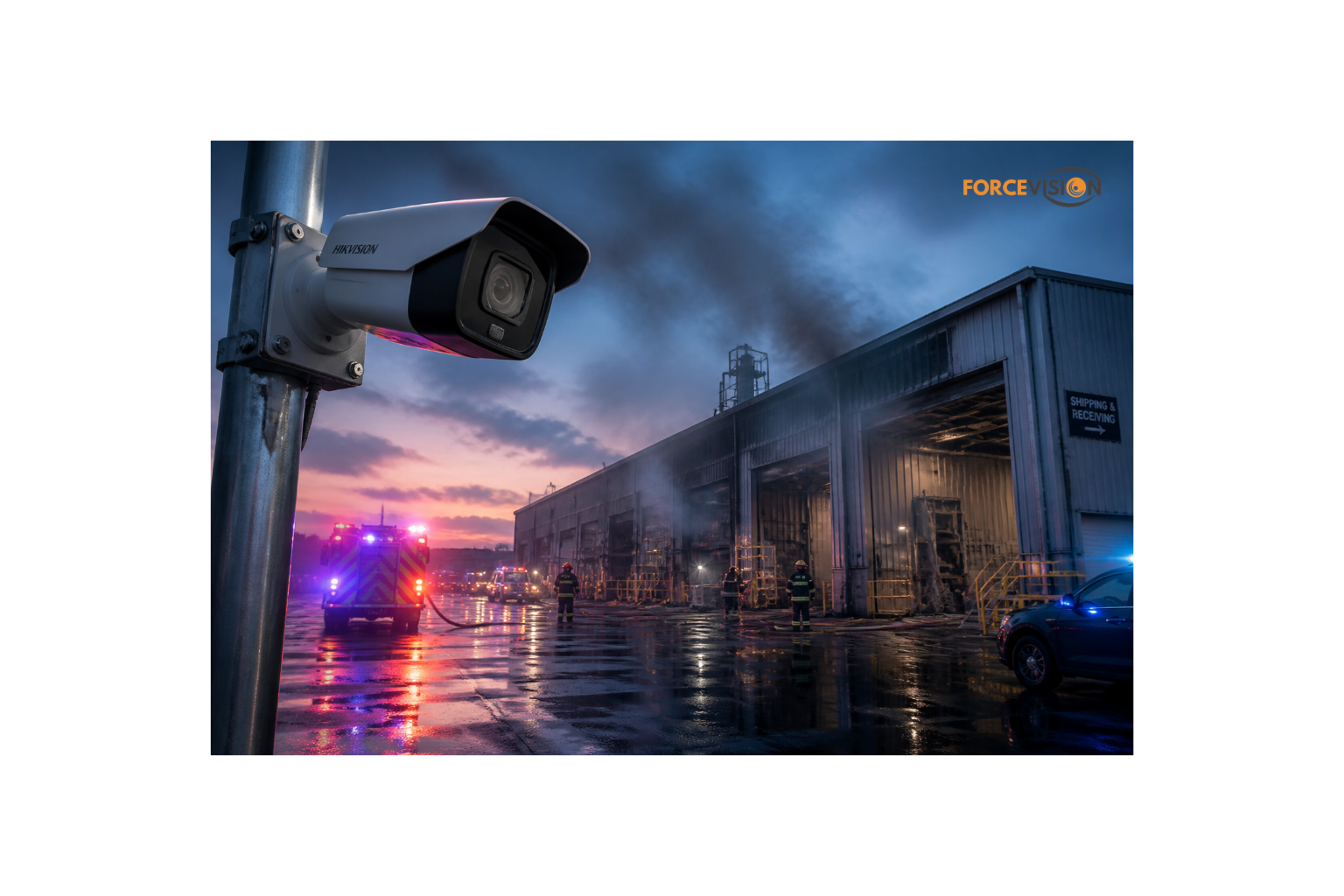
When a 1.2‑million‑square‑foot Kimberly‑Clark warehouse in Ontario, California went up in a six‑alarm blaze this April, investigators quickly focused on a chilling possibility: the threat came from the inside. An employee of a third‑party logistics operator was arrested on multiple felony arson charges, with police noting that video surveillance footage would be key to the investigation.
For large Canadian warehouses and distribution centres across Southern Ontario, this incident feels uncomfortably familiar, even if it happened thousands of kilometres away. The scale of the building, the reliance on third‑party contractors, the volume of inventory under one roof — it all mirrors what you see in logistics hubs from Mississauga to Brampton to the Golden Horseshoe.
Why insider risk is different in large warehouses
Most industrial security planning assumes threats arrive at the fence line: trespassers, cargo thieves, or vandals testing the perimeter. But at a site the size of a modern paper goods warehouse or e‑commerce distribution centre, the riskiest person might already have a badge, PPE, and knowledge of where cameras do not reach.
Insiders understand blind spots, alarm procedures, and how long it takes for a supervisor or guard to respond. In the Ontario, CA fire, the suspect worked for a third‑party logistics firm operating the warehouse on behalf of the brand owner, which is a structure you see frequently in Canadian industrial parks. That arrangement can blur accountability for security standards, camera coverage, and monitoring practices.
How industrial CCTV needs to change for insider threats
Traditional CCTV designs for warehouses focus on dock doors, perimeter fencing, and office entries. That is a start, but the Kimberly‑Clark case shows why interior coverage and analytics are just as important.
For a 64‑camera (or larger) industrial CCTV system in a Canadian warehouse or distribution hub, a more insider‑aware design should include:
-
Overhead coverage of high‑value storage aisles, mezzanines, and racking where arson or theft could begin unnoticed.
-
Fixed dome cameras inside stairwells, electrical rooms, and mechanical spaces where someone might start a fire or tamper with systems out of sight.
-
PTZ cameras with pre‑set tours focused on areas where contractors or visitors work unsupervised.
-
Smart video analytics that flag unusual loitering, off‑hours presence in restricted zones, or repeated visits to the same sensitive location.
In other words, industrial CCTV for Canadian warehouses and distribution centres cannot just be about proving what happened after a loss. It needs to elevate unusual behaviour in real time so supervisors and safety teams can intervene.
Where 64‑camera systems fit in Canadian warehouses
Once a facility grows past a few docks and a single bay of racking, 16‑ or 24‑camera systems hit their limits very quickly. A 64‑camera platform gives operations and safety leaders enough coverage to treat CCTV as infrastructure rather than a patchwork of fixes.
At a typical Southern Ontario warehouse handling paper goods, packaged foods, or consumer products, a 64‑camera industrial CCTV platform can be distributed roughly as follows:
-
20–24 cameras dedicated to the interior floor, racking, and mezzanine areas, with overlapping views.
-
12–16 cameras focused on dock doors, yard lanes, and trailer parking.
-
8–12 cameras on the building perimeter and employee parking.
-
4–8 specialty views for stairwells, mechanical rooms, battery charging areas, and other high‑risk locations.
When paired with modern NVR security systems and a hardened network, this becomes the backbone of a continuous record of who was where, when, and what they were doing. That record is exactly what investigators referenced in the Ontario, CA case when they emphasized that reviewing video surveillance would be part of their effort.
Using video analytics to spot unsafe behaviour before disaster
Insider‑driven arson is rare, but the kinds of behaviours that precede major incidents are not: unauthorized smoking in storage bays, makeshift heaters, blocked exits, or staff “fixing” equipment they should not touch. Industrial CCTV for Canadian warehouses and distribution centres can help catch these early.
With video analytics tuned for industrial environments, large sites can:
-
Detect people in restricted zones after shift change or during weekends.
-
Alert on loitering around hazmat cages, flammable storage, or electrical rooms.
-
Correlate badge access logs with video to quickly confirm who actually entered a zone, not just whose card was used.
-
Provide rapid “video audit” capability after any alarm, letting supervisors see the 10 minutes before a smoke detector triggers rather than starting at the moment it went off.
When analytics are tied into a central NVR and monitored either on‑site or by a trusted remote team, the difference between “we have footage” and “we had a chance to prevent this” becomes very real.
CCTV as a bridge between safety, HR, and operations
The Ontario, CA warehouse fire fortunately did not result in reported injuries, but it did force a full evacuation and destroyed significant inventory. In Canada, the same scenario would immediately involve not only police but also insurers, the Ministry of Labour, and potentially the Transportation of Dangerous Goods program if regulated materials were stored.
A well‑architected 64‑camera industrial CCTV platform supports:
-
Safety teams: Verifying evacuation routes were clear, fire doors were closed, and staff followed procedures.
-
HR: Investigating misconduct by employees or contractors in a fair, evidence‑based way.
-
Operations: Understanding how a small incident escalated — for example, whether forklifts, pallets, or blocked aisles contributed to spread or hampered response.
This multi‑department value is one reason many large operators now fund CCTV upgrades from shared budgets rather than treating them as a narrow “security” expense.
Designing your next‑generation warehouse CCTV system
If you operate a warehouse or distribution centre in Burlington, Oakville, Mississauga, Brampton, or anywhere along the 401/403 corridor, the lesson from Ontario, CA is not to panic — it is to audit. Walk your facility and ask:
-
Where could someone start a fire or sabotage equipment without being on camera?
-
Where do contractors or third‑party staff work without line‑of‑sight from supervisors?
-
Can you reconstruct a full path of travel for any person entering the site, from gate to task area?
-
Do you have enough camera density to investigate a claim without relying on a single “lucky” angle?
If the answer to any of these questions is “no”, the next industrial CCTV system you plan should be built around closing those gaps, not simply adding higher‑resolution views of the same old spots.
ForceVision helps large sites across Southern Ontario design industrial CCTV for Canadian warehouses and distribution centres that accounts for both outside and insider risk, using 64‑camera and larger platforms where appropriate. If you are wondering what a more resilient design would look like for your facility, ForceVision can walk your team through options in a no‑pressure assessment tailored to your layout and risk profile.
The Ontario, California warehouse fire will lead to years of insurance, legal, and operational fallout. Use it as a prompt to review your own coverage, monitoring, and analytics — before your cameras are only useful for explaining what went wrong.
FAQ
Q1: How many cameras does a typical large warehouse actually need?
Most large warehouses in the 300,000–800,000‑square‑foot range end up in the 64‑ to 128‑camera range once they properly cover interior racking, docks, yards, and sensitive spaces.
Q2: Do video analytics really work in busy industrial environments?
Yes, when configured correctly. Modern analytics can handle forklifts, pallets, and worker movement, focusing alerts on off‑hours access, restricted zones, and unusual dwell times rather than constant motion.
Q3: How does CCTV help with insurance after a fire or major loss?
Clear, time‑stamped footage helps insurers see what occurred, verify that safety procedures were followed, and resolve questions faster, which can support smoother claims and potentially better terms over time.
Q4: What if we already have a small legacy CCTV system?
You do not have to rip everything out at once. Many operators phase an upgrade, integrating existing cameras into a new NVR and incrementally building toward a 64‑camera industrial CCTV platform that meets current risk.


