

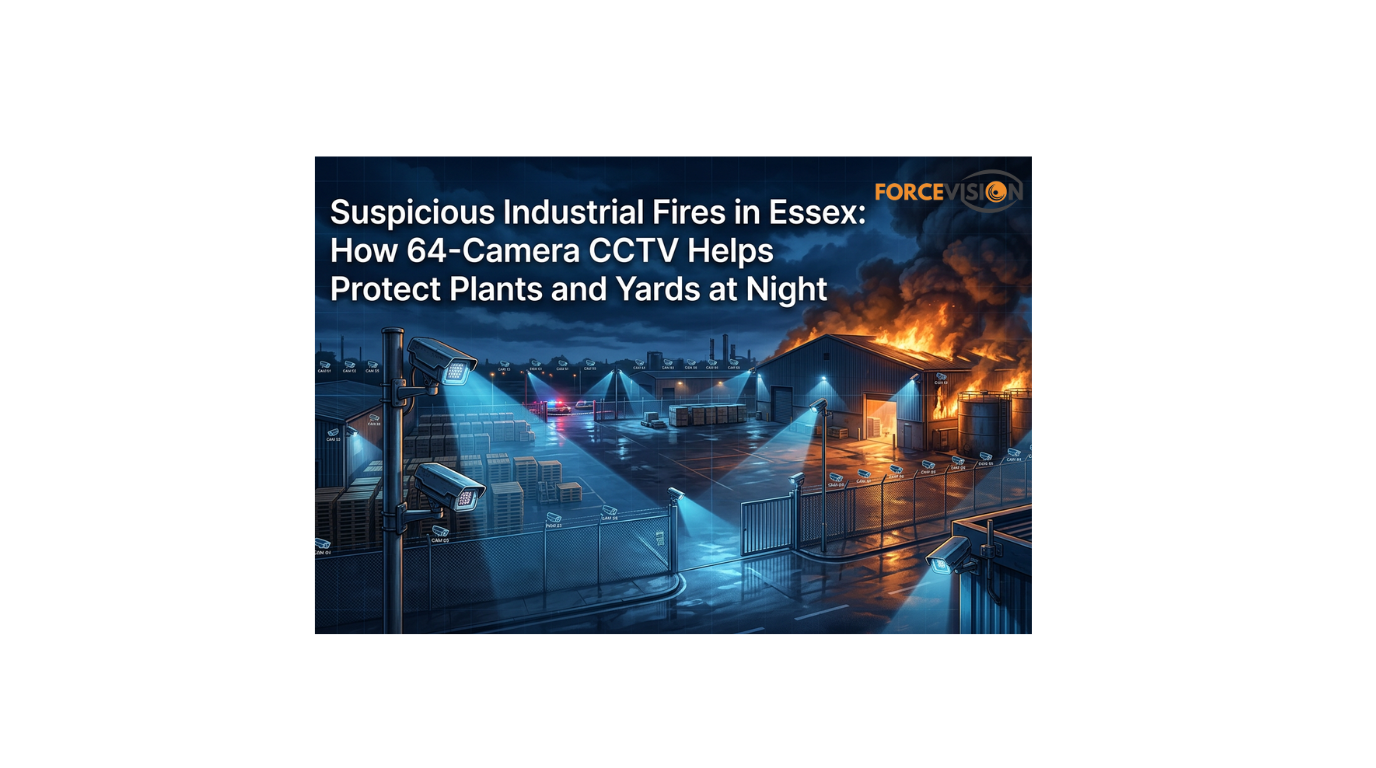
A Suspicious Commercial Fire That Hits Close to Home
In late March 2026, Ontario Provincial Police and Lakeshore firefighters responded to a blaze at a commercial property on Industrial Drive in the community of Comber, Essex County. The fire broke out just before 1 a.m., when the building was unoccupied, and investigators quickly deemed the incident “suspicious.” Thankfully, no injuries were reported—but the aftermath tells a familiar story for industrial operators across Southern Ontario.
The OPP Crime Unit, along with the Office of the Ontario Fire Marshal, is now investigating the Comber fire and has asked nearby residents and businesses to review any available security or surveillance footage for suspicious activity around the time of the incident. In other words, investigators are turning first to video to understand what happened before the flames. For large plants, warehouses, rail‑served yards, and energy sites, this is a clear signal: if your cameras are not watching your buildings and yards properly at night, you may be flying blind when it matters most.
Why Industrial and Commercial Sites Are Attractive Arson Targets
Industrial and commercial properties often sit in low‑traffic areas—industrial parks, along rail corridors, or near highways—making them attractive targets for arson, vandalism, and opportunistic crime after hours. Empty yards and dark loading areas can conceal suspicious behaviour long before a fire starts.
Common risk factors include:
-
Large, unoccupied buildings during nights and weekends.
-
Exterior storage of pallets, waste, or combustible materials near walls.
-
Poorly lit corners and blind spots around loading docks and service yards.
-
Limited human presence to challenge suspicious behaviour before ignition.
Once a fire starts, response time becomes critical. Research on building fire incidents underscores how discovery and response delays can dramatically affect life safety and property loss. While smoke detectors and sprinkler systems are vital inside, many ignition events start outside—on loading docks, near dumpsters, or along building perimeters—where traditional indoor sensors may not detect early warning signs. That is where industrial‑grade CCTV can provide an extra layer of protection.
What a 64‑Camera, Fire‑Aware Layout Looks Like Around Plants and Yards
Most legacy camera systems at industrial sites were installed primarily to deter theft, not to support arson or fire investigations. To address today’s risks, a 64‑camera design should explicitly consider fire and arson scenarios:
-
Perimeter and yard coverage
Cameras along fence lines and approach roads capture vehicles and people entering around the time of a later fire, just as investigators are now asking Comber‑area businesses to check for suspicious activity. -
Building exteriors and loading docks
Fixed and PTZ cameras focused on dock doors, overhead canopies, and exterior walls help detect people loitering, placing objects, or attempting to ignite materials near structures. -
Waste, recycling, and pallet areas
Dedicated views over dumpsters, scrap bins, and pallet stacks—common ignition points for arson—make it easier to spot risky behaviour in advance and reconstruct what led to a blaze. -
Critical infrastructure
Cameras monitoring transformers, fuel tanks, chemical storage, and mechanical rooms can provide crucial context if a “suspicious” fire involves infrastructure rather than open yard areas.
By stitching these perspectives together, investigators can often trace back from visible flames to the minutes or hours when a suspect vehicle entered, a person walked behind a building, or flammable material was moved closer to a wall.
Using CCTV to Detect Suspicious Behaviour Before a Fire Starts
New advances in video analytics—and in some cases, dedicated fire‑and‑smoke detection algorithms—make it possible to use cameras not just for post‑event review but for proactive detection. In high‑risk industrial contexts, analytics can help you:
-
Flag loitering near doors, dumpsters, and fuel points during times when no one should be present.
-
Detect vehicles circling a lot multiple times, as seen in previous Ontario arson investigations captured on surveillance video.
-
Identify visible flames or smoke in outdoor camera views, providing an extra alarm path alongside traditional sensors.
When configured correctly, these alerts can route to on‑call supervisors, remote monitoring centres, or security teams, who can verify events in real time and call fire services earlier if something looks wrong. In communities like Essex County, where OPP are publicly urging businesses to review surveillance around suspicious fires, having analytics‑assisted visibility is a clear advantage.
How CCTV Footage Supports Fire and Arson Investigations
When a fire is deemed suspicious—as in Comber—CCTV quickly becomes one of the most important sources of evidence for both police and fire investigators. High‑quality footage can:
-
Show who was on or near the property before ignition, including vehicles, license plates, and individuals.
-
Reveal where the fire appears to have started, helping investigators narrow down the point of origin.
-
Distinguish between accidental factors (for example, smoking in prohibited areas, unsafe hot work) and more deliberate acts like accelerant use or repeated returns to the scene.
Investigators frequently ask nearby businesses to review and share their surveillance, as seen not only in Essex but in other Ontario arson and structure‑fire probes. For industrial operators, this means your footage may become part of a broader community safety investigation—even if your building was not the primary target. Having clear, retainable footage and a process for secure export is crucial.
Insurance, Risk, and the Cost of Being Blind
From an insurance and risk‑management standpoint, suspicious fires at commercial and industrial properties are a major concern. Insurers need to determine:
-
Whether reasonable precautions were taken to secure the property.
-
Whether any negligence—such as storing combustibles too close to buildings—contributed to the loss.
-
Whether criminal activity (arson) was involved, potentially triggering different coverage and recovery pathways.
CCTV footage can help answer these questions, showing how waste and pallets were stored, whether trespassers had been active in the area, and what time patterns existed around the incident. For large industrial clients with complex risk portfolios, providing this level of documentation can support smoother claims handling and underpin discussions about future premiums and risk‑engineering investments.
Designing 64‑Camera Systems with Fire and Arson in Mind
When ForceVision works with industrial operators—rail yards, plants, logistics hubs, and energy sites—fire and arson risk are part of the planning conversation, not an afterthought. A fire‑aware 64‑camera design typically:
-
Prioritises clear coverage of building exteriors, especially where materials, dumpsters, and pallets are stored.
-
Ensures that key approaches and access roads are captured with enough clarity to identify vehicles and individuals.
-
Integrates with remote monitoring, so suspicious behaviour at 2 a.m. does not depend solely on a drive‑by patrol for detection.
-
Supports secure retention and export, so footage can be quickly shared with OPP, municipal fire services, and the Ontario Fire Marshal when requested.
If the recent suspicious commercial fire in Comber has you asking whether your own site would be able to support a similar investigation—or, better yet, spot a problem earlier—ForceVision can walk your safety, operations, and risk teams through a 64‑camera assessment focused specifically on night‑time and fire‑related exposure.
FAQs: Industrial CCTV for Fire and Arson Risk in Ontario
How long should industrial sites keep exterior footage for fire investigations?
Because some fire patterns emerge over time and investigators may not request footage immediately, many operators aim for at least 30–60 days of retention on exterior cameras, with key views kept longer based on risk and storage capacity.
Can cameras actually detect fire and smoke automatically?
Yes. Research and commercial solutions now offer computer‑vision‑based fire and smoke detection, which can analyse CCTV feeds for tell‑tale visual patterns, supplementing traditional sensors—especially in large, open spaces.
Do we need special cameras for night‑time fire and arson risk?
You need cameras with adequate low‑light performance and well‑designed lighting. In some high‑risk areas, thermal imaging can help detect people or hotspots in low‑visibility conditions.
Won’t more cameras feel intrusive to employees?
Focusing on exterior risk zones, clear policies, and transparent communication about the purpose—property protection, fire prevention, and community safety—helps employees see cameras as a safety tool, not covert surveillance.


