

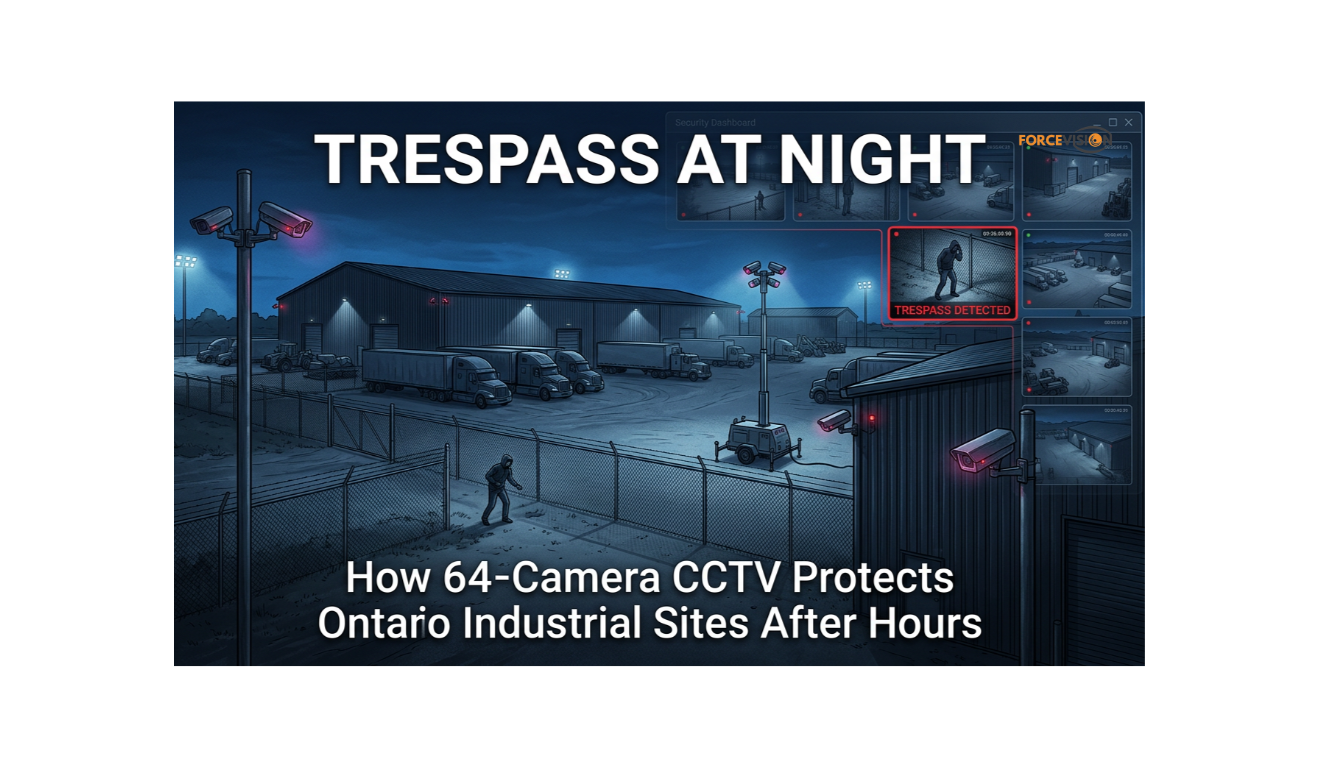
Night-Time Trespass Is a Growing Red Flag for Industrial Sites
Recent incidents in Ontario, including arrests for “trespass at night” around commercial and industrial properties, underline a risk many operators already feel: after dark, large yards and plants can become attractive targets for thieves, vandals, and thrill‑seekers. While some of these events end quietly, others escalate into theft, copper stripping, fuel siphoning, or dangerous interactions with heavy equipment or rail infrastructure.
For rail yards, manufacturing plants, logistics hubs, and energy sites, the pattern is familiar. Staffing drops off after hours, supervisors go home, and vast areas of property are left to a combination of perimeter fences, a few patrols, and legacy cameras that may not see well in low light. In this context, a properly designed 64‑camera CCTV system—with the right mix of fixed, PTZ, and low‑light cameras—is one of the most effective tools available to manage night‑time risk.
Why After-Hours Risk Looks Different from Daytime Risk
Daytime OHS and security risks often revolve around vehicle traffic, production equipment, and interactions between workers and contractors. At night, especially on weekends or holidays, the risk profile shifts:
-
Perimeter breaches by individuals testing fences, gates, or rail access points.
-
Unauthorised exploration of yards and facilities by trespassers who may not even understand the hazards around them.
-
Targeted theft attempts focused on easily removed items like copper, tools, catalytic converters, or unsecured equipment.
-
Potential sabotage or vandalism of vehicles, equipment, or critical infrastructure at energy and rail sites.
Because fewer legitimate movements occur at night, even a single unmonitored intrusion can unfold over a long window, increasing both loss potential and safety risk.
What a Night-Ready 64-Camera Layout Looks Like
Designing CCTV for after‑hours protection is not just about adding infrared cameras. It requires a strategic mix of camera types, placement, and lighting. For a typical Ontario industrial site, a night‑ready 64‑camera layout might include:
-
Perimeter bullets and thermal units along fence lines, rail spurs, and access roads to spot movement at the boundary, even in low light or poor weather.
-
PTZ cameras at key intersections and high ground, able to track and zoom in on suspicious activity triggered by analytics or alarms.
-
Fixed domes on building corners covering both walls and adjacent yard space, reducing blind spots where intruders can hide.
-
Coverage for critical outdoor assets such as transformers, fuel tanks, valves, and parked rolling stock or trailers.
This design should be tightly coordinated with site lighting plans so that any person entering the property at night can be clearly seen and identified on video from multiple angles.
Using Analytics and Remote Monitoring to Detect Trespass Early
Modern video analytics and remote monitoring are particularly valuable at night, when human attention tends to wane and legitimate traffic is sparse. By defining virtual zones and schedules, industrial operators can:
-
Flag any human‑sized movement in yard or rail zones that should be empty.
-
Detect someone approaching high‑risk equipment or storage areas after hours.
-
Distinguish between small animals, passing road traffic, and actual intruders.
When an alert triggers, a remote monitoring centre or on‑call security supervisor can quickly verify the situation via live video and decide whether to dispatch on‑site staff, call police, or issue an audio warning through deterrence cameras. Over time, this kind of consistent response reduces the likelihood that repeat trespassers view your yard as an easy, low‑risk playground.
Coordinating CCTV with Physical and Procedural Controls
CCTV should never be the only night‑time defence. It works best as part of a layered approach that includes physical barriers and clear procedures:
-
Fencing and gates: ensure fences are intact, topped appropriately, and that gates are locked and monitored.
-
Lighting: maintain consistent, glare‑free illumination in yards and around buildings to support both safety and camera performance.
-
Asset hardening: lock up or immobilise portable equipment and tools; protect cabling and fuel lines with secure enclosures.
-
Patrol protocols: integrate live or remote video checks into night‑time rounds, focusing on known hotspots and vulnerable areas.
CCTV provides the verification layer that shows whether these controls are present and being used as intended, and it supplies crucial evidence when they fail or are deliberately defeated.
Safety Benefits: Protecting the Public and First Responders
Trespass at night on industrial and rail properties is not just a property crime issue—it is a public safety concern. Unauthorised individuals may wander into areas with moving trains, heavy vehicles, high‑voltage equipment, or hazardous substances, placing themselves and others at risk.
Industrial‑grade CCTV helps by:
-
Detecting trespassers before they reach truly dangerous zones.
-
Providing real‑time situational awareness to supervisors and, when needed, first responders.
-
Supplying detailed footage for incident reviews and community safety outreach.
This is especially important for rail yards, energy sites, and large manufacturing plants near residential areas, where community relations and corporate social responsibility are front‑of‑mind.
How ForceVision Helps Industrial Sites Manage Night-Time Risk
ForceVision designs 64‑camera‑and‑larger CCTV systems specifically for big industrial operations—rail yards, logistics hubs, energy terminals, and manufacturing plants—where after‑hours exposure can translate into multi‑million‑dollar risks. Rather than simply adding more cameras to existing poles, ForceVision:
-
Conducts night‑focused risk assessments to understand how your site looks and behaves after dark.
-
Designs camera layouts and lighting plans geared toward early detection of trespass and clear identification of intruders.
-
Integrates analytics and remote monitoring so your security posture remains strong even when staffing levels are low.
If recent night‑time trespass incidents in Ontario have you re‑evaluating your after‑hours posture, the team at ForceVision can walk your operations and safety leaders through what a night‑ready 64‑camera design would look like for your property, with a free, no‑pressure assessment.
FAQs: After-Hours CCTV for Industrial Sites in Ontario
Do we need different cameras for night‑time coverage?
Yes. For reliable night coverage, industrial sites often combine infrared or low‑light cameras with proper lighting, and in some cases thermal cameras, to ensure clear images in all conditions.
How do we reduce false alarms at night?
Configuring analytics carefully—drawing accurate zones, setting schedules, and tuning sensitivity—helps differentiate between animals, weather, and actual intrusions, especially when paired with trained remote monitoring.
Can CCTV help with charges against trespassers?
High‑quality video can support police in identifying suspects and documenting behaviour, which strengthens enforcement actions under trespass and related offences.
Is 64 cameras excessive for a single site?
For large industrial yards, plants, and terminals, 64 cameras is often the minimum needed to properly cover perimeters, yards, building exteriors, and key interior zones without leaving exploitable night‑time gaps.


