

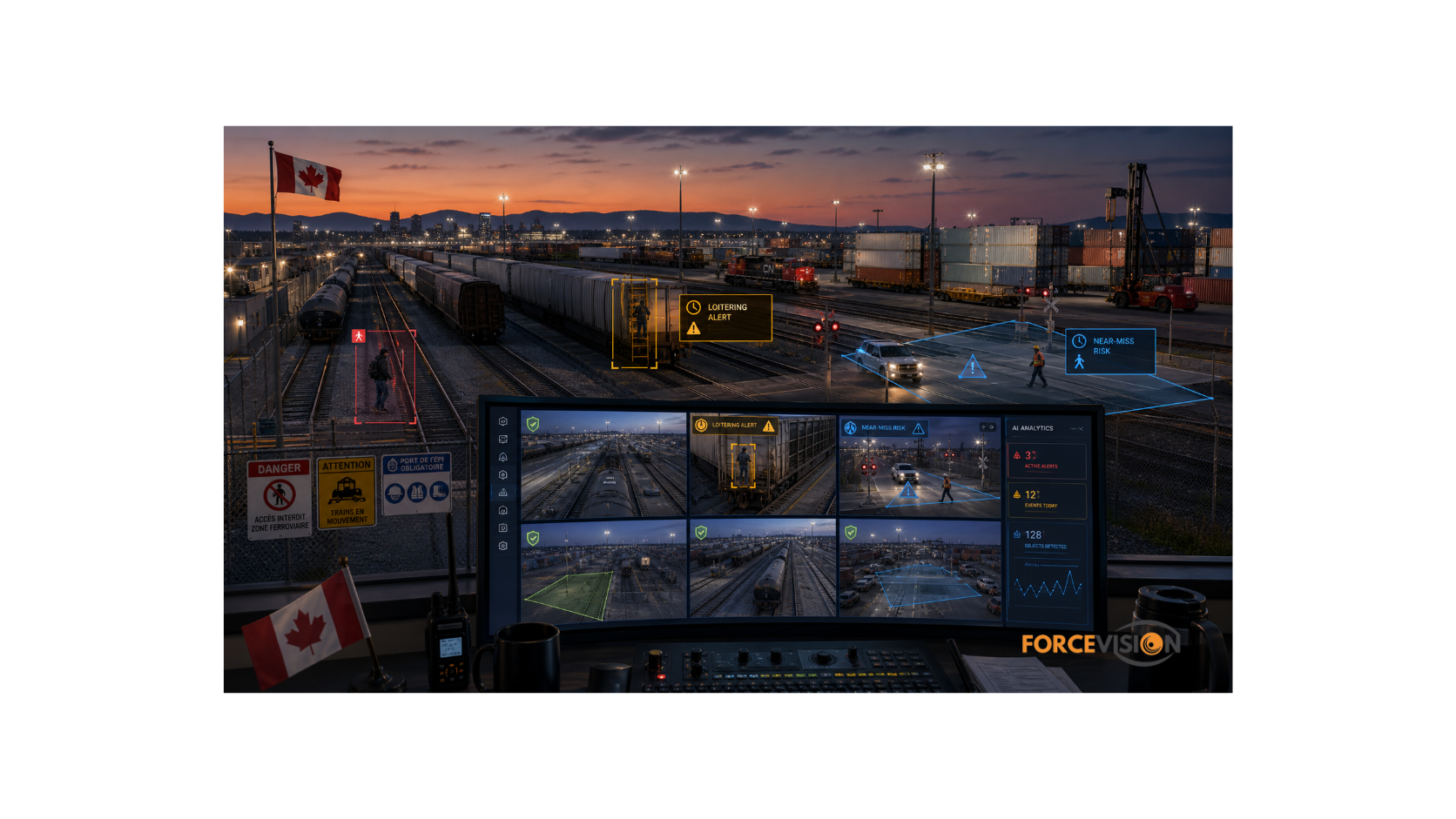
Rail networks are vast – and human eyes alone cannot watch them
Rail networks have long struggled to monitor large areas for trespassing, theft, and safety incidents. Research on railway surveillance highlights how modern systems must cover kilometres of track, yards, platforms, and access points while detecting both security threats and risky behaviour. Studies also note that traditional monitoring – a few operators watching walls of screens – cannot keep up with the volume of video generated by extensive rail CCTV systems.mdpi+1
In Canada, where rail corridors cut through urban, suburban, and rural areas, operators face a mix of challenges: unwanted trespass, vandalism, theft from parked cars near stations, and, in some cases, self‑harm attempts near tracks. For large Southern Ontario yards and intermodal terminals near GO stations and urban hubs, these risks are magnified by high passenger and vehicle volumes.crimesciencejournal.biomedcentral+2
Why Ontario rail yards need smarter surveillance
Academic work on rail security stresses that CCTV must now serve multiple functions at once: security, safety, and operational awareness. For Ontario operators, that translates into:mdpi+1
-
Detecting trespassers near active tracks and switching zones before they are in real danger.mdpi+1
-
Spotting people in unauthorized areas of yards, fuel facilities, and maintenance shops after hours.mdpi+1
-
Monitoring large parking lots and access roads around GO stations and rail‑adjacent facilities, which have seen vehicle theft activity in the Toronto area.linkedin
-
Supporting incident investigations quickly, without scrubbing through hours of footage.
As rail‑adjacent vehicle theft and trespass trends gain attention in Southern Ontario, operators cannot assume that a few legacy cameras and patrols will be enough. Video analytics for rail yards now offer a way to get more value from each camera, automatically highlighting events that matter.linkedin
How video analytics for rail yards work
Video analytics for rail yards use algorithms to detect patterns in footage, such as motion, shapes, and behaviours that may indicate risk.mdpi+1
Common applications include:
-
Intrusion detection along trackside fences or virtual perimeters, generating an alert when a person crosses into a restricted zone.mdpi
-
People detection on tracks, in tunnels, or near platform edges outside normal boarding and alighting patterns.mdpi+1
-
Object detection and classification for trains, vehicles, and equipment, helping operators understand real‑time yard occupancy and movements.mdpi+1
-
Behaviour recognition, such as loitering near high‑risk locations that may correlate with self‑harm or vandalism.mdpi
Newer research looks at combining multiple sensors and camera feeds to reduce false alarms and improve robustness in challenging weather and lighting. For Ontario sites, where snow, rain, and glare are routine, those advances are particularly relevant.mdpi
Applying analytics across a Southern Ontario yard
In practical terms, a 64‑camera‑plus system with video analytics for rail yards in the Golden Horseshoe might be configured as follows:
-
Fixed cameras with analytics along perimeter fences and access roads to detect people or vehicles entering from non‑gate points.
-
PTZ cameras with auto‑tracking to follow a detected trespasser or suspicious vehicle across multiple zones.mdpi+1
-
Overhead cameras on towers or lighting masts, using analytics to monitor workers’ proximity to live tracks, moving equipment, and exclusion zones.mdpi+1
-
Platform and yard cameras configured to flag people lingering in dangerous areas, especially outside normal passenger flows.crimesciencejournal.biomedcentral+1
Alerts can be routed to yard control rooms, security teams, or even mobile devices carried by supervisors, depending on policies and union agreements. The goal is not to replace human judgment but to give staff early warning and better situational awareness.
Supporting suicide prevention and public safety
One focus area in the research literature is using video analytics to help prevent suicides and self‑harm on rail networks. Analyses of transit systems show that certain patterns – such as prolonged loitering near platform edges or tracks – may precede some attempts.crimesciencejournal.biomedcentral+1
By configuring video analytics for rail yards and stations to identify these behaviours, operators can:
-
Alert nearby staff or transit police to check on individuals in apparent distress.crimesciencejournal.biomedcentral+1
-
Coordinate with local partners and first responders to intervene more quickly.crimesciencejournal.biomedcentral
-
Review footage after incidents to refine detection rules and staff training.
For rail‑adjacent industrial yards and logistics hubs in Ontario, similar approaches can also help detect intoxicated or disoriented individuals who wander onto rail property from nearby roads or parking lots.linkedin+1
Turning surveillance into operational intelligence
Beyond safety and security, video analytics for rail yards can help operators improve efficiency. Some systems can measure queue lengths, track dwell times for trains and trucks, and highlight bottlenecks at gates and transfer points.mdpi+1
That means the same camera network can:
-
Support yard‑planning decisions.
-
Provide evidence for schedule and staffing adjustments.
-
Offer data for continuous improvement without sending extra staff into hazardous zones.
ForceVision works with rail and rail‑adjacent operators across Southern Ontario to design CCTV and analytics solutions that match the reality of sprawling yards, mixed traffic, and shared access with commuters. If you are exploring video analytics for rail yards or intermodal terminals, ForceVision can help map which zones to prioritise and how to integrate alerts into your existing operations and safety workflows.
FAQs
Q1. Are video analytics accurate enough for safety‑critical rail applications?
While no system is perfect, research shows that well‑tuned analytics with multimodal inputs can detect critical events with increasing reliability, especially when combined with human oversight and clear procedures.mdpi
Q2. Do analytics require new cameras?
Not always. Many existing IP cameras can feed into an upgraded analytics platform, though some high‑risk zones may benefit from higher‑resolution or thermal cameras to improve performance in poor conditions.mdpi+1
Q3. How do analytics affect privacy?
Most rail‑yard analytics focus on anonymous patterns – movement, shapes, time in zone – rather than identifying individuals. Clear signage, policies, and data‑retention practices remain important for community and workforce trust.
Q4. Is this only for passenger rail?
No. Freight rail yards, intermodal terminals, and rail‑adjacent logistics hubs all benefit from better detection of trespass, theft, and unsafe behaviour around heavy equipment and live tracks.


