

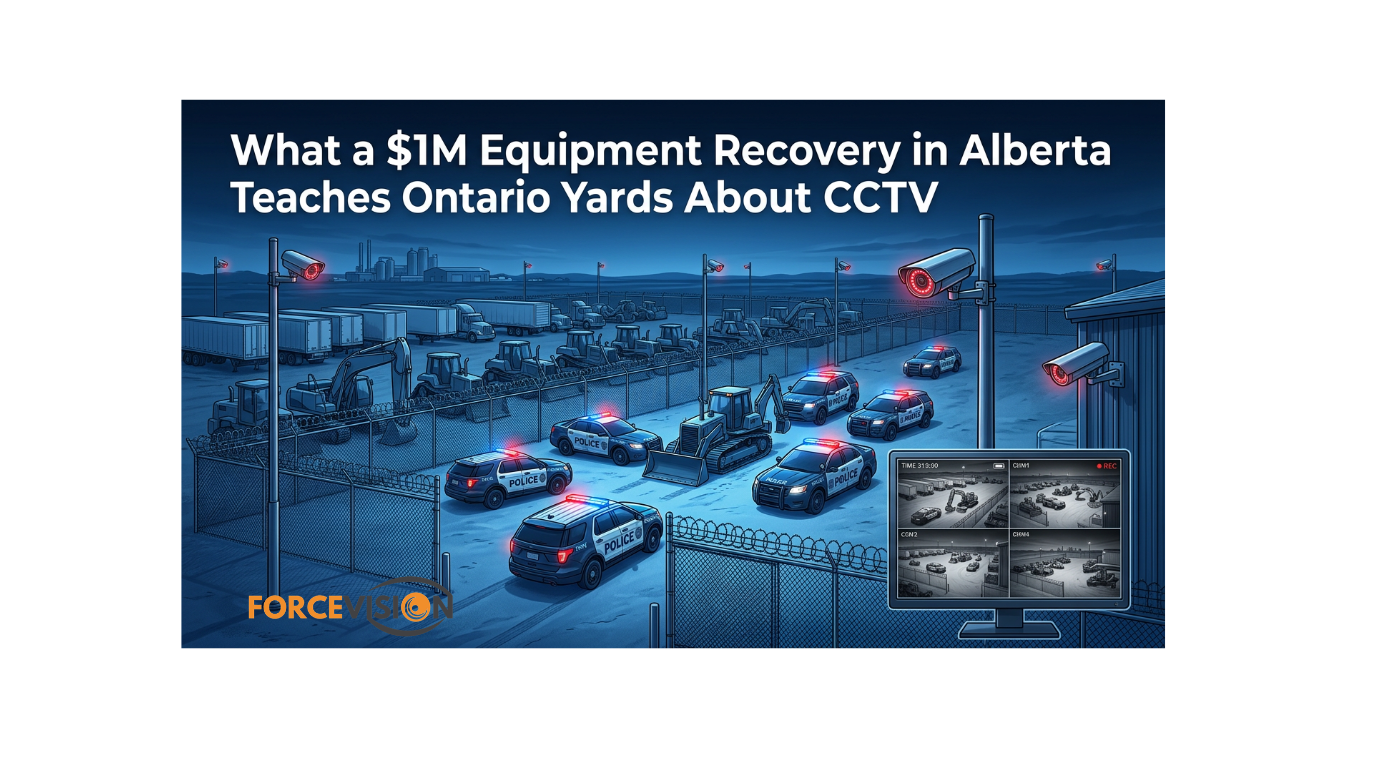
In February, Alberta RCMP announced they had recovered more than one million dollars in stolen equipment and machinery from a rural property in Wetaskiwin County, after a month‑long investigation into multiple thefts across central Alberta and Edmonton. Four individuals were arrested, and the case underscored just how quickly a small group of prolific offenders can strip fleets and job sites of high‑value gear.
For operators of equipment yards, fabrication shops, and large construction staging areas in Ontario, this incident should feel very close to home. The same types of skid steers, generators, trailers, and specialized machines that vanished in Alberta are parked every night in Hamilton, Kitchener, Barrie, and the GTA. Industrial CCTV for heavy equipment yards in Canada is no longer a nice‑to‑have; it is central to asset protection.
Why are heavy equipment sites so attractive to thieves?
Heavy equipment and specialized machinery are portable stores of value, often with weak or inconsistent marking and tracking. They can be loaded quickly, moved at night, and resold or parted out with relatively low risk compared with traditional retail theft. In the Alberta case, equipment from multiple separate thefts ended up consolidated on a single rural property before recovery.
Many Ontario yards face similar challenges: large outdoor footprints, mixed fleets, and changing inventory make it hard to notice what is missing until days later. Perimeter fencing, chains, and lighting help, but without industrial CCTV for heavy equipment yards in Canada, operators rarely have the evidence they need to reconstruct when a machine left, how it was moved, and by whom.
What are the typical surveillance gaps at equipment yards?
Across the construction, aggregates, and industrial services sectors, several CCTV gaps appear again and again:
-
Perimeter blind spots where fences meet tree lines, berms, or neighbouring lots.
-
Uncovered access roads and informal “back gates” used by staff and contractors.
-
Yard rows where cameras see roofs of machines but not plates, VINs, or operator cabins.
-
Poor night performance from aging cameras that produce unusable footage when it matters most.
Industrial CCTV for heavy equipment yards in Canada should explicitly design around these patterns. That means documenting real access routes, typical parking patterns, and high‑risk storage areas for smaller, easily moved equipment.
How should a 64‑camera system be planned for a large yard?
For bigger construction and equipment yards, a 64‑camera platform is often the practical minimum for full coverage rather than an aspirational number. The goal is to create overlapping fields of view that leave intruders with nowhere to hide from the moment they approach the property.
Key components include:
-
Perimeter bullet cameras every 50–75 metres, with some aimed outward to catch vehicles approaching and others inward to capture movement along the fence line.
-
PTZ cameras mounted on poles or building corners overseeing vehicle gates, fuel islands, and the densest equipment clusters.
-
Dome cameras at office doors, parts cages, and shops where keys, attachments, and portable tools are stored.
-
Sufficient IR or white‑light illumination to ensure night footage is clear and court‑usable, not grainy smears of light.
An industrial NVR with the capacity to handle 64+ channels and long retention ties all of this together, giving supervisors quick search tools to review targeted time windows when an incident is reported.
How can analytics and remote monitoring change the risk profile?
In a dispersed yard environment, human guards or supervisors cannot see everything at once, particularly overnight or on weekends. Video analytics layered onto industrial CCTV for heavy equipment yards in Canada helps shift from reactive reviews to proactive alerts.
Basic rules such as detecting people in the yard after curfew, vehicles moving in restricted zones, or motion near specific storage areas can generate alerts to a control room or monitoring centre. More advanced systems can distinguish between wildlife, wind‑blown debris, and actual human intrusions, reducing false alarms. Research in rail and transit security shows how multimodal surveillance and smarter analytics improve detection of critical events in large, complex networks. The same approach can be applied to networks of construction and industrial yards.
Remote monitoring, whether handled internally or by a trusted third party, allows these alerts to be triaged quickly. Operators can move from “we discovered the theft Monday morning” to “we confronted the intruder on camera Saturday night,” which dramatically changes outcomes.
How does CCTV support collaboration with police and insurers?
In the Alberta recovery, coordinated work between local detachments and specialized units like the Auto Theft Unit proved critical. When industrial sites can provide clear video evidence—vehicle descriptions, licence plates, time‑stamped movements—it strengthens investigators’ ability to connect incidents and build strong cases.
For insurers, clear footage showing fences cut, gates breached, and machines removed by unknown vehicles supports claims and can help reinforce that the operator took reasonable security measures. Over time, industrial CCTV for heavy equipment yards in Canada can contribute to better risk profiles, which may influence premiums or underwriting decisions, especially when combined with documented security procedures.
What practical steps should Ontario operators take now?
If you operate equipment yards, large construction staging sites, or industrial service depots in Southern Ontario, consider using this Alberta case as a prompt to run your own risk review:
-
Map your current camera coverage against actual access routes and equipment clusters.
-
Identify night‑time blind spots and test footage quality after dark.
-
Confirm that your NVR retention period matches how long it typically takes to notice missing equipment.
-
Develop a standard operating procedure for exporting and securing video when an incident is suspected.
If you’re unsure whether your current system would stand up to a serious theft attempt, ForceVision can help benchmark your setup against best practices for heavy equipment and industrial yards. A no‑pressure assessment can highlight quick wins and longer‑term upgrade paths tailored to your site and budget.
The lesson from Alberta is straightforward: prolific offenders can cause outsized damage, but they are also vulnerable to coordinated, evidence‑driven investigations. Make sure your yards are part of the solution side of that equation, not the weak link.
FAQ
Q1: Are cameras enough on their own to stop equipment theft?
A: Cameras are one pillar of defence. They work best alongside good lighting, strong access control, clear key management, and staff training on suspicious behaviour.
Q2: How long should we retain yard footage?
A: Many heavy equipment sites aim for at least 30 days, but 60–90 days may be appropriate where theft discovery is often delayed or projects are remote.
Q3: Do we need high‑megapixel cameras everywhere?
A: Not necessarily. Use higher resolution for gates, roadways, and high‑risk clusters where identification matters most, and standard resolution elsewhere to control storage and cost.
Q4: Can one system cover multiple yards?
A: Yes. Modern NVR and VMS platforms can manage cameras across multiple locations, giving regional managers a consolidated view and standardizing security practices.


