

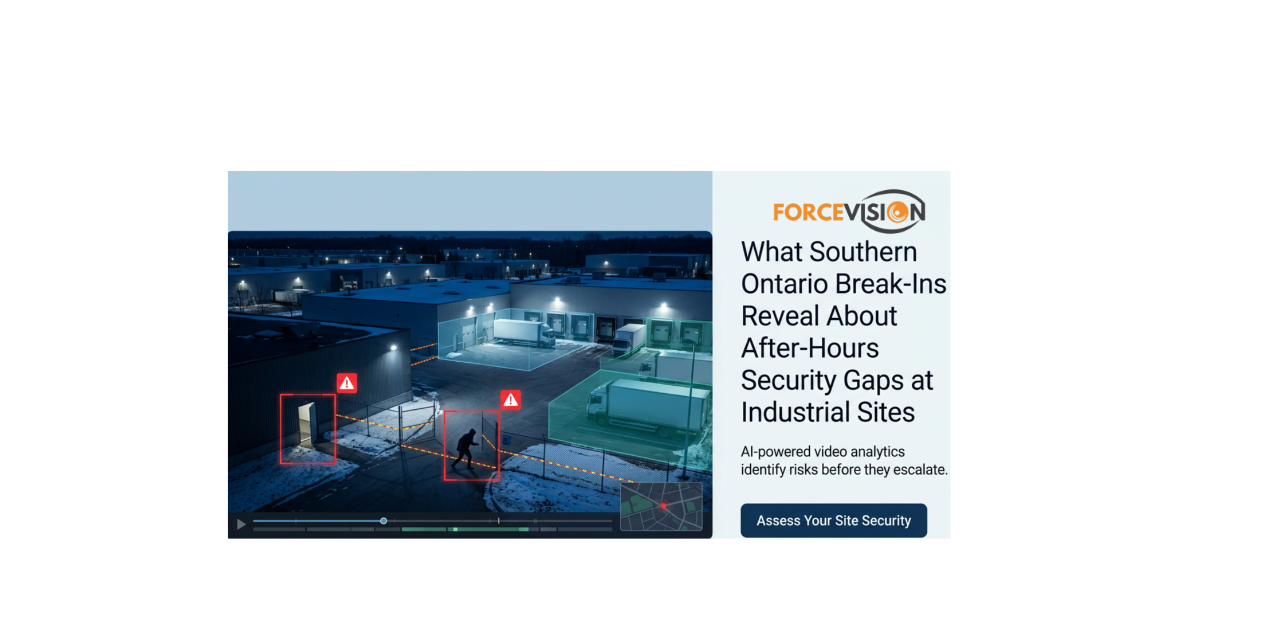
Waterloo Regional Police recently detailed a series of break‑and‑enters targeting vape shops across Southern Ontario, linking incidents in Kitchener, Niagara, Hamilton, Guelph, and London. With multiple locations hit and suspects travelling across regions, the investigation relied on video evidence and inter‑agency collaboration to make arrests.
Although these incidents involved smaller retail businesses, the pattern is deeply relevant to large industrial sites. The same type of organized groups that move quickly between strip malls can just as easily target lightly monitored warehouses, contractor yards, and industrial facilities with valuable tools and materials stored on site.
Why after‑hours gaps exist at industrial facilities
Industrial operators often assume that perimeter fences and building‑mounted cameras are enough to deter after‑hours theft. Yet as these regional crime patterns show, determined offenders frequently:
-
Exploit blind spots in camera layouts.
-
Target side doors, loading bays, and roof access points.
-
Use vehicles to shield their movements from a single fixed camera.
For large manufacturing plants, logistics hubs, and rail‑served facilities, the physical footprint is much larger than a single storefront. That creates many more potential entry points — and many more opportunities for misconfigured or outdated cameras to miss critical activity.
The role of video in cross‑jurisdiction investigations
In the Southern Ontario vape store cases, video footage showed how suspects gained entry to multiple businesses, helping investigators link the crimes and build a stronger case. At the industrial level, the stakes are higher: a single break‑in might involve theft of high‑value tools, copper, or components, but repeated hits across multiple yards can quickly escalate to hundreds of thousands in losses.
High‑quality, time‑synchronized video is crucial when:
-
Multiple sites for the same company are targeted.
-
Incidents occur across different police jurisdictions.
-
Vehicles and individuals need to be identified consistently across locations.
For large industrial operators with sites in Kitchener, Hamilton, Brampton, and beyond, standardizing CCTV quality and retention policies across all locations makes this kind of cross‑site analysis much more effective.
Closing after‑hours gaps with layered CCTV
After‑hours industrial CCTV security in Ontario should be designed as a layered system:
-
Perimeter layer: Bullet cameras along fences, access roads, and rail spurs to detect prowlers before they reach buildings.
-
Approach layer: PTZ cameras covering parking lots, loading areas, and employee entrances to track vehicles and individuals as they move through the site.
-
Entry layer: High‑resolution dome cameras at man doors, dock doors, and overheads to capture faces and actions at point of entry.
-
Interior layer: Strategic cameras in tool cribs, parts rooms, and production areas with high‑value or easily portable assets.
Analytics can tie these layers together by triggering alerts when movement is detected in restricted zones outside defined operating hours.
Coordinating CCTV across multiple sites
Many large industrial organizations have grown through acquisitions, leaving them with a patchwork of camera systems and standards. As cross‑regional crime trends evolve, this fragmentation becomes a liability.
A multi‑site CCTV strategy should include:
-
Standardizing minimum resolution and retention times.
-
Implementing a common VMS so investigators can search across multiple facilities.
-
Centralizing alerting so after‑hours incidents are visible to security teams, not just local staff.
When an operator can pull synchronized footage from several sites after a series of break‑ins, patterns in vehicles, methods of entry, and timing become much clearer, enabling better coordination with police.
How ForceVision helps industrial operators harden after‑hours security
ForceVision works with large rail, manufacturing, logistics, and energy clients to design after‑hours industrial CCTV security in Ontario that reflects both local crime trends and enterprise‑wide needs. That can include:
-
Upgrading legacy cameras to high‑definition models in critical zones.
-
Adding PTZ coverage where suspects often use vehicles or long approaches.
-
Implementing common VMS platforms and alerting rules across all sites.
If your industrial facilities have experienced suspicious activity or near‑miss incidents, ForceVision can conduct a risk‑focused CCTV audit to identify where after‑hours gaps exist and how to close them with layered coverage and analytics.
FAQ
Q1: How long should industrial sites keep CCTV footage?
Many large operators retain footage for at least 30–90 days to support investigations, especially where incidents may not be discovered immediately.
Q2: Are PTZ cameras worth the investment?
PTZ cameras are valuable in large yards and approach areas where you need flexible coverage and the ability to zoom in on vehicles or people during incidents.
Q3: Can a central monitoring team handle multiple sites effectively?
Yes, with a unified VMS and standardized alert rules, a central team can monitor key events from many facilities without watching every camera constantly.
Q4: Do after‑hours alerts generate too many false positives?
Thoughtful configuration, including zoning and schedule‑based rules, can minimize nuisance alerts by focusing only on movement where it truly indicates risk


