

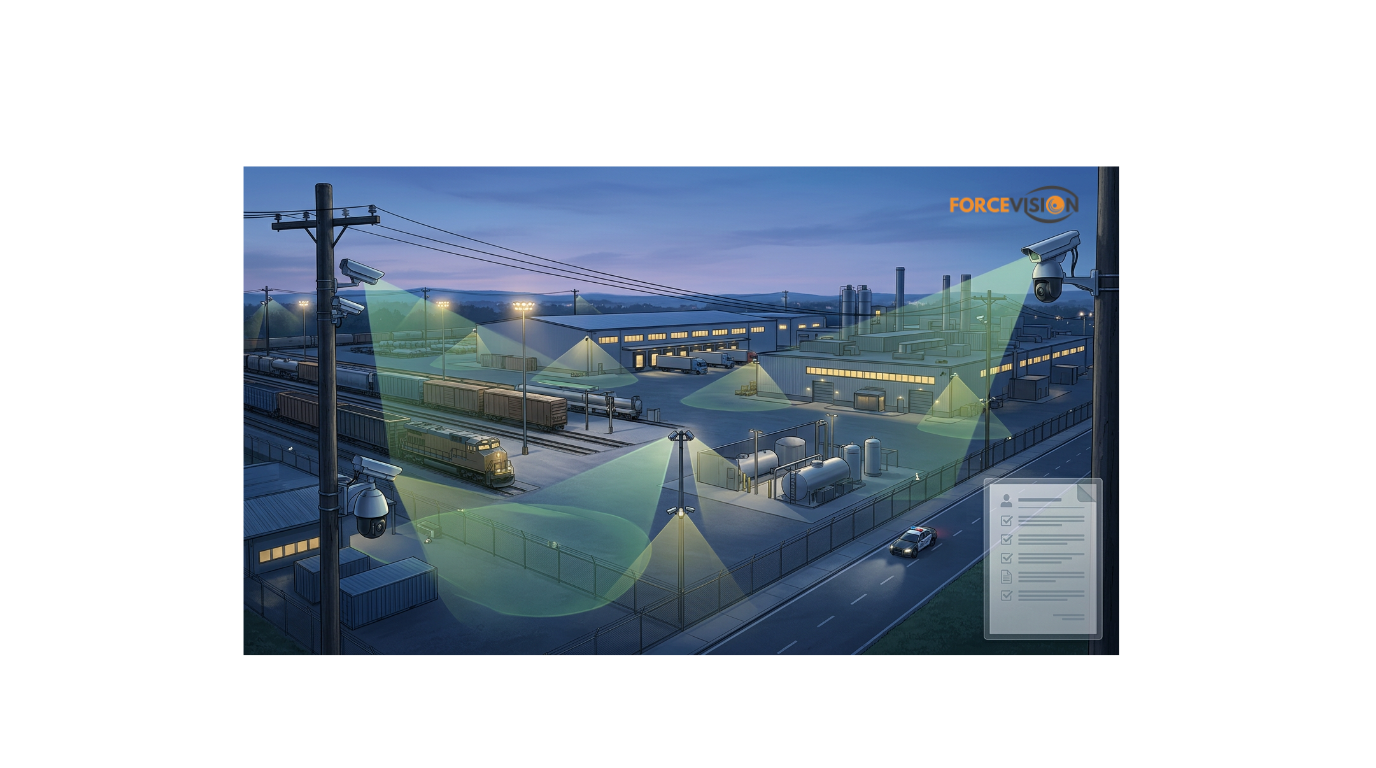
Insurance conversations for large industrial operators have changed. Where underwriters once focused mainly on fire protection and basic physical security, they now ask detailed questions about surveillance coverage, video retention, and how footage is actually used in operations. For big‑ticket risks—rail yards, distribution hubs, manufacturers, and energy facilities—insurers increasingly see industrial‑grade CCTV as core risk‑control infrastructure, not a discretionary add‑on.
This shift reflects a reality that industrial operators and insurers share: a single loss event at a CN‑scale yard, a Magna‑size plant, or a major terminal can quickly reach seven or eight figures when you factor in asset damage, business interruption, environmental costs, and potential injury claims. In this context, industrial CCTV for insurance risk reduction at Canadian yards and plants is about protecting balance sheets as much as it is about catching trespassers.
How CCTV influences underwriter perception
When underwriters assess a large industrial risk, they look at both physical protections and management quality. A modern, well‑documented CCTV program sends strong signals on both fronts. Key questions they ask include:
-
Does the site have yard‑wide coverage, or only a few door cameras?
-
Are critical zones—perimeters, loading areas, rail crossings, hazardous processes—covered from multiple angles?
-
How long is footage retained, and how quickly can relevant clips be retrieved?
-
Who uses the footage: only security, or also operations, safety, and HR?
Operators who can answer these questions confidently, often with a written CCTV plan and site map, demonstrate a proactive approach to risk. Conversely, vague or incomplete answers raise red flags that may influence deductibles, limits, or conditions.
CCTV as a tool for loss prevention
From an insurer’s perspective, the best claim is the one that never happens. Video plays a direct role in preventing losses by:
-
Deterring opportunistic theft and vandalism through visible coverage and signage.
-
Enabling early detection of intrusions or unsafe activity via remote monitoring and analytics.
-
Highlighting recurring unsafe behaviours or process weaknesses that lead to incidents.
For example, a logistics yard that uses CCTV analytics to identify trucks habitually blocking emergency routes—and then corrects the layout or procedure—reduces the chance that an emergency response is delayed in a real event. A manufacturing plant that uses video to investigate repeated minor collisions can redesign traffic flows before a serious injury occurs. These improvements are exactly the kind of risk‑control stories insurers like to hear.
Supporting fair and efficient claims handling
When losses do occur, high‑quality CCTV can significantly improve the claims process for both insureds and insurers. Footage helps:
-
Establish timelines and facts quickly, reducing disputes over what happened.
-
Verify the presence and use of safety measures (PPE, barriers, procedures).
-
Identify third‑party responsibility in multi‑party incidents (contractors, carriers, tenants).
-
Document the scale of damage and immediate response actions.
Canadian insurers increasingly reference video evidence in handling liability, cargo, and property claims. Operators who can supply clear, time‑stamped footage from multiple angles often see faster resolution and fewer contentious negotiations. In some cases, video has exonerated operators from liability when footage showed that all reasonable precautions were in place and the incident stemmed from factors beyond their control.
Designing a CCTV program with insurers in mind
Industrial CCTV for insurance risk reduction at Canadian yards and plants should be designed with explicit attention to insurance requirements. Practical steps include:
-
Mapping cameras to high‑severity risk zones highlighted in risk‑engineering reports (e.g., flammable storage, rail crossings, high‑value warehouses).
-
Documenting camera locations, fields of view, and retention periods in a summary that can be shared with underwriters.
-
Ensuring that critical events—alarms, access‑control breaches, incident reports—are cross‑referenced with video and preserved beyond standard retention where needed.
-
Training operations, safety, and HR teams to use footage for root‑cause analysis and corrective action, then documenting those improvements.
When operators show how CCTV is part of a broader risk‑management system, not just a standalone security measure, insurers gain confidence that incidents will be less frequent and better managed when they do occur.
How ForceVision supports insurance‑ready CCTV
ForceVision designs industrial CCTV systems with insurers and risk engineers in mind. For rail yards, logistics hubs, manufacturing plants, and energy facilities across Southern Ontario, this means:
-
Sizing systems at 64 cameras and above to cover entire yards and plants, not just buildings.
-
Providing clear diagrams of coverage and NVR configurations that clients can share with brokers and underwriters.
-
Ensuring sufficient retention and export capabilities to support investigations and claims.
-
Aligning camera placement with the risk‑engineering priorities outlined by insurers.
If your next renewal meeting is coming up and you are unsure how your CCTV program will look under scrutiny, ForceVision can help you perform a gap assessment and develop an improvement roadmap that you can bring directly into insurance discussions.
A practical step before your next renewal
Before your next policy renewal or risk‑engineering visit, walk through your CCTV program as if you were your own insurer. Ask:
-
Can we show them a simple map of our cameras and coverage?
-
Can we explain how video has helped us prevent or investigate incidents in the last year?
-
Are there obvious blind spots over high‑severity risks?
If the answers are weak or incomplete, consider investing in a 64‑camera, industrial‑grade design that you can confidently present as part of your risk‑control story. It is an investment in both protection and insurability.
FAQ
Q1: Do insurers offer discounts for industrial CCTV systems?
While policies vary, many insurers factor strong CCTV and risk‑management programs into overall pricing, deductibles, and terms, even if they do not advertise specific “discounts.”
Q2: What CCTV details do underwriters typically ask for?
They often ask about the number and type of cameras, coverage areas, monitoring arrangements, retention periods, and examples of how video is used to manage risk.
Q3: How long should footage be kept for insurance purposes?
Thirty days is a common baseline, but many large operators aim for 60–90 days, especially where incidents may surface or be reported after some delay.
Q4: Can CCTV ever hurt an insurance claim?
Footage that shows clear negligence can complicate claims, but most operators find that the benefits—clarity, exoneration, and faster resolution—far outweigh the risks when they maintain strong safety and risk‑control practices.


