

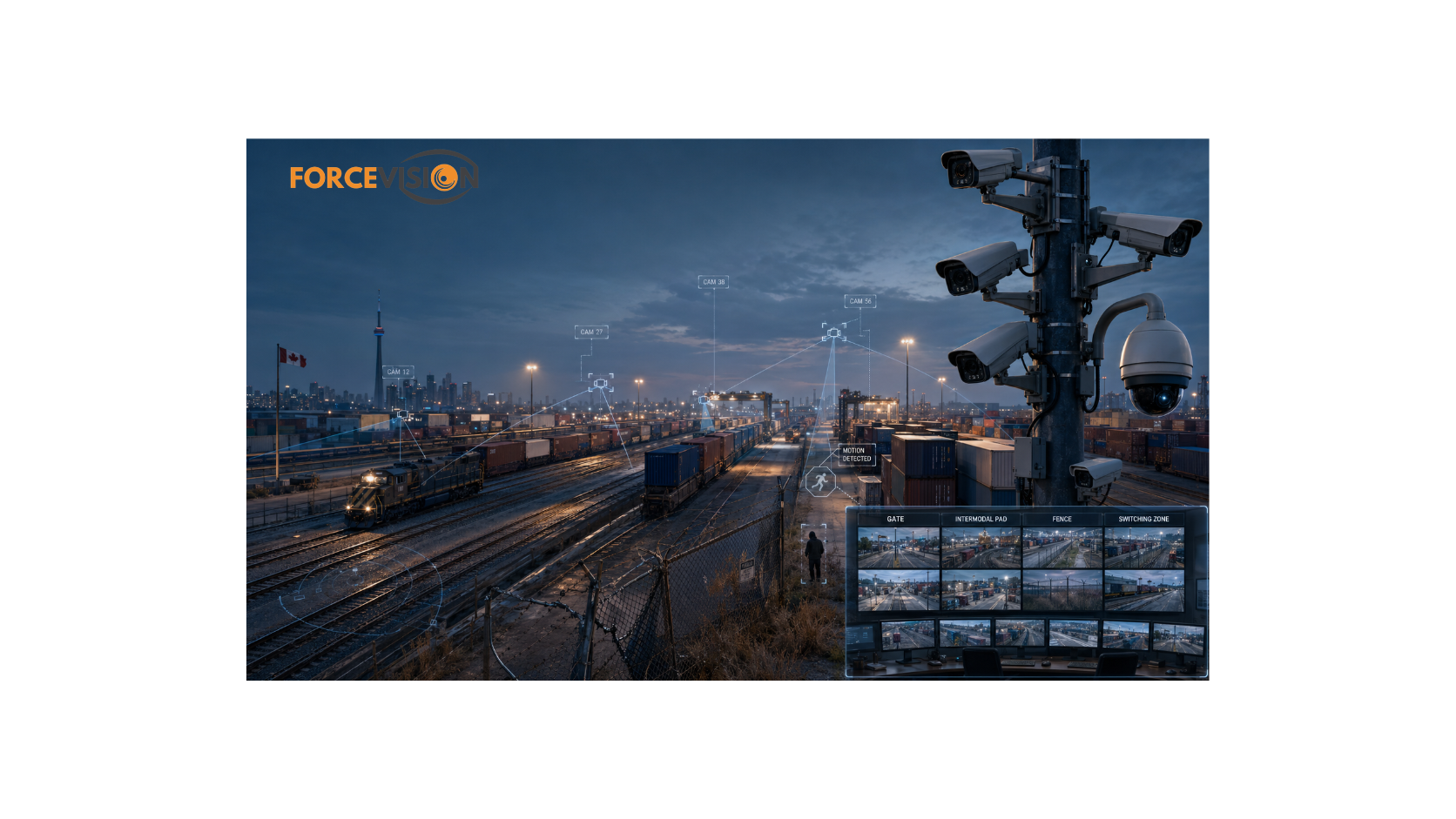
Investigative reports and law‑enforcement briefings over the past year have highlighted a worrying trend: rail cargo theft is on the rise, with armed groups targeting trains and yards in brazen attacks. While many high‑profile incidents have occurred outside Canada, the underlying vulnerabilities—vast yards, long trains, and limited human oversight—are the same ones Canadian operators manage every day.
For rail terminals in Southern Ontario, where containers and auto racks move between mainline trains, local yards, and truck carriers, the challenge is not simply guarding a fence line. It’s maintaining situational awareness across kilometres of track, multiple ladder tracks, and high‑value storage areas where containers, trailers, and specialized equipment sit vulnerable.
Traditional camera deployments—one or two units at gates and offices—cannot keep pace with the scale and sophistication of modern cargo theft. CN‑scale and CPKC‑scale yards now need 64‑camera rail yard CCTV systems designed specifically around train movements, yard geometry, and high‑risk assets.
What makes rail yards uniquely vulnerable?
Rail yards combine several risk factors that thieves exploit:
-
Sheer physical scale: Long strings of cars and multiple tracks make it easy for intruders to approach from less‑observed angles.
-
Variable lighting and weather: Night operations, fog, and snow complicate visual monitoring, especially in remote zones.
-
Complex ownership: Containers and cars may belong to multiple railroads, leasing companies, or shippers, complicating responsibility.
Research on rail security highlights these challenges and notes that effective surveillance must detect static objects, unexpected human presence, and unusual activity across large, open environments. Without sufficient camera density and analytics, yard teams are effectively blind outside the immediate vicinity of towers and crew buildings.
How should 64‑camera systems be laid out in rail yards?
Designing 64‑camera rail yard CCTV systems for Canadian cargo security starts with mapping assets and operations. Key coverage zones include:
-
Main access points and perimeter: Vehicle gates, pedestrian entrances, and fence lines near public roads or trails.
-
Critical switches and ladder tracks: Areas where trains are built and broken down, and where unauthorized access can cause safety incidents.
-
High‑value storage lines: Tracks where loaded auto racks, intermodal cars, or hazardous materials sit for extended periods.
-
Transfer points with trucks: Intermodal pads and adjacent roadways where containers shift between rail and highway.
A mix of fixed bullet cameras for long sightlines and PTZ units to zoom in on specific events allows security teams to both monitor general patterns and investigate anomalies. Elevated mounting points—light standards, signal masts, and building roofs—extend coverage, while overlapping fields of view ensure that critical areas are never dependent on a single device.
How can video analytics help detect trespassing and theft?
Recent advances in video analytics for rail networks focus on detecting trespassing, static objects, and other anomalies in complex environments. For cargo security, these tools become especially powerful when combined with a 64‑camera baseline.
Useful analytic functions in rail yards include:
-
Person detection in restricted track zones after hours or in areas far from crew activity.
-
Line‑crossing and zone‑entry alerts for access routes to high‑value car blocks.
-
Loitering detection for individuals or vehicles lingering near fences, parked cars, or road‑rail crossings.
-
Object‑left/object‑removed detection in defined areas, highlighting when a container, trailer, or equipment piece appears or disappears unexpectedly.
Because analytics can operate continuously, they serve as an early‑warning system. Instead of discovering theft after a train reaches its destination or a customer flags missing cargo, yard management can respond when suspicious behaviour is happening in real time.
How does CCTV support rail worker safety as well as cargo security?
Cargo theft and worker safety are tightly linked in rail environments. Intruders on tracks, unauthorized vehicles inside yards, or tampered equipment all create safety risks for crews. Surveillance systems built purely for security miss an opportunity if they don’t also serve operations and safety.
A 64‑camera rail yard CCTV system can help:
-
Confirm track is clear before remote movements or shove moves through complex ladder tracks.
-
Investigate near‑misses between locomotives, yard vehicles, and ground crews.
-
Monitor compliance with safety rules, such as blue‑flag protection and restricted access to certain tracks.
By providing visual evidence for safety reviews and training, CCTV helps prevent incidents that not only harm workers but also disrupt operations and damage high‑value rolling stock. This aligns directly with the 10x‑value approach—where video supports operations, safety, and HR, not just security.
What are the implications for Canadian rail operators?
Canadian railroads operate under intense scrutiny from regulators, shippers, and the public. A major cargo theft incident, especially one involving hazardous materials or critical goods, would carry reputational, financial, and regulatory consequences.
Investing in 64‑camera rail yard CCTV systems for Canadian cargo security is not simply a technology upgrade; it’s an operational resilience strategy. When railroads can show robust visual records, analytics‑driven detection, and integrated responses that tie into dispatch and police, they make a stronger case to customers, regulators, and insurers that rail remains a secure mode.
For yards in Southern Ontario, this may mean rethinking legacy installations and designing surveillance as a system, not a collection of cameras. That includes standardizing retention policies, ensuring video coverage aligns with cargo‑handling workflows, and training staff to use footage for continuous improvement.
How can ForceVision help Canadian rail yards?
Every yard has its own fingerprint—different lengths, different neighbours, different mixes of intermodal, bulk, and automotive. Off‑the‑shelf camera kits can’t account for that.
ForceVision works with large rail and intermodal operators across Southern Ontario to design 64‑camera and larger CCTV platforms tuned to yard geometry, traffic patterns, and risk priorities. If you’re exploring how to modernize surveillance in one or more rail facilities, ForceVision can provide a no‑pressure assessment that maps current coverage, identifies high‑impact gaps, and outlines practical upgrade phases.
A smart starting point: pick one yard and overlay recent theft incidents, near‑misses, and trespass reports on a map of your camera locations. Where the dots cluster without coverage, that’s where rail‑specific CCTV design can make a measurable difference.
FAQ
Q1: Are 64 cameras enough for a large rail yard?
In many mid‑sized yards, 64 cameras are a strong baseline, but major classification yards may require more to cover all tracks, perimeter segments, and intermodal pads adequately.
Q2: Can analytics reliably detect trespassers in complex rail environments?
Research shows that modern analytics, when tuned to rail conditions and paired with appropriate camera placement, can effectively detect trespassing and critical events despite visual complexity.
Q3: How long should rail operators retain CCTV footage?
Retention requirements vary, but many railways maintain 30–90 days as a standard, with extended retention for specific incidents, investigations, or regulatory obligations.
Q4: Does CCTV reduce the need for on‑site security staff?
CCTV and analytics augment, rather than replace, human presence. They allow staff to focus on responding to alerts and patrolling higher‑risk zones instead of trying to visually monitor entire yards unaided.


