

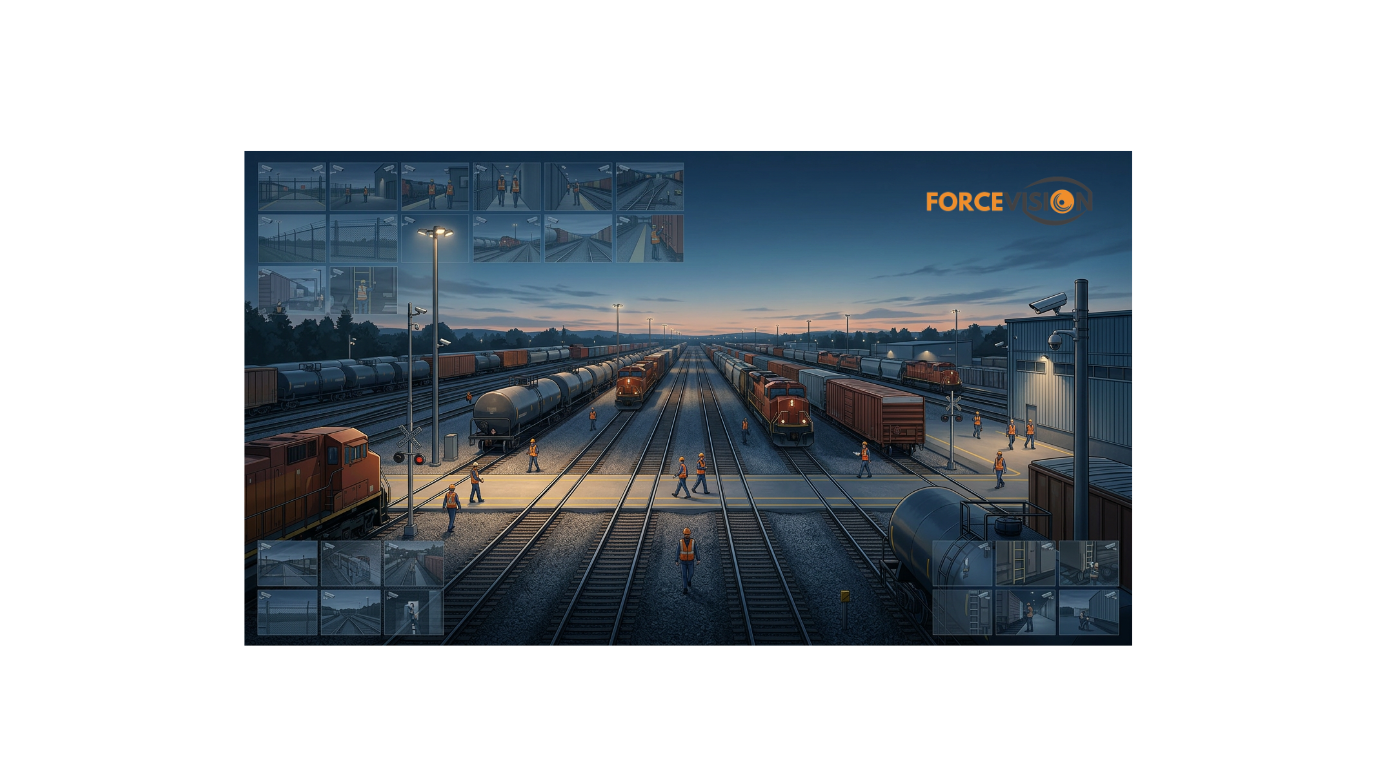
Rail yards have always been complex environments—long tracks, moving rolling stock, intermodal cranes, and high‑value cargo all sharing the same footprint. As trespassing, copper theft, and safety incidents draw more attention, rail operators are reassessing how they monitor these spaces. Recent research into rail security emphasizes that effective surveillance is crucial to preventing vandalism, trespassing, and sabotage, yet traditional approaches struggle to cover the sheer scale of modern yards. For many Canadian yards, a scattering of legacy cameras on buildings and gates is no longer enough.
In Southern Ontario, freight operations near major industrial corridors—from Hamilton and Burlington to Vaughan and Pickering—handle dense traffic under tight schedules. Yards must manage not only train movements but also truck circulation, container handling, hazardous materials, and maintenance activities. Without a cohesive video strategy, near‑misses, unauthorized entries, and small thefts go unnoticed until they become serious incidents or regulatory headaches. That’s where 64‑camera CCTV for Canadian rail yards comes into focus as a practical, modern baseline.
What are the main security and safety risks in rail yards today?
Studies on railway security highlight several recurring threats: trespass, theft, vandalism, and risks associated with hazardous cargo. Copper theft, in particular, continues to challenge rail and transit systems worldwide, with thieves targeting signal cabinets and cabling that are vital for safe operations. Beyond theft, yards see routine trespassing by pedestrians cutting through tracks, which can lead to injuries, delays, and traumatic events for crews.
From a safety standpoint, the risk extends to day‑to‑day operations: vehicles crossing tracks at unauthorized points, staff walking in blind zones, and contractors unfamiliar with site rules. When incidents occur, investigators often find gaps in coverage: the critical moment happened just outside the view of existing cameras, or footage is too low‑resolution to support clear conclusions. This not only slows root‑cause analysis but also weakens the rail operator’s position with regulators, unions, and insurers.
Why is a 64‑camera approach well‑suited to rail yards?
A modern 64‑camera CCTV for Canadian rail yards is designed to match the scale of the environment. Rather than focusing on a handful of buildings, the system is mapped to operational zones: yard entrances and exits, throat areas, classification tracks, intermodal pads, fueling points, and perimeter fencing. Each cluster of cameras is chosen to provide overlapping views, so any person, vehicle, or wagon can be tracked across multiple fields of view as they move.
Fixed bullet and dome cameras deliver continuous coverage on key chokepoints—gates, crossings, and pedestrian paths—while PTZ units watch wide‑area regions like classification tracks or container stacks. With 64 channels to work with, operators can allocate dedicated views to high‑risk areas like signal cabinets, copper storage, and hazardous material tracks without sacrificing general situational awareness. This structure also scales: larger yards can move beyond 64 channels into multi‑NVR architectures that still feel manageable.
How do analytics help manage vast rail environments?
Research into video analytics for rail networks shows that smart algorithms can detect critical events—trespassing, people on tracks, and unusual objects—more reliably than human monitoring alone. For example, analytics can be trained to alert operators when a person enters a restricted track zone, lingers near a signal cabinet, or appears on a bridge or platform area outside normal patterns. They can also spot static objects or vehicles stopped where they should not be, potentially indicating stalled trains, blocked crossings, or abandoned equipment.
In the context of 64‑camera CCTV for Canadian rail yards, analytics turn a large camera grid into a prioritized stream of events. Instead of asking staff to watch dozens of feeds, the system surfaces anomalies: a gate left open, a truck entering from an unusual direction, or movement in a designated “no‑access” corridor. This not only improves security response but also supports operational decision‑making, such as identifying recurring bottlenecks and unsafe behaviours.
How does better CCTV support investigations and compliance?
When something does go wrong—whether a theft, derailment, near‑miss, or worker injury—good video coverage can be the difference between speculation and understanding. With 64‑camera CCTV for Canadian rail yards, investigators can reconstruct sequences from multiple angles: how a vehicle approached a crossing, whether warning signals were active, who accessed a cabinet, or how staff moved during a switching operation. This clarity supports internal safety reviews, regulatory reporting, and discussions with unions and contractors.
Clear, time‑stamped footage also strengthens the operator’s position with insurers and, where necessary, in legal proceedings. Instead of debating conflicting accounts, parties can review common evidence and focus on fixes. Over time, this contributes to a culture where incidents are addressed with data, not guesswork, and where lessons learned can be shared across multiple yards and terminals.
What’s the operational upside beyond security?
Rail operators who invest in 64‑camera CCTV for Canadian rail yards often discover that the biggest wins are operational. Video helps track locomotive and wagon movements, monitor crane performance, and verify the handling of priority cargo. Supervisors can see in real time whether a yard plan is unfolding as intended—whether a track is free, whether a truck queue is building, or whether weather is creating visibility issues in certain corridors.
Video can also support training: incident clips, anonymized where appropriate, help crews understand why certain rules exist and how small deviations can snowball into serious risks. Safety teams can use footage to validate whether new procedures are working or whether signage and markings need improvement.
How can ForceVision help rail operators in Southern Ontario?
Rail yards and intermodal terminals around the Golden Horseshoe each have unique layouts, risk profiles, and legacy systems. Designing 64‑camera CCTV for Canadian rail yards takes more than a standard parts list—it requires translating operational realities into a camera and analytics plan that works day and night, in all conditions. ForceVision works with rail and logistics clients across Southern Ontario to map yards, select appropriate IP cameras and NVR platforms, and integrate analytics tuned to rail‑specific risks.
If you’re considering an upgrade or planning a new yard, a no‑pressure discussion with ForceVision can help you understand how to evolve from fragmented cameras to a cohesive, rail‑ready video platform. That conversation often starts with a simple yard walk‑through and ends with a practical roadmap you can phase in over time.
FAQ
Q1: Are there standards or best practices for rail yard CCTV?
A1: While formal standards vary, many best practices draw on research into rail security and focus on layered coverage of tracks, crossings, perimeters, and critical assets like signal cabinets.
Q2: Can analytics reliably detect people on tracks at night?
A2: Modern video analytics, combined with good lighting and camera placement, can detect people and vehicles on tracks with high reliability, though systems must be tuned to local conditions.
Q3: How do yards manage data from so many cameras?
A3: Industrial NVR platforms support 64+ channels with tools for event search, retention policies, and integration into existing control rooms and dispatch centres.
Q4: Does CCTV replace physical patrols in rail yards?
A4: No, but it makes patrols more targeted by highlighting hotspots and real‑time events, allowing security staff to focus on areas where they can add the most value.


